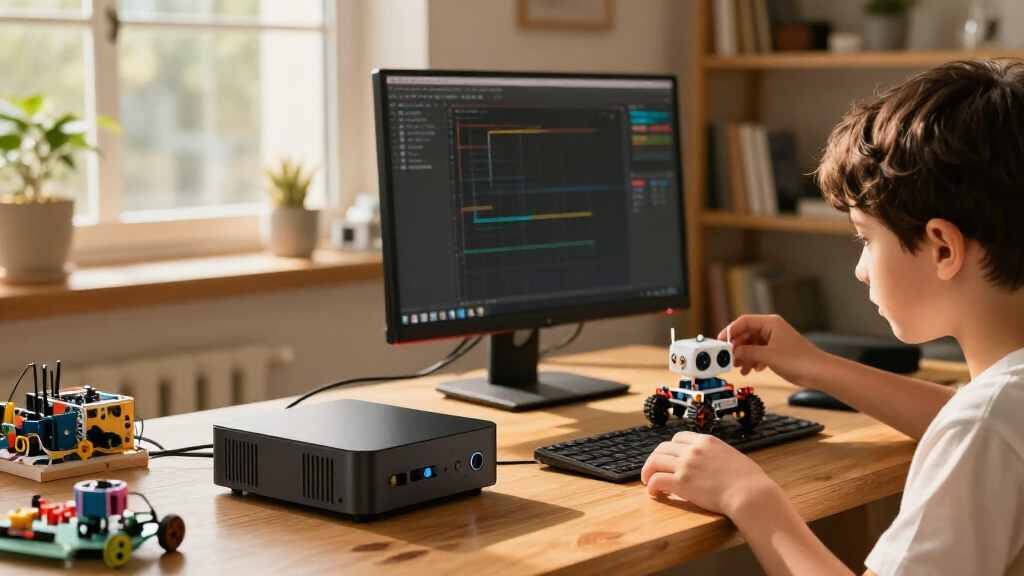

🔍 Read the full analysis: 10 Best AI Mini PCs For 2027 on ThorstenMeyerAI.com

Prime made for students and young adults
- Fast, free delivery for dorm and study essentials
- Prime Video and Amazon Music included
- Member-only deals
TL;DR
This 10-model buying guide compares AI mini PCs by their listed processor, memory and storage rather than by the AI label alone. The source ranks the MINISFORUM MS-S1 MAX highest for its specified 64GB of memory and 2TB SSD, while warning that some listings lack key specifications and should be checked before purchase.
A 2027 AI mini PC buying guide, the original analysis, ranks 10 compact computers by their listed processor, memory and storage, naming the MINISFORUM MS-S1 MAX as its top choice for demanding workloads. The guide says its Ryzen AI Max+ 395 processor, 64GB of LPDDR5x memory and 2TB SSD give it the largest specified memory and storage configuration among the listed systems, while cautioning that several other product listings omit details needed for a reliable comparison.
The guide places the GEEKOM A9 Max in a middle ground: its listed Ryzen AI 9 HX 470, 32GB of DDR5 memory and 2TB SSD provide a fully specified configuration below the MS-S1 MAX’s stated memory capacity, as discussed in a roundup of AI mini PCs for local workloads. The source describes it as a balanced option, but does not provide independent benchmarks to quantify how either computer performs on specific AI applications.
For heavier AI-oriented work, the guide also points to the GMKtec EVO-X2, which uses a Ryzen AI Max+ 395. However, the supplied listing does not state its memory or storage capacity. The GEEKOM A5, with a Ryzen 7 7730U and 16GB of RAM, is presented as a better fit for general computing than large local models or demanding graphics tasks; memory capacity for local AI is also explored in a Mac mini comparison.
The other entries are the GEEKOM IT13 MAX (two listings), ACEMAGIC F5A, GMKtec NucBox, MINISFORUM UM890 Pro and GEEKOM A8. The source material does not supply complete specifications for each of these products, so their inclusion here does not establish their relative performance or suitability for local AI. It also reports conflicting memory-type information between the two IT13 MAX listings.
The 10 picks
- 1
 MINISFORUM MS-S1 MAX Mini AI Workstation PC, Ryzen AI Max+ 395, 64GB LPDDR5x,…View on Amazon →
- 2
 GMKtec EVO-X2 AI Mini PC with AMD Ryzen AI Max+ 395View on Amazon →
- 3
 GEEKOM A9 Max Mini PC with AMD Ryzen AI 9 HX 470, 32GB DDR5 RAM, and 2TB SSDView on Amazon →
- 4
 GEEKOM IT15 Mini PC, Intel Core Ultra 9 285H, 32GB DDR5 RAM, 1TB NVMe SSDView on Amazon →
- 5
 ACEMAGIC F5A Top AI Mini PC with AMD Ryzen AI 9 HX 470View on Amazon →
- 6
 ACEMAGIC Retro X5 Mini Gaming PC with AMD Ryzen AI 9 365, 32GB RAM and 1TB SSDView on Amazon →
- 7
 GEEKOM IT13 MAX AI Mini PC 2026, Intel Ultra 9 185H, 24GB LPDDR5, 500GB SSDView on Amazon →
- 8
 GEEKOM IT13 MAX Mini PC with Intel Core Ultra 9 185H, 24GB RAM, 512GB SSDView on Amazon →
- 9
 GMKtec K17 AI Mini PC – Intel Core Ultra 5 226V, 16GB LPDDR5X, Intel Arc 130V…View on Amazon →
- 10
 GEEKOM A5 Mini PC with AMD Ryzen 7 7730U, 16GB RAM, 500GB SSDView on Amazon →
Choosing Capacity Over the AI Label
Mini PCs can serve very different needs, from office work and cloud-based AI tools to running models locally. The guide’s comparison highlights that memory and storage capacity matter alongside the processor name: a system with limited working memory may not suit a large model or several demanding applications, even if its product listing uses AI-focused language.
That makes configuration checks a practical purchasing issue. Buyers comparing systems should confirm the exact memory, SSD and processor included in the version they intend to order, and check whether memory can be upgraded. The source gives no prices, workload benchmarks or independent test results, so it cannot establish which system offers the best value or delivers a particular level of AI performance.
Products Worth Considering

Apple iPad mini (A17 Pro) 128GB Wi-Fi 6E – Starlight

Logitech MX Mechanical Wireless Illuminated Keyboard, Tactile Quiet, Graphite

Bose QuietComfort Wireless Noise-Cancelling Headphones, Sandstone
As an affiliate, we earn on qualifying purchases.
How the Guide Ranks Systems
The source says it ranks the computers by how their listed specifications match likely workloads, considering processor class, memory capacity and type, storage, and graphics information. It favors systems with more clearly stated capacity for demanding work, then considers whether a configuration better fits everyday use. The MS-S1 MAX’s specified 64GB of memory and 2TB SSD drive its top placement; the A9 Max’s 32GB and 2TB make it the guide’s balanced alternative.
Its central distinction is between local and cloud-based AI. Cloud services depend more on an internet connection, while local applications put greater demands on a computer’s memory and processing resources. The guide advises checking software requirements rather than assuming an “AI” label proves a computer will support a particular application. It also says graphics names alone are not enough to predict results, which can vary with software support, thermal limits and the task.
“I ranked these AI mini PCs by their fit for real workloads, not by the AI label alone.”
— ThorstenMeyerAI.com buying guide
Missing Specs Limit Comparisons
The supplied material does not identify the precise configurations for all 10 entries. It specifically says the ACEMAGIC F5A and GMKtec EVO-X2 listings omit memory and storage details, and that the two GEEKOM IT13 MAX listings disagree on memory type. Those gaps prevent a complete, like-for-like comparison and mean buyers should verify the current manufacturer or retailer listing before ordering.
The source also gives no prices, release or availability information, independent benchmarks, power measurements, upgrade details for every model, or tests using named AI software. The guide’s rankings are therefore recommendations based on stated specifications, not proof that a particular model will run a given local model or outperform another system in measured tests. Product configurations may differ by seller or change over time.
Verify Configurations Before Buying
Before choosing, check the current listing for the exact processor, memory capacity and type, SSD size, operating system and upgrade options. Confirm that the configuration matches the system requirements for the applications you plan to use, and look for workload-specific benchmarks if performance is central to the purchase.
The source provides no announced follow-up testing or future product launch date. The next useful step for buyers is to compare complete, current configurations and prices rather than relying on model names or AI branding alone.
Key Questions
Which mini PC does the guide rank first?
The guide names the MINISFORUM MS-S1 MAX as its top pick, citing its listed Ryzen AI Max+ 395, 64GB of LPDDR5x memory and 2TB SSD. The ranking is based on the source’s specification comparison, not reported independent benchmark results.
Which model is presented as a balanced alternative?
The GEEKOM A9 Max is described as a balanced high-spec option, with a Ryzen AI 9 HX 470, 32GB of DDR5 memory and a 2TB SSD listed in the source.
Are all 10 systems confirmed to be suitable for local AI?
No. The source cautions that an AI label does not establish suitability for intensive local workloads. It recommends checking the software’s requirements and the computer’s exact memory, processor and graphics configuration.
What specifications need extra checking?
The source says memory and storage are missing from the supplied ACEMAGIC F5A and GMKtec EVO-X2 listings, and memory-type details differ between two GEEKOM IT13 MAX listings. Verify the exact configuration with the seller or manufacturer.
Source: ThorstenMeyerAI.com