
🔍 Read the full analysis: 16 GB Or 64 GB? Finding A Mac Mini For Local AI on ThorstenMeyerAI.com

Prime made for students and young adults
- Fast, free delivery for dorm and study essentials
- Prime Video and Amazon Music included
- Member-only deals
TL;DR
Apple is marketing its Mac mini as a desktop for always-on AI, and its unified memory lets some open models run locally. A 16GB model can handle smaller, compressed models; 64GB supports larger ones, but neither matches data-center hardware for memory capacity or bandwidth.
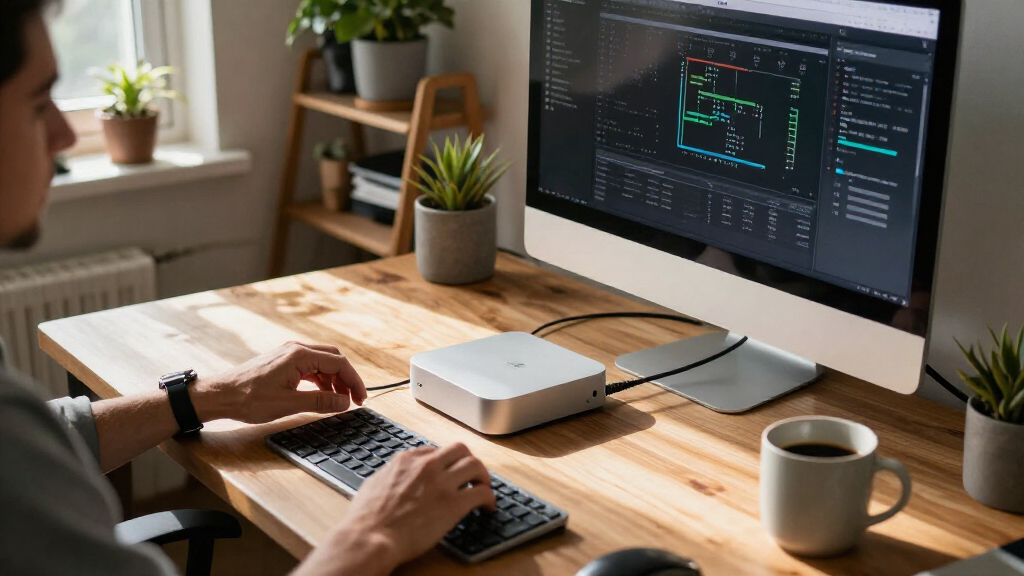
Apple’s current Mac mini lineup, announced on August 25, 2026, is being promoted as a desktop for always-on AI agents, but the model a buyer can run depends heavily on memory. Apple’s 16GB M6 can accommodate some smaller models, while the 64GB M5 Pro can load larger ones; neither offers the memory capacity or bandwidth of leading data-center GPUs.
Apple’s U.S. lineup starts at $899 for an M6 Mac mini with 16GB of unified memory. The M6 can be configured with up to 32GB, while the M5 Pro offers 24GB, 48GB or 64GB; Apple’s listed top configuration costs $3,199 and includes 1TB of storage. These are prices and options reported from Apple’s site on November 16, 2026.
Model requirements illustrate the difference between configurations. Google’s Gemma documentation lists its 12B model at 6.7GB at 4-bit precision, and the 31B model at 17.5GB at 4-bit or 34.9GB at 8-bit. OpenAI says its gpt-oss-20b runs within 16GB of memory. Those figures do not mean all that memory is available for model weights: macOS and other apps need space, and longer context windows use additional memory.
Speed and capacity are separate limits. Apple lists 153–170GB/s of memory bandwidth for M6 Mac minis and 307GB/s for the M5 Pro. Nvidia lists 3.35TB/s for its H100 SXM GPU, around 11 times the M5 Pro figure. OpenAI sizes gpt-oss-120b for a single 80GB GPU, beyond the Mac mini’s maximum 64GB configuration.
Memory Sets the Local AI Ceiling
For people choosing a Mac mini for local AI, memory determines which models can load, while bandwidth affects how quickly the machine can generate responses. The 16GB entry configuration may suit smaller quantized models or experimentation, but leaves less room for the operating system, other applications and longer conversations. A 64GB model provides greater headroom, at a substantial price premium.
Running models locally can appeal to users who want offline access, more control over their data or to avoid per-token cloud charges. The source material also reports an idle power draw of about 4 watts while an agent waits for work. Those advantages do not mean local use is automatically cheaper or faster: purchase price, electricity, setup and the performance limits of the hardware all matter.
Apple says Thunderbolt 5 can be used to cluster multiple Mac minis to run larger models on-device. That is an option Apple describes, not evidence that a cluster matches a specialized accelerator in speed or total cost. Buyers need to weigh the value of local control against the extra hardware and slower processing that may come with it.
Products Worth Considering

DJI Mini 5 Pro Fly More Combo Plus with DJI RC 2

Logitech MX Mechanical Wireless Illuminated Keyboard, Tactile Quiet, Graphite

Amazon Kindle Scribe (32GB) with Premium Pen, Tungsten (Like-New)
As an affiliate, we earn on qualifying purchases.
How Unified Memory Helps Models Fit
AI model weights are the numerical values a model uses to generate responses. They need to remain in memory during use. In many PCs, a graphics card has its own memory, separate from system RAM; Apple’s silicon instead gives the CPU and GPU access to a shared unified memory pool. That can let the GPU use more of the computer’s installed memory for a model than a discrete graphics card with a smaller memory allocation.
Apple’s MLX documentation describes the shared-memory design, while Google’s Gemma documentation cautions that its memory estimates cover static model weights only. The system, applications and context consume additional memory. Quantization, such as using 4-bit rather than 8-bit weights, reduces the space models need, but may affect output quality.
The lineup combines different memory and bandwidth choices: the M6 offers 16GB to 32GB and up to 170GB/s, while the M5 Pro offers 24GB to 64GB at 307GB/s. A model’s parameter count alone is not enough to predict performance. For example, Google’s Gemma 4 26B A4B activates four billion parameters per token, but Google says all 26 billion must still be loaded into memory.
“the leading desktop for always-on agentic computing”
— Apple, in its August 25, 2026, Mac mini press release
Real-World Fit and Speed Vary
Published memory figures do not establish how quickly a given model will run on each Mac mini or how much memory remains for practical use. Actual results can vary with quantization, context length, software and concurrent apps. The cited specifications and vendor guidance do not provide a single benchmark comparing these configurations across the listed models.
Nor do the figures establish whether local operation will save money for a particular buyer. Cloud prices, usage levels, electricity costs and the price of the computer all affect that calculation. The source material also does not give performance measurements for Apple’s proposed Thunderbolt 5 clusters, so their speed and cost compared with cloud or GPU-server options remain unclear.
Check Model Needs Before Buying
Before choosing a configuration, buyers should compare a model’s memory requirement at the intended precision with the Mac’s total unified memory, then leave capacity for macOS, other apps and the desired context length. Apple’s listed configurations and model makers’ documentation provide the relevant starting figures, but do not replace tests of the particular software and workload.
Apple has pointed to Thunderbolt 5 clustering for larger on-device models, while the published lineup tops out at 64GB in one Mac mini. Until more comparative performance and cost data are available, whether clustering makes sense—and how the local experience compares with cloud services—remains a question for follow-up testing.
Key Questions
Can a 16GB Mac mini run local AI models?
Yes, some can. Google lists 6.7GB for Gemma 4 12B at 4-bit precision, and OpenAI says gpt-oss-20b runs within 16GB. The operating system, applications and context also use memory, so the model’s published requirement is not the whole system requirement.
What does 64GB let a Mac mini run?
Google lists its Gemma 4 31B model at 34.9GB at 8-bit precision, which could fit within a 64GB machine with space remaining for other uses. A model’s actual fit depends on context and software, and its full 16-bit version is listed at 69.9GB, more than the Mac mini’s maximum memory.
Does a 26-billion-parameter model need 26GB of memory?
Not necessarily. Memory needs depend on precision and model design, not parameter count alone. Google’s Gemma 4 26B A4B estimate is 14.4GB at 4-bit precision; despite activating four billion parameters per token, all 26 billion parameters must be loaded, according to Google.
Is a Mac mini faster than a data-center GPU for local AI?
The cited bandwidth specifications point the other way: Apple lists 307GB/s for the M5 Pro, compared with Nvidia’s 3.35TB/s for the H100 SXM. These figures are not a direct benchmark of model response speed, but show a substantial difference in memory bandwidth.
How much does the Mac mini cost?
As of November 16, 2026, the cited U.S. prices start at $899 for an M6 with 16GB of memory. The 64GB M5 Pro configuration with 1TB storage is listed at $3,199.
Source: ThorstenMeyerAI.com