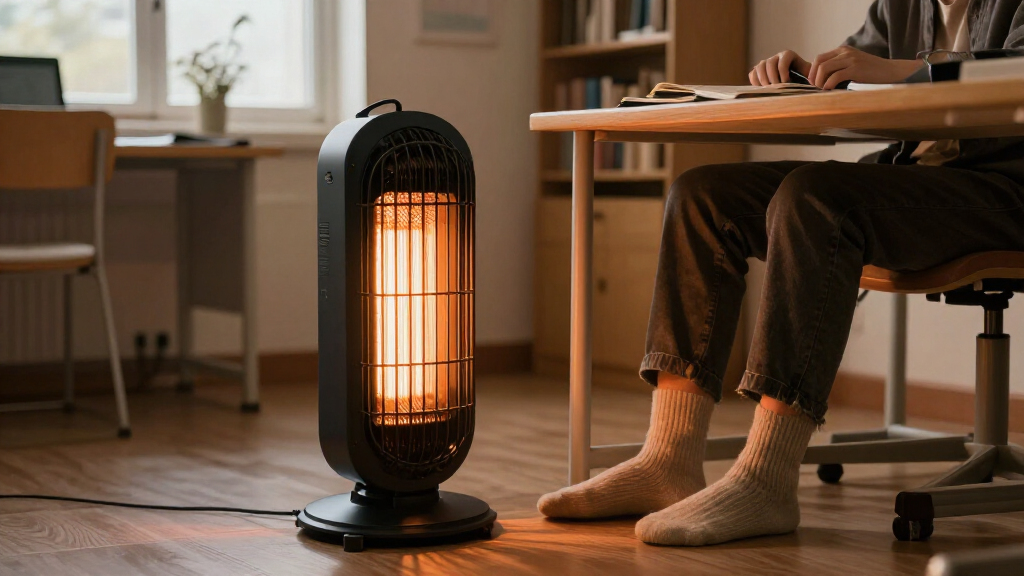

Use this guide to place, inspect, and operate a portable electric space heater safely in a home or small office. It is for people with little or no heater experience. Allow 10-15 minutes for the initial setup, then check the heater and surrounding area during use.

Prime made for students and young adults
- Fast, free delivery for dorm and study essentials
- Prime Video and Amazon Music included
- Member-only deals

DREO Portable Ceramic Space Heater with Thermostat
- ✔ Heating output: 1500 watts
- ✔ Listed coverage: 200 sq. ft.
- ✔ Temperature range: 41°F–95°F
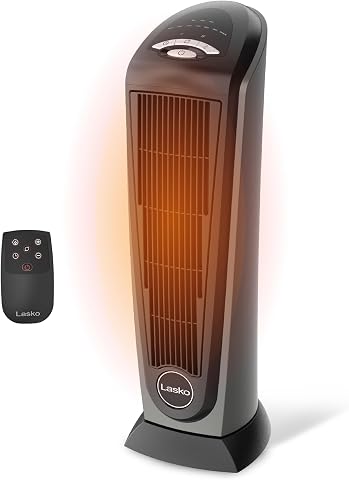
Lasko 23-Inch Ceramic Tower Space Heater with Remote Control, Silver (751320)
- ✔ Heating output: 1500 watts
- ✔ Heating element: Ceramic
- ✔ Heat settings: 2
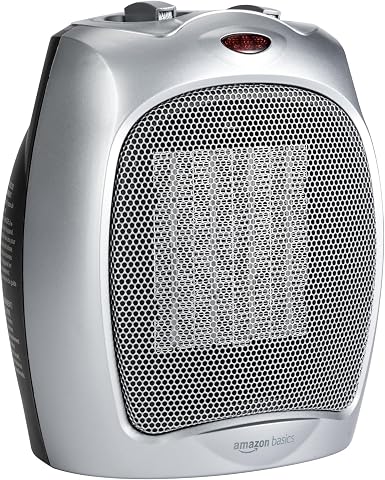
Amazon Basics Portable Ceramic Space Heater, 1500W, Silver
- ✔ Power settings: High 1500W, low 900W, fan only
- ✔ Listed coverage: 161.4 sq. ft.
- ✔ Dimensions: 7.52 × 6.34 × 9.45 inches
Difficulty: Beginner | Time: 10-15 minutes to set up; ongoing checks while in use
What You’ll Need
Tools & Materials:
- Electric space heater with an intact power cord
- Clear, level, dry floor area
- Working smoke alarm in or near the room
Knowledge:
- Basic ability to read the heater’s labels and operating instructions
- Ability to identify the room’s electrical outlet and circuit breaker
Read the manufacturer’s instructions before use; controls, clearances, and safety features differ by model. Do not use a heater with a damaged cord, loose plug, cracked housing, or signs of overheating. Keep the heater away from water and areas where children or pets could knock it over.
DREO Portable Ceramic Space Heater with Thermostat
The DREO Portable Ceramic Space Heater earns the top spot because it combines detailed temperature control with compact size and a comparatively quiet stated operating level. Its thermostat adjusts in 1°F increments across a broad 41°F–95°F range, which gives us finer control than the Lasko’s stated 60°F–85°F range. Four speeds and a 12-hour timer also make it easier to tailor operation to a room and schedule.At 34 dB, DREO has the quietest stated noise level in this group; Amazon Basics lists 43 dB, while no noise figure is provided for Lasko. The three-pound body and remote add convenience, though the heater still needs a corded outlet and its stated coverage is capped at 200 square feet. Its tip-over and overheat protection, flame-resistant materials and child lock give it the most detailed safety feature set in this lineup. Buyers looking for room-wide air movement may prefer Lasko’s oscillation, and those who want a simpler low-heat setting may find Amazon Basics’ 900W mode more direct.
Pros:
- Thermostat adjusts in 1°F increments
- 34 dB stated noise level and four speeds
- Tip-over, overheat and child-lock protections
- Remote control and 12-hour timer
Cons:
- Listed coverage is limited to 200 square feet
- Requires a corded electrical outlet
Best for: People who want fine thermostat adjustments, a long timer and quiet operation in a compact heater for a room within its listed 200-square-foot coverage.
Not ideal for: Buyers seeking oscillation, a heater for spaces larger than the listed coverage, or operation without a nearby electrical outlet.
Bottom line: Choose DREO for the strongest combination of precise controls, quiet stated operation and specified safety features.
“Choose DREO for the strongest combination of precise controls, quiet stated operation and specified safety features.”
Lasko 23-Inch Ceramic Tower Space Heater with Remote Control, Silver (751320)
The Lasko 23-Inch Ceramic Tower is our pick when the priority is moving warm air around a room. Its widespread oscillation gives it a distinct advantage over both DREO and Amazon Basics, which are described as compact, non-oscillating heaters. The taller form and built-in carry handle help it serve as a movable room heater, while the remote can operate heat settings, oscillation and the timer from across the room.This model is less granular than DREO: it has two heat settings and a stated thermostat range of 60°F–85°F, compared with DREO’s four speeds and wider temperature range. Its seven-hour timer is also shorter than DREO’s 12 hours. Still, Lasko offers a useful balance for people who want oscillation without managing a broad array of settings. The supplied details list overheat protection and cool-touch housing, but not tip-over protection or a coverage area. We should consider those missing specifications when comparing it with DREO, whose safety features and coverage are stated more fully.
Pros:
- Widespread oscillation helps move warmth around the room
- Remote controls settings, oscillation and timer
- Carry handle supports moving it between rooms
- Cool-touch housing and overheat protection are specified
Cons:
- Two heat settings offer less flexibility than DREO’s four speeds
- No coverage area or tip-over protection is specified in the supplied details
- Seven-hour timer is shorter than DREO’s 12-hour timer
Best for: People who want a portable tower heater that oscillates to distribute warmth across a shared indoor room and can be controlled remotely.
Not ideal for: Buyers who need a stated room-coverage figure, a highly precise thermostat, a longer timer, or specified tip-over protection.
Bottom line: Pick Lasko when oscillation and remote operation matter more than fine thermostat control or a longer timer.
“Pick Lasko when oscillation and remote operation matter more than fine thermostat control or a longer timer.”
Amazon Basics Portable Ceramic Space Heater, 1500W, Silver
The Amazon Basics Portable Ceramic Space Heater focuses on simple, portable operation. At 2.8 pounds and under 10 inches tall, it is the lightest option here by the supplied weight figures, making it easy to reposition on a tabletop or carry between suitable indoor spots. Its three modes—1500W high, 900W low and fan-only—also make it the only model in this lineup with a specified lower-wattage heat setting and a fan-only mode.That simplicity comes with fewer room-comfort features. Unlike Lasko, it does not oscillate, so warm air is not directed across a wider area by a moving base. Compared with DREO, it has a higher stated noise level at 43 dB, a narrower listed coverage area of 161.4 square feet, and no remote or timer in the supplied details. Tip-over and overheat protection are included, but the manufacturer description says to avoid humid areas, so it is not appropriate for bathrooms or similarly damp settings. It makes the most sense for a small area where easy relocation and straightforward settings matter more than refined controls.
Pros:
- Lightweight 2.8-pound design
- High, low and fan-only operating modes
- Tip-over and overheat protection
- Compact tabletop footprint
Cons:
- Does not oscillate
- Listed coverage is smaller than DREO’s
- Avoid use in bathrooms and other humid areas
Best for: People who want a lightweight heater for a smaller indoor area, with high, low and fan-only modes and basic portability.
Not ideal for: Buyers who want oscillation, remote control, a timer, quietest-listed operation, or a heater for humid environments.
Bottom line: Choose Amazon Basics for a compact heater with a useful low-power mode when room-wide heat distribution is not a priority.
“Choose Amazon Basics for a compact heater with a useful low-power mode when room-wide heat distribution is not a priority.”
As an Amazon Associate we earn from qualifying purchases.
Before You Start
Check the heater’s label for its wattage and the manual for required clearance around the unit. A typical 1,500-watt heater draws substantial power, so connect it directly to a wall outlet. Do not use an extension cord, power strip, timer, or smart plug unless the manufacturer explicitly approves that exact setup. Keep the heater off while you prepare the room.
Never leave a portable heater running while you sleep or when everyone leaves the room. Stop using it immediately if the plug or outlet becomes hot, you smell burning, see sparks, or hear unusual buzzing.
Step-by-Step Instructions
Step 1: Choose a safe location
Place the heater upright on a hard, level, dry surface. Leave the clearances stated in the manual on every side, including above the heater. If the manual gives no specific distance, keep it at least 3 feet (about 1 metre) from bedding, curtains, furniture, paper, clothing, and other combustible materials. Do not place it in a doorway, on a bed or table, or where people can trip over its cord.
Tip:Keep the heater out of bathrooms and other damp locations unless its instructions specifically permit that use.
Check: The heater stands steadily, with its air intake and outlet unobstructed and the required clear space around it.
Step 2: Inspect the heater and outlet
With the heater unplugged, check its housing, grille, plug, and full length of the cord for cracks, loose parts, fraying, cuts, or scorch marks. Look at the wall outlet for damage or discoloration. Do not use the heater if any part is damaged or if the plug fits loosely; have the appliance or outlet checked by a qualified professional.
Tip:Do not open the heater or attempt electrical repairs unless you are qualified to do so.
Check: The heater, cord, plug, and outlet look intact, with no looseness, damage, or signs of overheating.
Step 3: Connect it directly to the wall
Plug the heater directly into a suitable wall outlet. Push the plug in fully, and route the cord along a wall or another place where it cannot be walked on, pinched, covered, or caught under a rug. Do not connect other high-power appliances to the same outlet or use an extension cord or power strip unless the heater maker permits it.
Tip:If the outlet or plug feels hot, switch the heater off, unplug it if safe, and stop using that outlet until it has been checked.
Check: The plug sits firmly in the wall outlet, and the cord remains visible, uncovered, and out of the walking path.
Step 4: Set the controls before heating
Set the heater on its lowest or energy-saving setting first. Turn the thermostat to a modest temperature, then switch the heater on using the controls described in the manual. Keep the unit upright; do not cover it or block its intake or outlet. If it has a fan, use the manufacturer’s recommended setting for the room.
Tip:Use the heater to warm an occupied room, not to dry clothes, warm bedding, or heat food.
Check: The heater starts normally, remains stable, and sends warm air or heat without smoke, sparks, or unusual odors.
Step 5: Monitor the room and heater
Stay in the room while the heater is operating. Keep children and pets at a safe distance, and do not let anyone touch the grille or move the unit while it is hot. Check periodically that the heater is upright, its clearances remain open, and the cord and plug are not hot. Switch it off before leaving the room, going to sleep, or moving it.
Tip:A heater’s surfaces can cause burns even after it has been switched off. Let it cool before touching or relocating it.
Check: The room warms without anything touching or covering the heater, and the unit, plug, and outlet show no signs of overheating.
Step 6: Switch off and store it safely
Use the power control to switch the heater off. Unplug it by holding the plug, not pulling the cord, once the manual says it is safe to disconnect. Let the heater cool completely before cleaning or storing it. Keep it dry, place the cord loosely without tight bends, and store the unit where it cannot be crushed or damaged.
Tip:Follow the manual’s cleaning instructions. Never pour liquid on the heater or clean it while it is plugged in.
Check: The heater is off, cool, unplugged, and stored with its cord and housing intact.
Common Mistakes to Avoid
- Plugging the heater into an extension cord or power strip. — Connect it directly to a wall outlet unless the manufacturer specifically approves the accessory and its rating for that heater.
- Placing the heater too close to curtains, furniture, or bedding. — Measure the clearance required by the manual and keep combustible items outside that area throughout use.
- Leaving the heater running in an empty room or overnight. — Switch it off whenever the room is unattended or you go to sleep.
- Covering the heater or using it to dry clothes. — Keep all air openings clear and dry clothing on a proper rack well away from the heater.
Troubleshooting
Problem: The heater does not turn on.
Solution: Switch it off and check that the plug is fully seated. Check the home’s breaker if safe to do so. If the outlet works with another suitable device but the heater does not, follow the manual’s reset instructions or contact the manufacturer. Do not use a damaged unit.
Problem: The circuit breaker trips when the heater runs.
Solution: Switch the heater off and unplug it. Avoid running it on a circuit already serving other high-power appliances. Do not repeatedly reset a tripping breaker; ask a qualified electrician to check the circuit if the problem continues.
Problem: The heater turns off by itself.
Solution: Switch it off and check that it is upright and that the intake and outlet are clear. Let it cool, then consult the manual for tip-over or overheat reset steps. If it shuts off again under normal conditions, stop using it and contact the manufacturer.
Problem: There is a burning smell, smoke, sparks, or a hot plug.
Solution: Switch the heater off and unplug it only if you can do so safely. Keep people away. If there is smoke or fire, leave the area and call emergency services. Do not restart the heater until a qualified person has identified and fixed the cause.
What Success Looks Like
The heater is on a stable, dry surface with the manufacturer’s clearance, connected directly to an intact wall outlet, and operating without blocked vents, unusual smells, sparks, or excessive heat at the plug. You remain nearby while it runs and switch it off before leaving or sleeping. After use, it is cool, unplugged, and stored safely.
Next Steps
Repeat the cord, plug, outlet, and clearance checks each time you set up the heater. Clean and store it as the manual directs, and stop using it if damage or overheating appears. If you need heat in several rooms or regular heating throughout the day, ask a qualified heating professional about a suitable permanent system.
Frequently Asked Questions
Can I leave an electric space heater on while I sleep?
No. Switch it off before sleeping and before leaving the room unattended. Follow the heater’s manual for any additional restrictions.
Can I use a space heater with an extension cord?
Use a direct wall connection unless the manufacturer explicitly approves a particular extension cord with a sufficient rating. Never use a damaged cord or one that becomes warm.
How far should a space heater be from curtains or furniture?
Follow the clearance in the manual. If it does not state one, keep combustible items at least 3 feet (about 1 metre) away, including above and around the heater.
What should I do if the heater smells hot?
Switch it off and unplug it if safe. A burning smell, smoke, sparks, or hot plug calls for stopping use. Do not restart it until the cause has been checked.