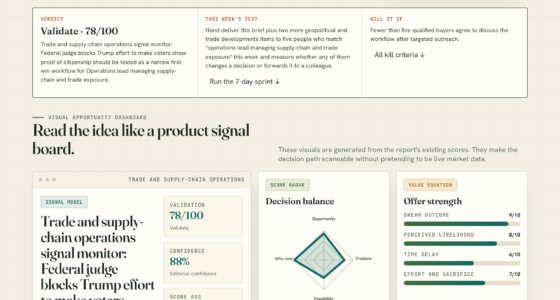
📊 Full opportunity report: Made-in-USA Claims: A Checklist For Consumer Brands on IdeaNavigator AI — validation score, market gap, and execution plan.

Prime made for students and young adults
- Fast, free delivery for dorm and study essentials
- Prime Video and Amazon Music included
- Member-only deals
TL;DR
IdeaNavigator AI proposes a living substantiation file to help consumer brands track the records behind Made-in-USA claims and flag supplier changes. Its brief also says the FTC opened an enforcement sweep in April 2026, but provides no supporting announcement or details, so that claim cannot be independently confirmed here.
IdeaNavigator AI has proposed a living substantiation file for consumer brands that print Made-in-USA claims on packaging, linking product records to supplier documents and assembly locations. The proposal describes a possible software workflow, not a launched product or confirmed regulatory action; its brief says the Federal Trade Commission opened an origin-claims enforcement sweep in April 2026, but gives no details or supporting evidence for that assertion.
The proposed system would connect each stock-keeping unit (SKU) to its bill of materials, supplier affidavits and assembly location. It would assign products a red, yellow or green claim status, allowing a compliance or operations lead to see which origin claims have supporting records and which need review. The brief does not define the status thresholds or specify how documents would be verified.
A second feature would flag supplier changes through webhooks or other automated alerts, identifying potentially affected claims before marketing materials or packaging go out. The concept responds to a recordkeeping problem described in the brief: evidence can be spread across email and purchasing records, while a supplier or factory change may alter the basis for a claim. No product launch, customer adoption, or working software is reported.
The suggested business model is an annual subscription tiered by brand SKU count, with a separately priced audit-response module. To test demand, IdeaNavigator AI proposes offering fixed-fee substantiation audits to 15 brands already printing origin claims and measuring how many move to a monitoring subscription. That is a validation plan, not evidence of sales, market size or customer demand.
Made-in-USA Claims A brand checklist
IdeaNavigator AI proposes a living file to connect origin claims with product and supplier records. The workflow is a concept, not a launched product or proof that a claim is legally supportable.
Build the evidence file
Link each product to the records behind its origin claim.
Tie each SKU to its bill of materials, supplier affidavits and assembly location.
Use red, yellow or green labels to show which records need review; thresholds are not defined.
Alerts could help teams review affected claims before packaging or marketing materials go out.
What brands still need to check
Organized records can help teams find evidence, but do not establish that a claim is accurate.
Keep evidence current
Supplier or factory changes may affect whether existing documents still support a claim.
Assess the underlying facts
A dashboard cannot verify documents or replace a brand’s assessment of its sourcing.
Validate before building
The proposed business test is a plan; the brief does not say it has started.
Verify the regulatory claim
The brief provides no agency announcement or case details for its reported enforcement sweep.
Why Supplier Records Matter
For a brand making an origin claim, the records behind that statement may become as important as the wording on the package. A supplier or manufacturing change can affect whether existing evidence still supports a claim, while scattered records can slow a company’s response to questions from regulators, retailers or customers. A centralized file could make it easier to locate relevant documents and identify products needing review.
The proposal’s practical value would depend on whether the records are accurate, current and connected to actual sourcing decisions. A dashboard or color label alone does not establish that a claim is legally supportable. Brands would still need to assess their products and evidence, and the proposal does not describe legal review, document checks or safeguards against outdated supplier information.
Products Worth Considering

Apple AirPods Pro (2nd Generation) Wireless Earbuds with USB-C MagSafe Charging Case

DJI Mini 4K Drone with 4K UHD Camera

Bose QuietComfort Wireless Noise Cancelling Headphones, Sandstone
As an affiliate, we earn on qualifying purchases.
How the Proposed File Works
IdeaNavigator AI frames the idea as a narrow first workflow for a compliance or operations lead at a consumer brand that already prints U.S.-origin claims. Rather than proposing a general-purpose compliance system, it focuses on tying each product to materials, supplier attestations and assembly details, then tracking changes that could affect the claim.
The brief says the FTC opened an enforcement sweep on origin claims in April 2026 and characterizes that development as making a paperwork obligation an active legal exposure. It does not identify an FTC notice, named case, penalty, affected company or enforcement action. That statement should be treated as an unverified claim in the brief, not as an independently established event. The workflow and commercial test are proposals; neither confirms a new FTC rule or a change in the law.
Enforcement Claim Needs Verification
The brief’s assertion about an FTC enforcement sweep in April 2026 is not accompanied by a link, agency statement or case details. It is not possible from the information provided to confirm whether such a sweep occurred, what claims or businesses it covered, or whether penalties were announced. The brief also does not identify a software vendor, product release date, participating brands or evidence that the proposed audit test is underway.
Other open questions concern how the system would handle incomplete bills of materials, supplier attestations that change, and products with complex manufacturing chains. No pricing, technical specifications, legal assessment or results are provided. The proposal should not be read as legal advice or as proof that any particular product qualifies for a U.S.-origin claim.
Validation Before a Product Launch
The next stated step is to test the idea with 15 consumer brands through fixed-fee substantiation audits and measure whether participants subscribe to ongoing monitoring. The brief does not give a schedule or say that the outreach has begun. If a product is developed, its effectiveness would depend on whether supplier and manufacturing changes are captured quickly and whether the underlying documentation is reviewed.
Separately, readers seeking to assess the regulatory claim should look for direct FTC materials identifying any relevant enforcement activity. Until those details are available, the reported sweep remains unverified, while the monitoring workflow remains a proposed business concept rather than an operational service.
Source: IdeaNavigator AI
Key Questions
What is the proposed substantiation file?
It is a proposed system that would link each product SKU to materials, supplier affidavits and assembly locations, then track the status of the records supporting an origin claim.
Has the FTC confirmed an April 2026 enforcement sweep?
The brief says a sweep began in April 2026, but provides no FTC announcement or case details. The claim cannot be confirmed from the information provided.
Does the proposal establish that a product is Made in USA?
No. A tracking system could organize evidence and flag changes, but it does not by itself prove that a claim is accurate or legally supportable.
Is the software available now?
No launch or working product is identified. The brief describes a proposed workflow and customer-validation test, not an available service.
Source: IdeaNavigator AI