
The best chemistry lab set for most students is the Thames & Kosmos CHEM C3000, thanks to its large experiment range and focus on structured learning. For younger beginners, the National Geographic Junior Chemistry Set offers a more approachable experiment-led starting point, while the Frienda 37-Piece Borosilicate Glass Lab Kit suits students who need reusable glassware rather than a curriculum in a box. The main choice is between guided activities with included materials and instructions or equipment sets that offer flexibility but may need separate experiments and supplies. Age guidance, adult supervision, glass handling, and storage also affect which set makes sense. Read on for the full comparison and buying advice for chemistry lab sets for students.

Prime made for students and young adults
- Fast, free delivery for dorm and study essentials
- Prime Video and Amazon Music included
- Member-only deals
Key Takeaways
- Experiment count is not the same as instructional depth: the CHEM C3000 leads for breadth, while the Junior Chemistry Set and Ooze Labs station are more approachable for guided, younger-user activities.
- Complete experiment kits and labware sets serve different needs: kits such as the National Geographic and Barbie sets provide activities, while the Frienda, JOLABEAR, FOUR E’S SCIENTIFIC, and QWORK options focus on reusable equipment.
- The 37-piece Frienda set offers more equipment variety than the 20-piece Frienda set, but a larger assortment may take more space and does not replace experiment instructions or consumables.
- The LINKTOR 444-piece molecular model kit teaches a different part of chemistry: it supports visualizing molecules and bonds, not conducting wet-lab experiments.
- Age fit and supervision separate the strongest choices: younger students are better served by guided sets, while older students with adult oversight can make better use of extensive glassware or the CHEM C3000.
| Frienda 37-Piece Borosilicate Glass Lab Kit |  | Best for a Broad Classroom Glassware Mix | Piece count: 37 | Glass material: Borosilicate glass | Rack: Blue, three-tier plastic | VIEW LATEST PRICE | See Our Full Breakdown |
| National Geographic Junior Chemistry Set with 50 Experiments |  | Best for Young Beginners | Brand: Blue Marble | Recommended age: 4 years and up | Experiments: 50 | VIEW LATEST PRICE | See Our Full Breakdown |
| Thames & Kosmos CHEM C3000 Chemistry Set, 333+ Experiments, Ages 12+ |  | Best for Advanced Student Study | Experiments: More than 333 | Chapters: 27 | Manual: 192-page full-color illustrated manual | VIEW LATEST PRICE | See Our Full Breakdown |
| JOLABEAR 15-Piece Laboratory Glassware Set |  | Best for Compact Student Workspaces | Set contents: 15 pieces | Glass material: 3.3 borosilicate glass | Beakers: 50 mL, 100 mL, and 250 mL | VIEW LATEST PRICE | See Our Full Breakdown |
| FOUR E’S SCIENTIFIC 19-Piece Glass Labware Set |  | Best for Heat-Rated Glassware Variety | Piece count: 19 | Material: Borosilicate glass | Beakers: 50 mL, 100 mL, 250 mL, and 500 mL | VIEW LATEST PRICE | See Our Full Breakdown |
| 18-Piece Lab Glassware Set with Beakers, Flasks, Graduated Cylinders, Droppers, Brushes, and Stirring Rods | 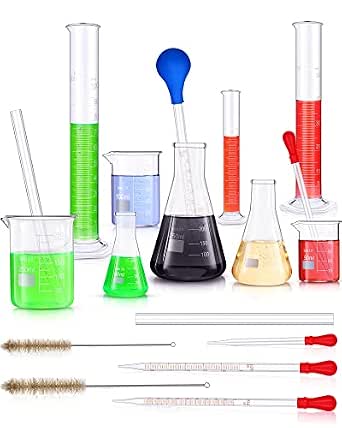 | Best for Hands-On Glassware Practice | Brand: Flutesan | Piece count: 18 | Material: Borosilicate glass | VIEW LATEST PRICE | See Our Full Breakdown |
| LINKTOR Chemistry Molecular Model Kit, 444 Pieces |  | Best for Visualizing Molecular Structure | Brand: LINKTOR | Piece count: 444 | Components: 136 atoms, 158 bonds, and 150 Fullerene components | VIEW LATEST PRICE | See Our Full Breakdown |
| Frienda 20-Piece Borosilicate Glass Labware Set | 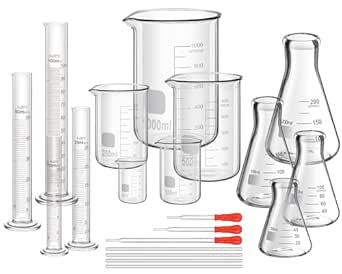 | Best for Broad Measuring Range | Brand: Frienda | Piece count: 20 | Material: Borosilicate glass | VIEW LATEST PRICE | See Our Full Breakdown |
| Thames & Kosmos Ooze Labs Chemistry Station Experiment Set |  | Best Guided Starter Kit | Brand: Thames & Kosmos | Model number: 642105 | Age range: 6 years and up | VIEW LATEST PRICE | See Our Full Breakdown |
| Barbie Chemistry Science Kit with 50 Experiments |  | Best for Household-Material Follow-Ups | Brand: Blue Marble | Age range: 8 years and up | Total listed experiments: 50 | VIEW LATEST PRICE | See Our Full Breakdown |
| QWORK 18-Piece Borosilicate Glass Labware Set |  | Best for Temperature-Controlled Labware Practice | Material: 3.3 borosilicate glass | Temperature resistance: Up to 180°C | Set contents: 3 beakers, 3 flasks, 3 cylinders, 5 droppers, 2 stir rods, 2 cleaning brushes | VIEW LATEST PRICE | See Our Full Breakdown |
| chemistry lab sets for student | Piece count | Brand |
|---|---|---|
| Frienda 37-Piece Borosilicate | 37 | — |
| National Geographic Junior Che | — | Blue Marble |
| Thames & Kosmos CHEM C3000 Che | — | — |
| JOLABEAR 15-Piece Laboratory G | — | — |
| FOUR E’S SCIENTIFIC 19-Piece G | 19 | — |
| 18-Piece Lab Glassware Set wit | 18 | Flutesan |
| LINKTOR Chemistry Molecular Mo | 444 | LINKTOR |
| Frienda 20-Piece Borosilicate | 20 | Frienda |
| Thames & Kosmos Ooze Labs Chem | 57 | Thames & Kosmos |
| Barbie Chemistry Science Kit w | — | Blue Marble |
| QWORK 18-Piece Borosilicate Gl | 18 | — |
More Details on Our Top Picks
Frienda 37-Piece Borosilicate Glass Lab Kit
The Frienda kit earns this role by pairing a wide mix of glassware with tools for measuring, transferring, stirring, and storing test tubes. Its four graduated-cylinder capacities and beakers ranging up to 1,000 mL give students more room to compare small samples with larger mixtures than the JOLABEAR 15-Piece Laboratory Glassware Set. The 37-piece assortment is a practical fit for demonstrations and science-fair preparation, especially when a teacher wants varied vessels in one kit. The tradeoff is that this is primarily equipment, not a guided chemistry course: it does not list experiments or included chemicals. Its three-tier rack is plastic, and the stated winding risk means it should be kept away from small children. Choose it for a supervised workspace that needs variety, not a self-contained starter curriculum.
Pros:- 37 pieces cover measuring, mixing, transferring, stirring, and test-tube organization.
- Four graduated-cylinder capacities support a range of measuring tasks.
- Beakers range from 50 mL to 1,000 mL for small samples and larger mixtures.
- Borosilicate glass components suit classroom and hobby use.
Cons:- No experiment guide or chemicals are listed, so buyers need to plan activities and source materials separately.
- The three-tier rack is plastic rather than glass.
- The stated winding risk and small-child warning make supervised storage and use important.
Best for: Teachers and older students who need several glassware sizes and a rack for supervised demonstrations or science-fair projects.
Not ideal for: Young children or beginners seeking guided activities and supplied chemicals; this set is equipment-focused and carries a warning to keep it away from small children.
- Piece count:37
- Glass material:Borosilicate glass
- Rack:Blue, three-tier plastic
- Graduated cylinder capacities:10 mL, 25 mL, 50 mL, and 100 mL
- Beaker capacity range:50 mL to 1,000 mL
- Test tube sizes:10 × 100 mm and 13 × 75 mm
- Item weight:5.5 pounds
Our verdict“Choose the Frienda kit when a supervised student lab needs varied glassware and organization more than a packaged experiment curriculum.”
National Geographic Junior Chemistry Set with 50 Experiments
For younger learners, this Blue Marble set puts guided activities ahead of glassware variety. It includes materials for 50 experiments, more than 20 child-safe lab tools, and illustrated step-by-step instructions, making it a more approachable first chemistry activity kit than the Thames & Kosmos CHEM C3000. The activities use familiar supplies such as baking soda and vinegar, which can make simple demonstrations easier to stage at home. Its age guidance starts at four, but that does not make every activity a fit for every child; an adult should select and supervise age-appropriate experiments. Some household ingredients are not included, and this set is not designed to provide the broader equipment or chemistry coverage of a student laboratory kit for older learners. I would choose it for structured early exploration, not for students ready for more advanced lab work.
Pros:- Materials are included for 50 hands-on experiments.
- More than 20 child-safe lab tools give young learners equipment to handle during activities.
- Illustrated, step-by-step instructions support early readers and family guidance.
- Some activities use familiar household items such as baking soda and vinegar.
Cons:- Some activities require additional household ingredients.
- The age-four-and-up guidance does not remove the need for adult activity selection and supervision.
- Its young-child focus offers less depth than the Thames & Kosmos CHEM C3000 for older students.
Best for: Families introducing children ages four and up to supervised, illustrated hands-on science activities.
Not ideal for: Middle-school students seeking broader chemistry topics, advanced equipment, or a substantial set of experiments using supplied laboratory chemicals.
- Brand:Blue Marble
- Recommended age:4 years and up
- Experiments:50
- Lab tools:More than 20
- Included components:Test tubes, goggles, and other lab tools
- Dimensions:11 × 4.22 × 9.64 inches
- Weight:0.72 kg
- Battery required:No
Our verdict“Pick this set for a young beginner who benefits from illustrated activities, and skip it if the student needs a deeper lab curriculum.”
Thames & Kosmos CHEM C3000 Chemistry Set, 333+ Experiments, Ages 12+
The CHEM C3000 is the strongest choice here for students who want a structured, wide-ranging chemistry course rather than a collection of glassware. Its 192-page illustrated manual leads through more than 333 experiments across inorganic, electrochemical, and organic chemistry, with 16 or more chemicals and substantial lab equipment. That gives it a much deeper educational scope than the National Geographic Junior Chemistry Set, which is aimed at much younger learners and short guided activities. The tradeoff is a greater supervision commitment: this kit is for ages 12 and up and requires adult supervision, with safety, first-aid, labeling, and disposal guidance included. Some experiments also call for household materials. I would put it first for a committed teen working with an adult, but not for a child who needs independent activities or a simple glassware starter set.
Pros:- More than 333 experiments span inorganic, electrochemical, and organic chemistry.
- The 192-page illustrated manual includes scientific explanations and safety guidance.
- Includes 16 or more chemicals alongside laboratory equipment.
- Equipment includes test tubes, beakers, an Erlenmeyer flask, pipettes, goggles, and an alcohol burner.
Cons:- Adult supervision is required, so it is not suited to unsupervised experimentation.
- Some experiments need additional common household materials.
- Its age and topic depth make it less suitable as an introductory kit for young children than the National Geographic Junior set.
Best for: Students ages 12 and up who want a guided, multi-topic chemistry program and have an adult available to supervise experiments.
Not ideal for: Young children, independent learners without adult supervision, or buyers who only need basic glassware for classroom demonstrations.
- Experiments:More than 333
- Chapters:27
- Manual:192-page full-color illustrated manual
- Chemicals:16 or more
- Recommended age:12 and up
- Supervision:Adult supervision required
- Safety standard:EN 71-4
- Included equipment:Test tubes, beakers, Erlenmeyer flask, tripod stand, alcohol burner, pipettes, syringe, goggles, and other lab tools
Our verdict“Choose the CHEM C3000 for a supervised teen seeking a substantial, guided chemistry course rather than a basic glassware assortment.”
JOLABEAR 15-Piece Laboratory Glassware Set
JOLABEAR suits students who need a focused, space-conscious set of glassware for routine mixing and liquid handling. Its 15 pieces cover beakers, Erlenmeyer flasks, graduated cylinders, pipettes, and a stirring rod, without the larger assortment and 1,000 mL beaker capacity found in the Frienda 37-Piece Borosilicate Glass Lab Kit. The cylinders’ hexagonal bases and removable anti-tip rings add practical stability, while the custom-fit foam helps protect the glass during storage and transport. This is a sensible choice for a student with a defined list of experiments and limited storage space. The main limitation is that the glassware arrives empty: chemicals, activity instructions, and other project materials are not included. Graduations are approximate, too, so students needing more precise measurement should choose equipment intended for that purpose.
Pros:- Combines beakers, flasks, graduated cylinders, pipettes, and a stirring rod in 15 pieces.
- 3.3 borosilicate glass provides reusable labware.
- Hexagonal cylinder bases and removable anti-tip rings add stability and protection.
- Custom-fit EPE foam cushions the glassware in transit and storage.
Cons:- Glassware is supplied empty, with no chemicals or project materials listed.
- Graduations provide approximate volume references rather than a stated precision measure.
- Its smaller assortment has less size range than the Frienda 37-Piece kit.
Best for: Students with limited storage who need a small, reusable glassware assortment for planned mixing and liquid-handling activities.
Not ideal for: Beginners looking for a complete experiment kit, or students who need included chemicals, instructions, larger vessels, or precise graduated measurements.
- Set contents:15 pieces
- Glass material:3.3 borosilicate glass
- Beakers:50 mL, 100 mL, and 250 mL
- Erlenmeyer flasks:50 mL, 100 mL, and 250 mL
- Graduated cylinders:10 mL, 50 mL, and 100 mL
- Other tools:Five 3 mL transfer pipettes and one glass stirring rod
- Item weight:2.59 pounds
- Package dimensions:16.06 × 9.88 × 4.88 inches
Our verdict“Choose JOLABEAR for compact, basic glassware needs, but look elsewhere for a guided kit or a wider capacity range.”
FOUR E’S SCIENTIFIC 19-Piece Glass Labware Set
This set stands out for students who want more vessel types and sizes than the compact JOLABEAR 15-Piece set, including four beakers, four conical flasks, and four graduated cylinders. Clear markings and tapered spouts can help with routine reading and controlled pouring, while the included droppers, stirring rods, and cleaning brush round out a practical glassware toolkit. Its borosilicate glass is rated for temperatures up to 500°C, though that rating alone does not make every heating setup appropriate for student use. Unlike the Thames & Kosmos CHEM C3000, FOUR E’S supplies no experiment curriculum or chemicals, so buyers need separate lesson materials and must follow suitable lab safety practices. The maker also cautions against letting stirring rods hit the glassware’s base or walls, and dimensions should be checked before use.
Pros:- Nineteen pieces include four sizes each of beakers, conical flasks, and graduated cylinders.
- Borosilicate glass is rated to withstand temperatures up to 500°C.
- Clear markings and tapered spouts support reading and controlled pouring.
- Includes two graduated droppers, four stirring rods, and a cleaning brush.
Cons:- No chemicals or experiment instructions are listed.
- Stirring rods should not contact the base or walls of the glassware.
- Buyers should check dimensions before use to confirm the vessels fit their workspace and experiments.
Best for: Students who already have activities planned and want multiple sizes of borosilicate beakers, flasks, and measuring cylinders.
Not ideal for: Beginners who need chemicals, guided experiments, or a complete instructional kit, and anyone unable to follow careful glassware handling guidance.
- Piece count:19
- Material:Borosilicate glass
- Beakers:50 mL, 100 mL, 250 mL, and 500 mL
- Conical flasks:50 mL, 100 mL, 150 mL, and 250 mL
- Graduated cylinders:10 mL, 25 mL, 50 mL, and 100 mL
- Droppers:Two graduated droppers
- Stirring rods:Four, in 15 cm and 20 cm lengths
- Maximum temperature:500°C
- Included accessory:One cleaning brush
Our verdict“Choose FOUR E’S for varied, heat-rated glassware when you already have a supervised plan for the experiments.”
18-Piece Lab Glassware Set with Beakers, Flasks, Graduated Cylinders, Droppers, Brushes, and Stirring Rods
This 18-piece borosilicate set suits students who want to practice measuring, pouring, and mixing with real lab-style vessels rather than follow a kit of prepared activities. Its beakers, Erlenmeyer flasks, and three graduated cylinders provide a useful spread of vessel types, while spouts and clear markings make routine transfers easier to manage. Compared with the Frienda 20-Piece Borosilicate Glass Labware Set, it has fewer pieces and no large measuring cups, but adds Erlenmeyer flasks for students practicing flask-based mixing. The tradeoff is scale: the largest listed vessel is 250 ml, so this set is better for small demonstrations than larger batches. It also includes only two brushes, which may slow cleanup when several pieces are used.
Pros:- Includes beakers, Erlenmeyer flasks, and graduated cylinders for varied lab-style tasks.
- Borosilicate glass is described as heat resistant.
- Clear markings and pouring spouts support measuring and controlled transfers.
- Five droppers and two stirring rods add useful tools for small experiments.
Cons:- The largest listed vessel capacity is 250 ml, limiting larger demonstrations.
- Only two cleaning brushes are included for the glassware.
- No chemicals, experiment guide, or activities are listed.
Best for: Students who already have experiment instructions and want a compact set of real glassware for small-scale measuring, mixing, and pouring practice.
Not ideal for: Students who need guided experiments, larger-volume work, or a more extensive measuring-cup selection; this set tops out at 250 ml and does not include an activity manual.
- Brand:Flutesan
- Piece count:18
- Material:Borosilicate glass
- Graduated cylinders:3: 10 ml, 50 ml, and 100 ml
- Beakers:3: 50 ml, 100 ml, and 250 ml
- Erlenmeyer flasks:3: 50 ml, 100 ml, and 250 ml
- Other included tools:5 glass droppers, 2 glass stirring rods, and 2 cleaning brushes
- Largest listed capacity:250 ml
Our verdict“Choose this set for small-scale glassware practice, but pick an activity kit if the student needs guided experiments or included materials.”
LINKTOR Chemistry Molecular Model Kit, 444 Pieces
For students who find formulas easier to understand when they can build a structure, this kit’s ball-and-stick and space-filling models make molecular shape and bonding visible in three dimensions. Its 444 components include atoms, bonds, and a substantial set of Fullerene pieces, giving it a more focused role than the glassware sets in this roundup: it teaches representation and geometry, not measuring or chemical reactions. Compared with the Thames & Kosmos Ooze Labs Chemistry Station, LINKTOR offers more direct practice with molecular structure, while Ooze Labs supplies equipment and guided activities. The main limitation is that the listing gives no experiment manual or specific curriculum. The recommended age is listed as 10–22 months, which conflicts with the stated Grade 7 to graduate-level audience, so buyers should verify suitability before ordering.
Pros:- Supports both ball-and-stick and space-filling molecular representations.
- Includes Fullerene components for constructing Carbon-60 models.
- Assembles and disassembles to let students revise structures.
- Makes bonds, molecular geometry, and bond angles easier to visualize than diagrams alone.
Cons:- Does not include experiment chemicals, lab glassware, or reaction activities.
- The listed recommended age of 10–22 months conflicts with the stated Grade 7 to graduate-level audience.
- No manual or curriculum details are provided in the supplied product information.
Best for: Middle- and high-school students studying molecular geometry, bonding, or organic structures who benefit from assembling models by hand.
Not ideal for: Younger children or students seeking hands-on chemical reactions, glassware practice, or a clearly age-matched learning guide.
- Brand:LINKTOR
- Piece count:444
- Components:136 atoms, 158 bonds, and 150 Fullerene components
- Model types:Ball-and-stick and space-filling
- Material:ABSYLUX
- Dimensions:8 x 6 x 2 inches
- Weight:800 g
- Recommended age as listed:10–22 months
Our verdict“Pick LINKTOR when the learning goal is molecular structure and geometry, not a complete chemistry experiment set.”
Frienda 20-Piece Borosilicate Glass Labware Set
The Frienda set is the strongest fit here for students who need to measure across several scales: its lineup includes measuring cups up to 1,000 ml, four graduated-cylinder sizes, beakers, droppers, and stirring rods. That broader capacity range makes it more adaptable than the Flutesan 18-Piece set, whose largest listed vessel is 250 ml. Its borosilicate glass and tapered spouts support routine measuring and pouring, but glass still calls for careful handling, especially in a student workspace. The product information also does not specify measurement accuracy, so I would treat it as general educational labware rather than rely on it for precision work. Unlike the Thames & Kosmos Ooze Labs kit, it supplies vessels rather than guided activities or chemicals.
Pros:- Five measuring-cup capacities extend up to 1,000 ml.
- Includes measuring cups, graduated cylinders, droppers, beakers, and stirring rods.
- Borosilicate glass is described as resistant to acids and alkalis.
- Clear scales and tapered spouts help with reading and transferring liquids.
Cons:- Glass pieces require careful handling in student settings.
- Measurement accuracy is not specified.
- No chemicals, experiment guide, or activities are listed.
Best for: Students with a teacher or experiment guide who need several glassware types and larger measuring capacity for classroom demonstrations.
Not ideal for: Younger beginners who need a complete guided activity kit, or students who require stated measurement tolerances and precision specifications.
- Brand:Frienda
- Piece count:20
- Material:Borosilicate glass
- Measuring-cup capacities:50 ml, 100 ml, 250 ml, 500 ml, and 1,000 ml
- Graduated-cylinder capacities:10 ml, 25 ml, 50 ml, and 100 ml
- Beaker capacities:50 ml, 100 ml, 150 ml, and 200 ml
- Dropper lengths:90 mm, 120 mm, and 200 mm
- Weight:3.9 lb
Our verdict“Choose Frienda for varied glassware and larger-volume measuring, provided the student already has safe, guided experiments to follow.”
Thames & Kosmos Ooze Labs Chemistry Station Experiment Set
The Ooze Labs Chemistry Station is the most ready-to-start option in this group for younger students: it pairs a plastic lab station and equipment with non-hazardous chemicals, experiment cards, and a full-color manual for about 20 activities. Slime, crystals, chromatography, fizzing reactions, and an underwater volcano give beginners varied ways to explore simple chemistry without requiring a separate glassware purchase. Compared with the Blue Marble Barbie Chemistry Science Kit, Ooze Labs has fewer listed activities, but its set is built around a dedicated station and includes a manual and cards for the experiments. The tradeoff is that students must set out and manage 57 pieces, which can make setup and cleanup more involved. Its plastic tools also serve a different purpose from the real glassware sets, which are better for practicing lab-style vessels.
Pros:- Includes approximately 20 activities with experiment cards and a full-color manual.
- Provides a lab station and varied equipment, including beakers, test tubes, a syringe, and a petri dish.
- Uses non-hazardous chemicals and does not contain borax.
- Activities cover several introductory themes, including slime, crystals, and chromatography.
Cons:- The 57-piece assortment requires setup and management of multiple small items.
- Plastic equipment does not provide the same glassware practice as the Flutesan or Frienda sets.
- The activity range is introductory rather than suited to advanced chemistry study.
Best for: Children ages 6 and up who need structured, varied introductory activities and a supplied station, tools, and non-hazardous chemicals.
Not ideal for: Older students seeking advanced chemistry, real glassware practice, or a minimal-setup activity; this is an introductory plastic-equipment kit with many small pieces.
- Brand:Thames & Kosmos
- Model number:642105
- Age range:6 years and up
- Approximate experiment count:20
- Piece count:57
- Included equipment:Beakers, test tubes, flasks, syringe, measuring cup, pipette, spatula, petri dish, funnel, and more
- Included learning materials:Experiment cards and a 16-page full-color manual
- Chemical safety:Non-hazardous chemicals; does not contain borax
Our verdict“Choose Ooze Labs for a young beginner who benefits from guided activities and included materials more than from real lab glassware.”
Barbie Chemistry Science Kit with 50 Experiments
This kit makes chemistry approachable for children ages 8 and up through familiar activities such as glowing slime, a lava lamp, and glowing chalk. Its headline total of 50 activities needs context: the box includes supplies for 15 experiments, while the other 35 use household items. That split can help families keep exploring after the supplied materials run out, but it asks an adult to source and prepare more of the later activities. Compared with the Thames & Kosmos Ooze Labs Chemistry Station, Barbie offers a larger activity count on paper and a bonus guide, while Ooze Labs lists about 20 activities alongside non-hazardous chemicals and a dedicated station. This is an activity kit, not a glassware set, so students seeking hands-on measuring with lab vessels should choose Flutesan or Frienda instead.
Pros:- Includes lab gear, goggles, and materials for 15 experiments.
- The bonus guide adds 35 activities using household items.
- Step-by-step instructions and a learning guide introduce chemistry and STEM concepts.
- Activities include glowing slime, a lava lamp, and glowing chalk.
Cons:- Materials are included for only 15 of the 50 listed experiments.
- The remaining 35 activities require household items not included in the kit.
- Does not provide the real glassware practice offered by the Flutesan and Frienda sets.
Best for: Families with children ages 8 and up who want an approachable activity kit and are comfortable gathering household supplies for follow-up experiments.
Not ideal for: Students who want all experiment materials included, real glass labware, or a kit focused on advanced chemistry rather than introductory STEM activities.
- Brand:Blue Marble
- Age range:8 years and up
- Total listed experiments:50
- Experiments with included materials:15
- Additional activities:35 using household items
- Included components:Lab gear, goggles, materials for 15 experiments, and bonus guide
- Dimensions:11 x 4.22 x 9.63 inches
- Weight:2.2 pounds
Our verdict“Pick this kit for an 8-and-up beginner who enjoys guided activities and can use household supplies for many of the follow-up experiments.”
QWORK 18-Piece Borosilicate Glass Labware Set
The QWORK set is a labware-focused choice for students who already have experiments in mind and need vessels for measuring, mixing, and controlled heating. Its 3.3 borosilicate glass is rated for rapid temperature changes up to 180°C, making it more suited to a lab plate or hot-water bath than a basic plastic-oriented experiment kit. Compared with the National Geographic Junior Chemistry Set, it supplies reusable glass equipment rather than a ready-made sequence of experiments, so students get more practice handling standard lab vessels but less built-in guidance.
The 18 pieces include beakers, flasks, cylinders, droppers, stir rods, and cleaning brushes; marked scales support measurement, though they should not be treated as precision instruments. The main limitation is significant for heating work: open-flame use is not suitable. It also lacks an experiment curriculum and reagents, so buyers need to provide activities and compatible supplies.
Pros:- 3.3 borosilicate glass resists rapid temperature changes up to 180°C
- Beakers, flasks, and cylinders cover several common lab tasks
- Marked scales help students practice measuring liquids
- Droppers, stir rods, and cleaning brushes add useful accessories
Cons:- Must not be heated over an open flame
- Does not include experiments, instructions, or listed chemicals
- Glassware requires careful handling and cleanup
Best for: Students who have teacher- or curriculum-led activities and need a varied set of glass vessels for measuring, mixing, and controlled heating.
Not ideal for: Beginners seeking a guided experiment kit, or students whose activities require direct flame heating; this set provides no experiment program and is not for open flames.
- Material:3.3 borosilicate glass
- Temperature resistance:Up to 180°C
- Set contents:3 beakers, 3 flasks, 3 cylinders, 5 droppers, 2 stir rods, 2 cleaning brushes
- Piece count:18
- Package dimensions:13.62 × 9.29 × 4.09 inches
- Item weight:2.36 pounds
- Manufacturer:QWORK
- Model number:WD15079
Our verdict“Choose the QWORK set for students who need reusable glass labware for supervised, controlled-heating activities, not a self-contained experiment kit.”
How We Picked
I compared these 11 products by how well they serve students learning chemistry, rather than treating every kit with chemistry in its name as interchangeable. The main criteria were age suitability, clarity and breadth of learning activities, usefulness of included equipment, material and handling considerations, storage demands, and how much additional setup or supplies a student may need. I also separated experiment kits from glassware sets and molecular models, since each supports a different kind of learning.
The ranking favors options that give students a clear path into chemistry and make their intended use easy to understand. The CHEM C3000 ranks first for students ready for a broad, structured program; the National Geographic Junior set takes the beginner role, and the Frienda 37-piece kit stands out for reusable equipment. Smaller glassware assortments rank lower for students who need lessons or experiments included, while the molecular model kit and themed sets serve more specific interests. A higher piece or experiment count alone did not determine placement.
| chemistry lab sets for student | Brand |
|---|---|
| Frienda 37-Piece Borosilicate | — |
| National Geographic Junior Che | Blue Marble |
| Thames & Kosmos CHEM C3000 Che | — |
| JOLABEAR 15-Piece Laboratory G | — |
| FOUR E’S SCIENTIFIC 19-Piece G | — |
| 18-Piece Lab Glassware Set wit | Flutesan |
| LINKTOR Chemistry Molecular Mo | LINKTOR |
| Frienda 20-Piece Borosilicate | Frienda |
| Thames & Kosmos Ooze Labs Chem | Thames & Kosmos |
| Barbie Chemistry Science Kit w | Blue Marble |
| QWORK 18-Piece Borosilicate Gl | — |
Factors to Consider When Choosing Chemistry Lab Sets For Students
Before choosing a set, decide what kind of chemistry learning the student will actually do. A guided experiment kit, a collection of glassware, and a molecular model set can all support science study, but they are not substitutes for one another. These factors can help match the purchase to the student’s age, workspace, and learning goals.
Choose Between Experiments and Equipment
Start by asking whether the student needs a sequence of activities or tools for activities chosen elsewhere. Experiment kits generally provide a more direct starting point, while glassware assortments can support repeat use across lessons but may leave the student to find procedures and materials. A common mistake is buying a labware set expecting it to include a complete course or a supply of reagents. Check exactly what is included and what must be sourced separately. If the student already has school experiments or a teacher’s plan, equipment may be useful; otherwise, guided activities can reduce setup friction.
Match the Kit to Age and Adult Support
Age labels are a starting point, not a substitute for checking the actual activities and handling requirements. Younger students often benefit from short, clearly directed experiments, while older students may be ready for more independent work with an adult nearby. Glassware brings breakage and cleanup concerns that plastic activity pieces may not. Think about who will supervise, how often, and whether the student can follow written directions without skipping steps. Avoid choosing a more advanced kit solely because it contains more pieces or experiments.
Treat Safety and Storage as Part of the Purchase
A chemistry set needs a suitable work area, not just a place on a shelf. Consider whether experiments require eye protection, careful measuring, ventilation, or adult handling, and follow the manufacturer’s safety instructions for each activity. Glass sets need secure storage away from the edge of a desk and should be checked for chips or cracks before use. Plan for a washable surface, space for drying components, and a way to keep small parts together. If those arrangements are difficult at home, a compact, guided activity set may be more practical than a larger glassware collection.
Look Beyond the Experiment Count
A large activity count can sound appealing, but the usefulness of those activities depends on clear instructions, variety, and whether materials are reusable or need replenishing. Ask whether the experiments build concepts progressively or simply offer many separate demonstrations. Also check whether the listed count refers to distinct activities, variations, or repeated uses of the same materials. A smaller set can be a better learning fit if it is easier to follow and supports repeated practice. When comparing kits, prioritize activities the student can do safely and revisit over headline numbers.
Factor in Replacement Supplies and Long-Term Use
Some kits are ready for a defined set of activities, while equipment-focused sets are designed to be used with materials obtained separately. That difference affects both convenience and future flexibility. Check which consumables are included, whether they are likely to run out after a few sessions, and whether replacement materials are clearly identified. Reusable glassware can make sense for a student who will continue with projects, but only if there is a plan for suitable procedures and safe storage. For a one-time introduction to chemistry, paying for equipment the student will not reuse may be poor value.
Select the Learning Format That Holds the Student’s Interest
Students learn chemistry in different ways: some enjoy observing reactions, others prefer following a guided station, and some benefit most from visualizing molecular structures. A model kit such as LINKTOR supports spatial understanding of molecules, but it does not provide hands-on wet-lab experiments. Themed kits can make an activity feel inviting, though the theme should not distract from the concepts or instructions. Consider the student’s interests alongside the learning objective, then choose a format that encourages repeat use. If the goal is broad practical chemistry, pair visual models with an experiment-focused resource rather than treating one as a replacement for the other.
Frequently Asked Questions
Should I choose a complete experiment kit or a glassware-only set?
Choose an experiment kit if the student needs activities and directions to get started. A glassware-only set is a better fit when a teacher, textbook, or existing project plan already provides procedures and materials. Do not assume that beakers, flasks, and droppers come with reagents or lessons. Compare the included contents against the student’s actual plan before buying. If the goal is an easy first experience at home, a guided kit is usually the more straightforward choice.
Is the CHEM C3000 suitable for a younger student working alone?
The CHEM C3000 is positioned for ages 12 and up, so the intended age range and the manufacturer’s directions should guide the decision. That does not mean every student in that range should work without adult oversight. Review the activity instructions and safety guidance before the first session, and supervise any steps that call for it. A younger beginner who wants simple, directed activities may find the National Geographic Junior set easier to approach. Match the kit to the student’s reading skills, care with equipment, and available supervision.
Does a molecular model kit replace a chemistry experiment set?
No. A molecular model kit helps students build and inspect representations of molecules, which can make structure and bonding easier to visualize. It does not provide the glassware, procedures, or materials needed for wet-lab experiments. It can complement an experiment kit or school coursework, especially when a student struggles to picture structures from diagrams. If the main goal is observing reactions, choose an experiment-focused set first. If the goal is understanding molecular shapes, a model kit may be the more targeted purchase.
How much glassware does a student actually need?
The right amount depends on the planned activities, available storage, and whether the student will reuse the equipment. A larger assortment can offer more flexibility, but it also takes more space and creates more pieces to handle, clean, and store. For a student following a set curriculum, start with the vessels and measuring tools required by those procedures rather than buying for a hypothetical future project. Check the dimensions and materials, not only the piece count. If the work plan is unclear, a guided experiment kit may prevent unnecessary equipment purchases.
What should I check before letting a student use a chemistry set at home?
Read the age guidance, activity instructions, and safety notes for the exact kit before use. Confirm which items are supplied, what additional protective equipment or household materials are needed, and whether an adult must supervise specific steps. Set up a stable, washable workspace with room to keep food and drinks separate, and plan for cleanup and storage. Inspect glassware for damage and keep small components organized between sessions. If the instructions or required precautions do not fit the home setup, choose a simpler activity format.
Conclusion
For the best overall student option, choose the Thames & Kosmos CHEM C3000 if the learner is ready for a broad, structured set of activities and has appropriate adult support. The Frienda 37-Piece Borosilicate Glass Lab Kit is my best pick for reusable labware, while the National Geographic Junior Chemistry Set is the better beginner choice for students who need a guided introduction. For a focused visual-learning need, the LINKTOR Molecular Model Kit helps with molecular structures but should not stand in for an experiment set. Buyers seeking smaller glassware assortments can compare the Frienda 20-piece, JOLABEAR, FOUR E’S SCIENTIFIC, 18-piece generic, and QWORK sets against the equipment required by their projects. I would choose a themed kit such as Ooze Labs or Barbie when its activity format is the strongest match for the student, not just for its presentation.