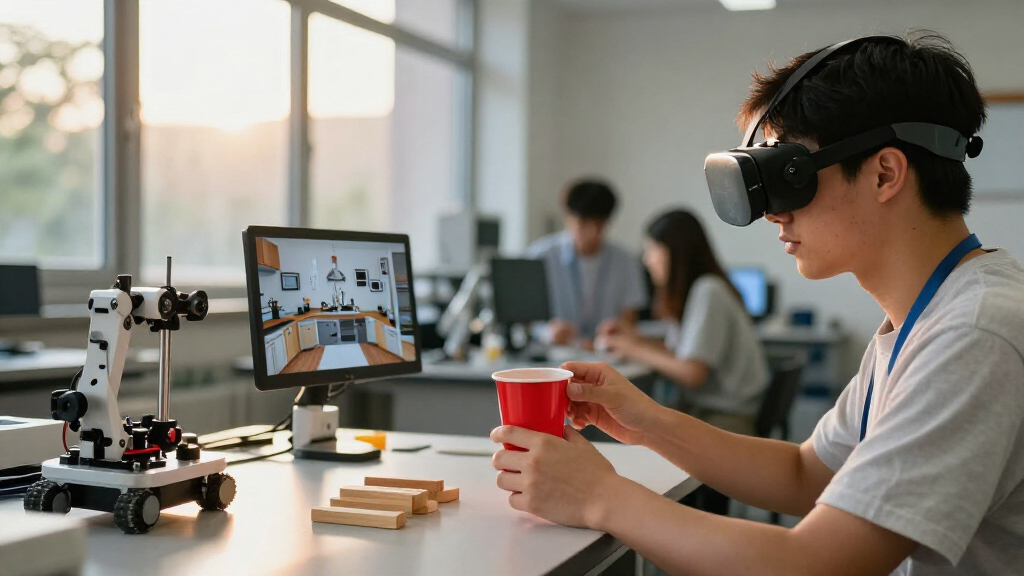

🔍 Read the full analysis: Can Genie 4 Bridge The Gap Between Virtual Worlds And Real-World Understanding? on ThorstenMeyerAI.com

Prime made for students and young adults
- Fast, free delivery for dorm and study essentials
- Prime Video and Amazon Music included
- Member-only deals
TL;DR
Google DeepMind describes Genie 4’s generated environments as a step toward artificial general intelligence, arguing that agents and robots can benefit from extensive practice in simulated worlds. But the claim is a research direction, not a measured result: a 2025 benchmark found video models’ physical reasoning remained limited, and Genie 4 has not been tested on the cited benchmark.
Google DeepMind says Genie 4’s realistic, interactive environments could help advance artificial general intelligence by giving AI agents and robots places to practise. But a November 1 analysis by Thorsten Meyer of ThorstenMeyerAI.com finds that this is a research ambition, not a demonstrated measure of understanding: a benchmark from DeepMind researchers found video models’ physical understanding remained limited, and Genie 4 itself has not been evaluated on the cited test.
DeepMind’s Genie 4 model page describes exploring realistic environments as a “key stepping stone on the path to AGI.” The argument is that agents can train and be tested in generated settings before operating in the physical world, where experiments can be costly, slow or unsafe. The claim does not establish that Genie 4 is close to AGI or that the model understands the physical rules behind the scenes it generates.
The source article distinguishes between a model that produces plausible images and one that predicts physical consequences. Genie 4 generates video frames based on preceding frames and user input; the article says it has no underlying game engine or stored 3D map. DeepMind’s described system also uses a Gemini model to plan scenes and check frames, while Genie generates the visuals. The company’s own framing points to hybrid world models rather than pixels alone as a promising direction.
The strongest caution in the source is a 2025 Physics-IQ benchmark from Google researchers, which found video models’ physical understanding “severely limited, and unrelated to visual realism.” On Physics-IQ Verified, where real videos score 100, the best image-to-video entry listed in the article scored 55.1 in its best of eight attempts. Gemini Omni 1.1 Flash, which the article identifies as part of the family DeepMind says anchors Genie 4, scored 35.3. Genie 4 has no reported score on that test in the supplied material, so these figures do not directly establish its performance.
THE AGI CLAIM, VERSION BY VERSION
Three Genies, one promise
Google DeepMind has tied every recent Genie to the path to AGI. Here is what each version could do, what was claimed, and who said it.
- 4 Dec 2024Genie 23D worlds from one image, consistent for up to about a minute.“…the breadth and generality required to progress towards AGI.”Company claim
- 5 Aug 2025Genie 3First real-time Genie: 720p, 24 frames per second, a few minutes of consistency.“World models are also a key stepping stone on the path to AGI…”Company claim
- 13 Nov 2025SIMA 2 in Genie 3 worldsDeepMind's game agent orients itself and self-improves in newly generated worlds.“…a major milestone toward training general agents across diverse, generated worlds.”Company report
- 6 Feb 2026Waymo World ModelWaymo says its driving simulator is built on Genie 3 and can generate rare events.“…from a tornado to a casual encounter with an elephant.”Company report
- 27 Oct 2026Genie 4Photorealism, native sound, live text steering, Gemini in the loop. Trusted testers only.“…a key stepping stone on the path to AGI.”Company claim
- 31 Oct 2026TechRadar pushes backColumnist Eric Hal Schwartz: realism is not understanding.“Faking plausibility is easier than grasping the underlying rules…”Opinion
The Genie 2 and Genie 3 capability notes are DeepMind’s own descriptions. No Genie post measures progress toward AGI; DeepMind published no benchmark numbers for Genie 4.
Sources: Google DeepMind, Genie 2 (4 Dec 2024), Genie 3 (5 Aug 2025), SIMA 2 (13 Nov 2025), Genie 4 model page (read 1 Nov 2026); Waymo (6 Feb 2026); TechRadar (31 Oct 2026, opinion).
Powered by Thorsten Meyer AI
Why Realism Is Not a Physics Test
The distinction matters to companies deciding whether to use generated worlds to train or evaluate robots, autonomous vehicles or other agents. Simulation could help teams explore scenarios that are difficult or risky to stage in reality, including rare road hazards. DeepMind reported in November 2025 that its SIMA 2 agent could follow instructions in worlds generated by Genie 3 and improve itself in newly created environments. Waymo said in February 2026 that its driving simulator was built on Genie 3 and could create rare events.
Those examples support the practical value of simulated environments, but they do not show that an agent trained there will behave reliably outside them. A convincing clip of a ball bouncing or a vehicle encountering an unusual hazard is not, by itself, evidence that the model captures forces, causal relationships or the consequences of an action. For buyers and developers, the relevant question is whether a system passes measurable physical tests and transfers its performance to real settings, not whether its demonstrations look convincing.
For the public, the distinction also limits what can be inferred from language such as “a step toward AGI.” DeepMind presents that phrase as a long-term direction for the work. The source article reports no Genie 4 benchmark results that measure progress toward AGI. Readers should treat the wording as a statement of the company’s research bet, rather than a finding that the model has general intelligence.
Products Worth Considering

Logitech MX Mechanical Wireless Illuminated Keyboard, Tactile Quiet, Graphite

Bose QuietComfort True Wireless Noise-Cancelling Earbuds, Black

Apple AirPods Pro 3 Wireless Earbuds with Active Noise Cancellation
As an affiliate, we earn on qualifying purchases.
A Claim Repeated Across Genie Versions
DeepMind’s case for generated worlds predates Genie 4. Its Genie 3 announcement in August 2025 used the phrase “a key stepping stone on the path to AGI”; the Genie 2 announcement in December 2024 described a move toward the “breadth and generality required to progress towards AGI.” The wording across versions frames world models as part of a longer research program, not a newly reported benchmark result.
The idea of training inside a model’s imagined environment also has earlier research roots. In 2018, David Ha and Jürgen Schmidhuber described an agent learning a simple video game inside a learned model of the game, then applying that skill back in the real game. Genie 4, as characterised in the source, represents a more visually capable version of generated environments, but the resemblance does not alone show that it has acquired an accurate internal account of the world.
The term “world model” can refer to different approaches. The source contrasts video-generating systems with models built from structured data and rules, citing a construction start-up called Dream that TechCrunch reported trains on more than 100 million square feet of US building-permit data. These systems serve different purposes: visual generation can display a scenario, while structured models may support calculations. Neither category’s label alone proves that its results will hold in physical use.
“The ability to explore an unlimited range of realistic environments is a key stepping stone on the path to AGI.”
— Google DeepMind, Genie 4 model page, as quoted by Thorsten Meyer
Genie 4’s Physics Score Is Unknown
The supplied source reports no Genie 4 result on Physics-IQ Verified and no benchmark numbers from DeepMind measuring Genie 4’s progress toward AGI. It also does not establish whether skills learned in generated scenes transfer reliably to physical robots or other real-world systems. The scores cited for other models provide context about the field, but cannot be treated as Genie 4’s score.
It remains unclear how well Genie 4 handles situations that require consistent physical predictions over time, rather than plausible individual frames, or how the system performs when its generated scenes differ from real environments. The source does not provide independent evaluations of those questions. Claims about potential benefits for training and safety should therefore be distinguished from demonstrated real-world performance.
Independent Tests Must Close the Gap
The next informative development would be a published evaluation of Genie 4 on physical-reasoning benchmarks, alongside tests of whether agents trained in its environments perform better in real or independently simulated tasks. Such results would help show whether the model’s visual realism corresponds to more reliable prediction, rather than simply more convincing output.
Until those results are available, companies considering world models can treat them as tools for generating scenarios and exploring ideas, not as proof that a robot, vehicle or plan will work in reality. The source article recommends asking vendors for physics tests and transfer results, rather than relying on demonstration clips. DeepMind’s public claims and any future benchmark findings will need to be assessed separately.
Key Questions
Has Genie 4 been shown to understand real-world physics?
Not in the evidence provided. The source article says Genie 4 has not been tested on Physics-IQ Verified and reports no Genie 4-specific physical-understanding score.
What does DeepMind mean by calling Genie 4 a step toward AGI?
DeepMind argues that generated environments could give agents and robots extensive opportunities to practise. The phrase describes the company’s research goal; the source reports no measurement showing that Genie 4 has achieved AGI or a defined level of progress toward it.
What did the Physics-IQ results show?
The 2025 benchmark found video models’ physical understanding “severely limited, and unrelated to visual realism.” The source lists a best-of-eight score of 55.1 for the best image-to-video entry on Physics-IQ Verified, where real videos score 100, and 35.3 for Gemini Omni 1.1 Flash. Neither figure is a Genie 4 score.
Could generated worlds still be useful if they do not prove understanding?
Yes. Simulated environments may let developers practise scenarios that are expensive or difficult to stage in reality. DeepMind reported SIMA 2 work in Genie 3 worlds, and Waymo said it built a driving simulator on Genie 3. Those uses do not, by themselves, prove reliable transfer to the physical world.
Source: ThorstenMeyerAI.com