
Corvus ISR’s latest public tracker benchmark offers a transparent glimpse into the performance of its wide-area motion imagery (WAMI) exploitation products. The benchmark employs a fully synthetic scene with perfect ground truth, ensuring that measurement accuracy is not compromised by real-world noise or unverified data. This approach allows for a precise comparison between two tracker models, highlighting the strengths and weaknesses of each under identical conditions, and underpins the importance of reproducibility in scientific evaluation.

Prime made for students and young adults
- Fast, free delivery for dorm and study essentials
- Prime Video and Amazon Music included
- Member-only deals
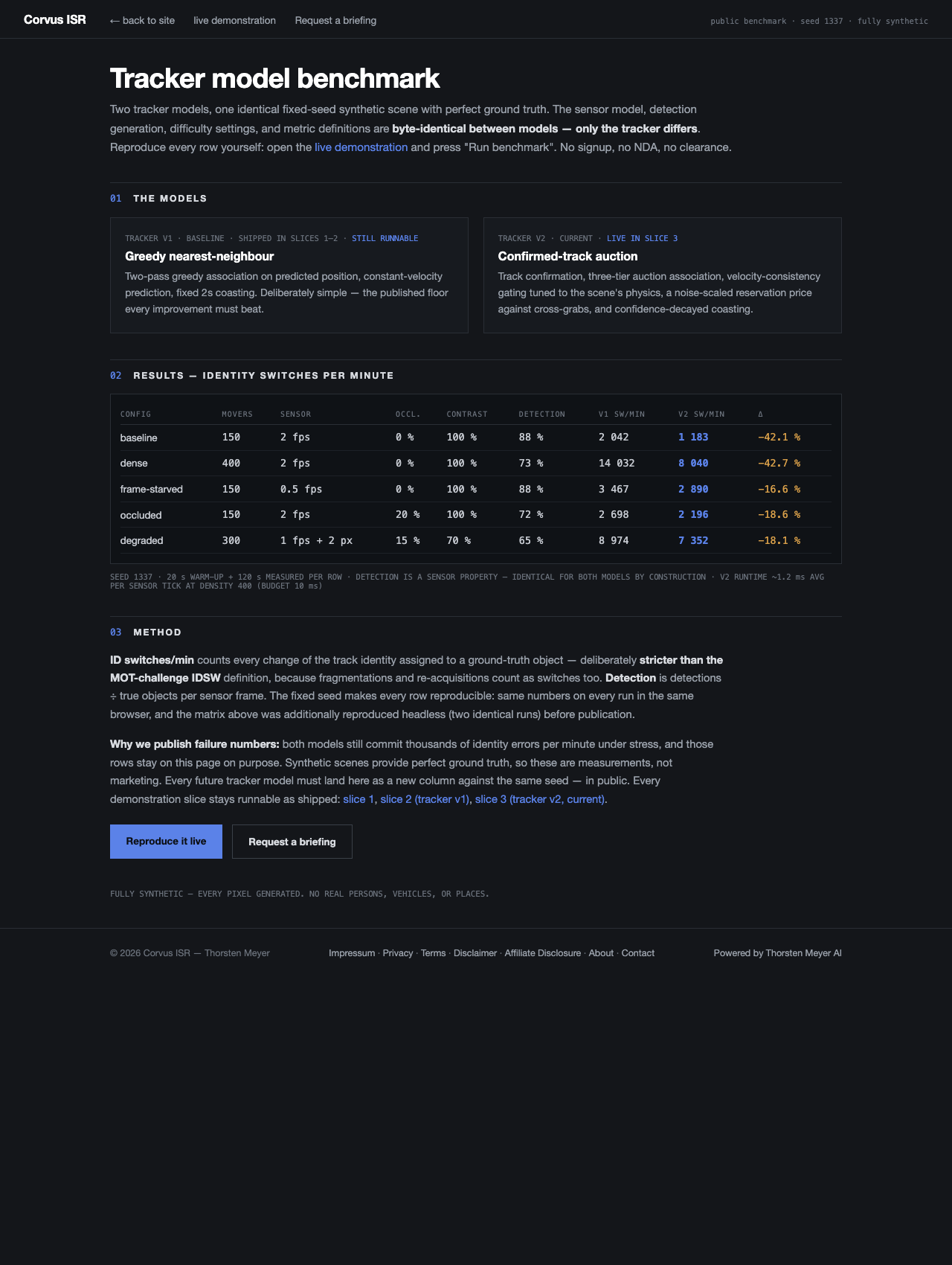
The two models tested are the v1 ‘greedy nearest-neighbour’ baseline, and the v2 ‘confirmed-track auction’ model currently showcased in demo slice 3. The v1 model uses a simple two-pass greedy association, velocity prediction, and fixed 2-second coasting—serving as the published performance floor. Meanwhile, the v2 model employs a more sophisticated three-tier auction association, velocity-consistency gating, and confidence-decayed coasting, demonstrating significant improvements in identity tracking accuracy.
Results reveal that, for a scenario with 150 movers at 2fps, ID switches per minute dropped from 2,042 to 1,183—an improvement of over 42%. In denser scenes with 400 movers, the reduction was similar, from 14,032 to 8,040 switches. These figures are meticulously documented on the site, reinforcing that every future tracker must be evaluated against a public benchmark with identical conditions. The published metrics include stress tests like occlusion, low frame-rate, and degraded visual conditions, illustrating that even state-of-the-art models still commit thousands of identity errors per minute under challenging scenarios.
In a move emphasizing scientific transparency, Corvus ISR publishes these failure numbers intentionally. Synthetic scenes with perfect ground truth enable precise measurement of errors such as fragmentations and re-acquisitions—counted as identity switches by the strictest standards—providing a truthful picture of tracker robustness. This openness contrasts with marketing claims that often highlight only successes, fostering a culture of measurement-driven development.
From an engineering perspective, the v2 model averages about 1.2 milliseconds per sensor tick at the maximum scene density of 400 movers, comfortably meeting real-time processing constraints. The entire benchmarking process is accessible via the live demo, where anyone can reproduce the matrix by clicking ‘Run benchmark’—no signup or NDA required. This demonstrates that the methodology is open and verifiable, ensuring that results are not just claims but reproducible facts.
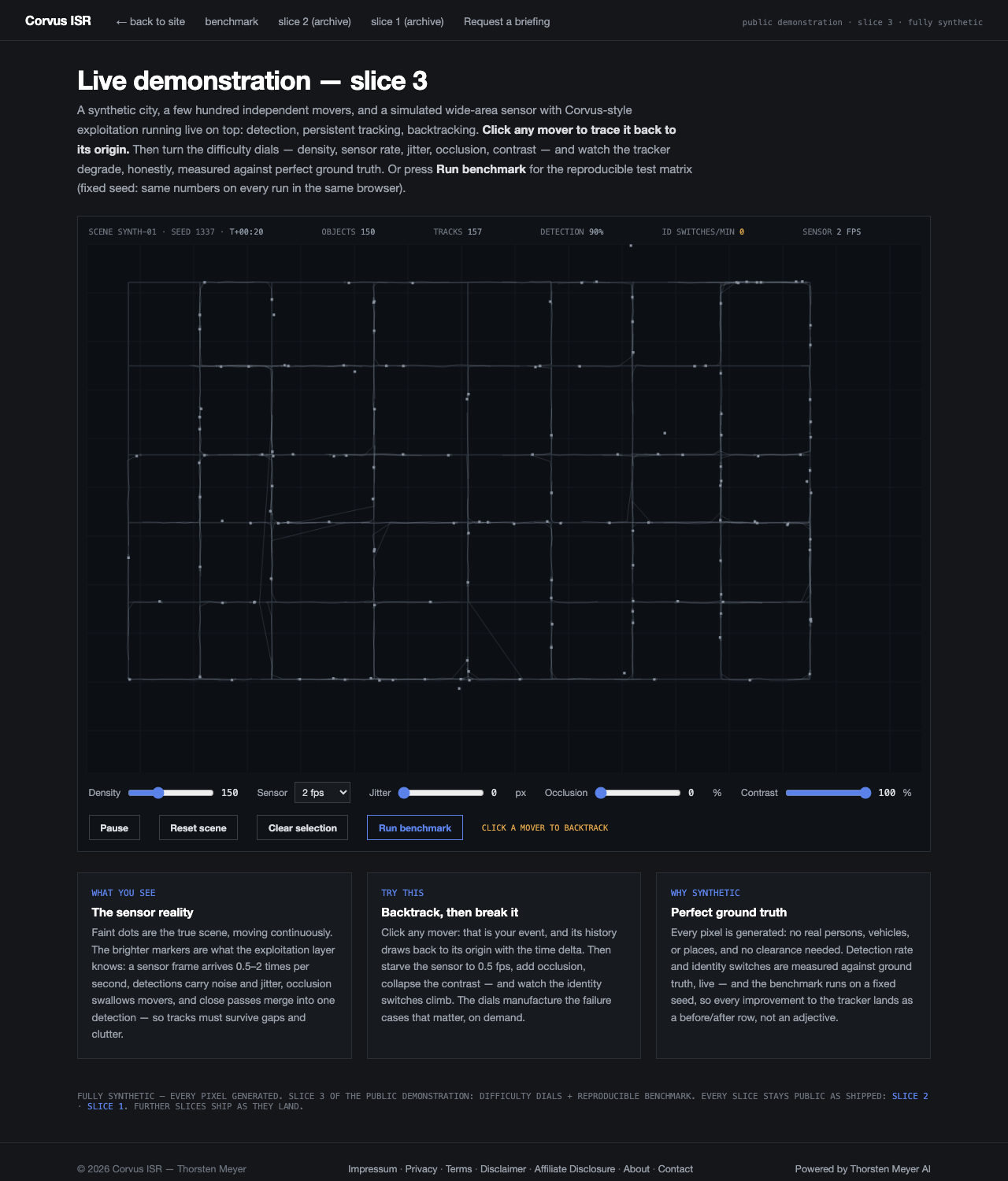
Because every pixel in these synthetic scenes is generated, there are no real-world variables like human intervention or weather effects, making the ground truth perfectly reliable. Researchers in science and education can thus analyze the methodology behind these metrics, understanding why testing against a fixed-seed synthetic environment
is crucial for benchmarking consistency. Such rigor helps advance the field by providing a clear standard for future development, grounded in transparent and reproducible measurement.
Ultimately, Corvus ISR invites curious minds and professionals alike to explore the public benchmark and see firsthand how their own models perform. By doing so, they can contribute to a more honest and scientific approach to tracking technology, ensuring that progress is measured, not just marketed.
wide-area motion imagery (WAMI) surveillance camera
As an affiliate, we earn on qualifying purchases.
As an affiliate, we earn on qualifying purchases.
Halloween Picks
halloween
As an affiliate, we earn on qualifying purchases.