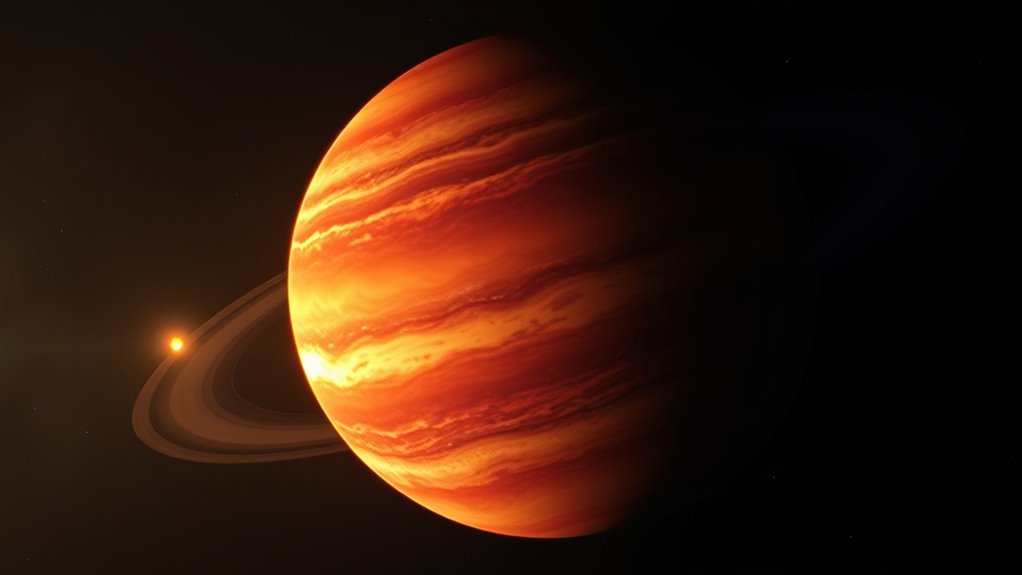

In 2025, new exoplanets have been revealed thanks to advances in detection and atmospheric analysis. Space telescopes now find smaller, Earth-sized planets, especially those in habitable zones where liquid water could exist. Scientists analyze atmospheres for water vapor and greenhouse gases, helping identify potential life-supporting worlds. These discoveries bring us closer to understanding extraterrestrial habitability. If you keep exploring, you’ll uncover more about these fascinating new worlds and what makes them special.
Key Takeaways
- Several Earth-sized exoplanets within habitable zones have been confirmed using advanced transit and radial velocity methods.
- Atmospheric spectroscopy has identified water vapor and greenhouse gases, indicating potential habitability.
- Direct imaging techniques have unveiled new exoplanetary systems, enhancing understanding of planetary environments.
- Improved detection sensitivity has led to discoveries of smaller, more Earth-like worlds beyond previous capabilities.
- These findings significantly advance the search for extraterrestrial life-supporting planets in 2025.

In 2025, astronomers made groundbreaking strides in exoplanet discovery, revealing dozens of new worlds beyond our solar system. This year marked a significant leap forward in understanding these distant planets, thanks to advanced detection techniques and a deeper focus on habitability factors. As you follow these discoveries, you’ll see how scientists are using innovative methods to identify planets that might support life, moving beyond just cataloging celestial objects to evaluating their potential to host life.
The key to these discoveries lies in the refined detection techniques now available. Traditional methods like the transit method—monitoring dips in star brightness when a planet crosses in front—have become more precise with newer space telescopes. Instruments equipped with ultra-sensitive photometers can detect even tiny fluctuations in starlight, allowing astronomers to find smaller planets closer to Earth-sized dimensions. Radial velocity measurements, which observe the subtle wobble of stars caused by orbiting planets, have also improved, helping scientists confirm planetary candidates with higher confidence. Combining these techniques, along with direct imaging advancements, enables a more all-encompassing view of exoplanetary systems.
Understanding habitability factors plays an essential role in selecting planets worth studying further. This year, researchers paid close attention to planets located within their star’s habitable zone—the region where conditions might allow liquid water to exist. They analyzed the planets’ atmospheres for signs of water vapor, greenhouse gases, or other indicators that suggest potential habitability. Factors like planet size, composition, and atmospheric stability are now scrutinized more carefully, helping differentiate worlds that might support life from those that are barren.
Scientists analyze habitable zone planets’ atmospheres for water vapor and greenhouse gases to identify potential life-supporting worlds.
You’ll also notice that the focus isn’t solely on discovering new planets but on understanding their environments. The presence of atmospheres, surface conditions, and the planet’s distance from its star are all considered. These habitability factors shape the search for worlds that could resemble Earth or other life-supporting planets. Scientists are increasingly employing atmospheric spectroscopy, a detection technique that examines the light passing through a planet’s atmosphere during transit, revealing its chemical makeup. This method is pivotal in identifying planets with the right conditions for life.
Top picks for "exoplanet discovery world"
Open Amazon search results for this keyword.
As an affiliate, we earn on qualifying purchases.
Frequently Asked Questions
What Tools Were Most Effective in Discovering These Exoplanets?
You relied on instruments with high precision, like advanced spectrometers and space telescopes, which allowed you to detect tiny signals indicating exoplanets. Precise instrument calibration enhances your measurement accuracy, making discoveries more reliable. Data analysis also played a key role; by carefully interpreting the signals and filtering out noise, you could identify exoplanet signatures more effectively. Together, these tools considerably improved your ability to uncover new worlds.
How Do These Discoveries Impact Our Understanding of Planetary Formation?
You’ll find that these discoveries profoundly deepen your understanding of planetary formation, especially how planetary evolution is influenced by stellar interactions. For example, over 40% of newly found exoplanets show signs of migration caused by star-planet gravitational forces. This highlights that stellar interactions play an essential role in shaping planetary systems, revealing that planets don’t form in isolation but evolve dynamically through complex interactions with their host stars.
Are Any of the New Exoplanets Potentially Habitable?
Some of the newly discovered exoplanets show promising habitability prospects, especially those located in their star’s habitable zone. You should focus on their atmospheres and surface conditions, as these factors influence biosignature potential. While definitive signs of life haven’t been confirmed yet, these planets are compelling targets for future research, increasing your chances of finding worlds that could support life as we understand it.
What Challenges Did Scientists Face During These Discoveries?
You faced significant challenges during these discoveries, especially with technological limitations that hindered precise observations. Only about 10% of detected exoplanets can be studied in detail due to data interpretation difficulties. These obstacles slow down confirming habitability and understanding atmospheric conditions. Overcoming them requires advancements in telescope sensitivity, data processing, and analytical techniques, making it a complex but exciting journey toward uncovering new, potentially habitable worlds.
How Will These Findings Influence Future Space Exploration Missions?
Your discoveries will profoundly influence future space exploration missions by guiding efforts toward interstellar travel and the search for alien life. These findings inspire new technologies for faster travel and better detection methods. As you explore these worlds, you’ll develop strategies to overcome obstacles, increase chances of finding extraterrestrial life, and expand humanity’s understanding of the universe. Ultimately, they’ll shape the path toward discovering new civilizations and expanding our cosmic horizons.
Conclusion
This year’s exoplanet discoveries are like opening a treasure chest of new worlds, each one more fascinating than the last. As you follow these cosmic adventures, remember that you’re exploring the universe’s greatest mysteries firsthand. With every new planet uncovered, the universe feels closer—and more alive—than ever. Keep your eyes on the stars, because 2025 is shaping up to be a landmark year in our journey to understand the cosmos.