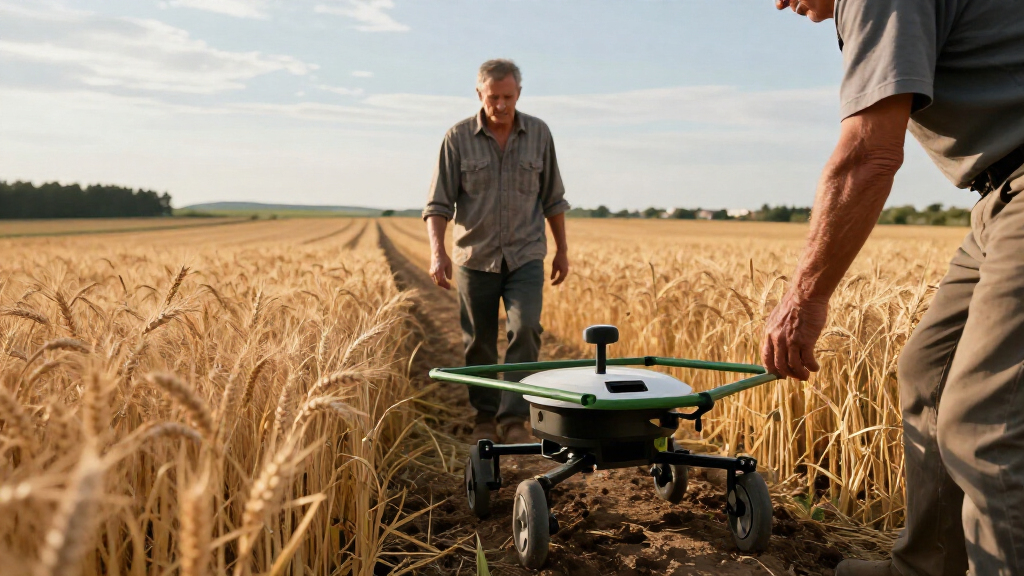
🔍 Read the full analysis: AI And The Long Journey From Fields To Machines on ThorstenMeyerAI.com

Prime made for students and young adults
- Fast, free delivery for dorm and study essentials
- Prime Video and Amazon Music included
- Member-only deals
TL;DR
A November 3 article from ThorstenMeyerAI.com uses agriculture to examine how technology can sharply reduce the share of workers needed in a sector. The historical account describes changes in tools, fertilizer and crop breeding, while noting that 928 million people still work in agriculture worldwide and that further automation forecasts are the author’s thesis, not an established fact.
A November 3 article on ThorstenMeyerAI.com examines how agricultural work declined from about 73.7% of the U.S. labor force in 1800 to roughly 1.5% today, as technology and farming practices raised output. The account uses agriculture as a historical case study for debates about automation, while stressing that the change unfolded over generations and that 928 million people worldwide still work in agriculture, according to the International Labour Organization’s 2025 estimate.
The article, part of the series Work After Work, draws on historical estimates to compare farming’s share of employment across countries. It cites economic historian Stanley Lebergott’s estimate, published by the U.S. Census Bureau, that 1.4 million of 1.9 million U.S. workers aged 10 and older worked in agriculture in 1800. The figure includes about 530,000 enslaved people; the article notes that figures before 1840 are estimates rather than census counts. Its central point is that the agricultural workforce share declined over time, not in a single sudden shift.
The account describes successive changes in tools, crop varieties and fertilizer. Deere & Company’s history dates a steel plough made by blacksmith John Deere to 1837. In the 1960s, breeders associated with Norman Borlaug’s work introduced short-straw wheat varieties in India and Pakistan; the Nobel Foundation says these plants could support more grain without falling over, particularly with irrigation and fertilizer. India’s official figures cited in the article put wheat production at 12.3 million tonnes in 1964–65 and 26.4 million tonnes in 1971–72.
It also points to synthetic ammonia as a source of nitrogen fertilizer. Fritz Haber filed a patent for synthesizing ammonia in 1908, and an industrial ammonia plant began operating in 1913, according to the article’s cited historical material. These developments helped change how much food could be produced without a comparable increase in agricultural labor. The article reports that global cereal production grew 4.2-fold from 1961, while the world population grew 2.7-fold over the same period, and cites U.S. farm output in 2023 as nearly three times its 1948 level.
How Farming Changed the Labor Equation
The historical record matters because it separates two outcomes often treated as the same: fewer people working in a sector and less of what that sector produces. The article’s figures suggest agriculture has produced more food with a much smaller share of workers, challenging the claim that fewer farmers necessarily mean less food. They do not, by themselves, establish that every sector can follow the same path or that all workers displaced by technology will find equivalent work.
The change remains uneven across countries. The article cites the ILO’s estimate that 928 million people worked in agriculture in 2025, about one in four workers worldwide. It gives agriculture’s share as 43% of workers in India, compared with about 1.5% in the United States and 1% in Germany. These differences matter for any discussion of automation: the pace and consequences depend on local economies, access to technology and the availability of other employment.
For readers following AI and workplace change, agriculture offers a long historical comparison, not a direct forecast. The shift took roughly two centuries in the United States, according to the article’s framing. The author’s suggestion that automation might eventually affect up to 90% of a sector within a decade or a few decades is explicitly a thesis, not a measured outcome or prediction supported by the historical data alone.
Products Worth Considering

DJI Mic 3 Wireless Microphone Kit (2 Transmitters, 1 Receiver, Charging Case)

Logitech MX Mechanical Wireless Illuminated Keyboard, Tactile Quiet, Graphite

Bose QuietComfort Wireless Noise-Cancelling Over-Ear Headphones, Black
As an affiliate, we earn on qualifying purchases.
From Hand Tools to Higher Yields
In the article’s account, early farming depended heavily on human and animal labor, with hand tools, draft animals and weather limiting how much food a household could grow. That helps explain why agriculture accounted for such large employment shares in historical estimates: food production required many workers, leaving fewer available for other occupations.
The figures vary in quality and definition. For example, the article cites Japanese historians’ reconstruction of an approximately 85% primary-sector share in 1872; that category included farming, forestry and fishing, rather than agriculture alone. Germany’s first official occupational count in 1882 put agriculture and forestry at 43.4% of workers, though the account says women helping on family farms were undercounted. India’s 1951 census put cultivators and agricultural laborers at 69.7% of workers, while China’s 1952 series recorded 83.5% in the primary sector.
The article presents mechanization as a sequence rather than a single invention. Steel ploughs addressed soil conditions; later machinery changed harvesting and field work; improved crop varieties and synthetic fertilizer increased potential yields. Its examples show why attributing the transformation to one technology would oversimplify a process involving tools, science, infrastructure and changing economies.
“The share fell long before the headcount.”
— Thorsten Meyer, article author
Limits of the Historical Comparison
The article does not establish that AI will reproduce agriculture’s employment trajectory in other sectors. Farming’s changes took place over a long period and involved several technologies and economic shifts; the proposed possibility of automation affecting up to 90% of a sector is the author’s thesis, with no specific sector, measurement method or underlying forecast detailed in the supplied material.
Some historical figures are estimates, not direct counts, and the categories differ between sources. The early U.S. labor-force figures include people aged 10 and older and enslaved workers; cross-country statistics may refer to primary-sector employment rather than farming alone. The article also does not specify how the ILO’s 2025 global total defines agricultural work or break down the figure by job type.
Higher output does not answer every question about workers’ outcomes. The material does not quantify how people leaving agriculture moved into other work, how wages or working conditions changed, or who benefited from productivity gains. Those details are necessary to judge the broader effects of automation beyond food production.
The Series Turns to Factory Work
The article identifies itself as the second episode of Work After Work, a series about how the economy is built. It says the next episode will cover mechanical reapers, threshers and tractors, extending the account of how machinery changed farm labor.
For the wider automation argument, the next useful test is whether comparable evidence can be assembled for other sectors: employment shares over time, total output, productivity, and what happened to workers who left. The article offers agriculture as a case study, but its account does not yet show whether the same relationship between technology, employment and output applies elsewhere.
Key Questions
What is the article’s main point about farming and automation?
It argues that agriculture shows how a sector can produce more while employing a much smaller share of workers. Meyer presents this as a historical comparison for discussions of automation, not proof that other sectors will follow the same path.
How many people still work in agriculture worldwide?
The article cites an ILO estimate of 928 million people in 2025, roughly one in four workers worldwide. The supplied material does not provide a detailed breakdown by occupation or country beyond selected national shares.
Which developments does the article link to rising farm output?
It describes improved tools such as steel ploughs, later agricultural machinery, short-straw wheat varieties and synthetic ammonia fertilizer. The article treats these as parts of a gradual, multi-step change rather than a single cause.
Does the article establish that AI will eliminate most jobs in a sector?
No. The suggestion that automation could affect up to 90% of a sector within a decade or a few decades is identified by Meyer as a thesis, not a fact. The article’s historical evidence concerns agriculture and does not establish an AI employment forecast.
Source: ThorstenMeyerAI.com