
TL;DR

Prime made for students and young adults
- Fast, free delivery for dorm and study essentials
- Prime Video and Amazon Music included
- Member-only deals
ERMIS-3, an 8U CubeSat developed by the University of Athens, has established an optical communications link with Greece’s Holomondas ground station. The ESA-supported demonstration tested precise pointing, acquisition and tracking, a key challenge for laser links between fast-moving small satellites and Earth.
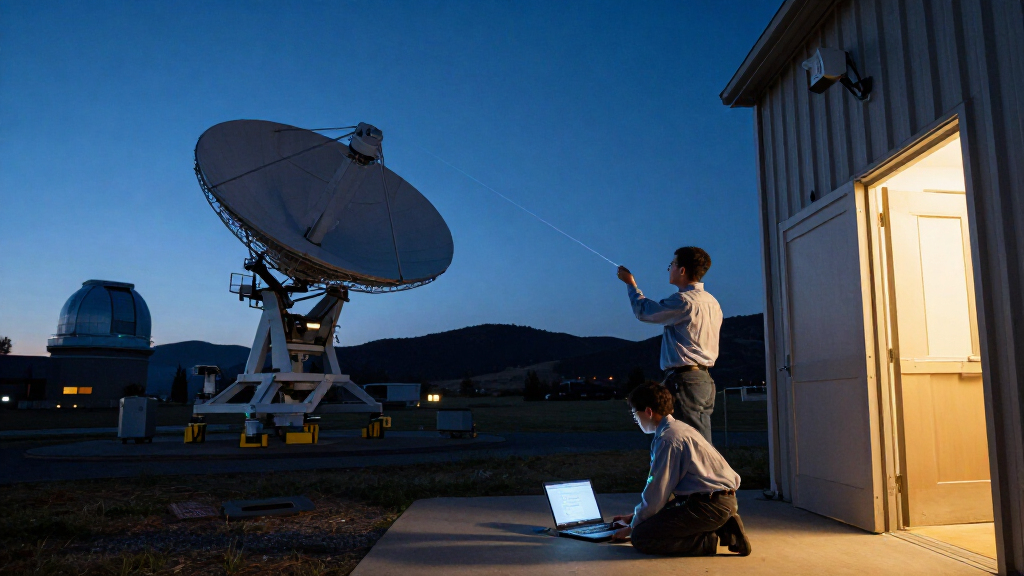
ERMIS-3, an 8U CubeSat developed by the National and Kapodistrian University of Athens, has established a laser communications link with the Holomondas Optical Ground Station in Greece, according to the European Space Agency. The demonstration, supported by ESA and carried out with terminals developed by Lithuanian company Astrolight, marks Greece’s first optical link with a low Earth orbit satellite.
The link connected ERMIS-3’s ATLAS-1 optical terminal with a terminal at Holomondas, also known as HolOGS-1. The ground station was developed by the Aristotle University of Thessaloniki. ESA said the satellite established the connection only weeks after commissioning, demonstrating a central mission objective: precise pointing, acquisition and tracking, known as PAT.
Laser communications can carry data using narrow beams, but the satellite and ground receiver must direct their terminals toward each other and keep tracking during a limited pass. ERMIS-3 is moving through orbit at several kilometres per second, while clouds can block an optical link and atmospheric turbulence can reduce signal quality. The report does not provide a data rate, link duration, or quantity of data transferred during the demonstration.
ESA contributed technical expertise, including environmental testing and optical alignment at its European Space Research and Technology Centre in the Netherlands. ERMIS-3 launched on March 30, 2026, alongside ERMIS-1 and ERMIS-2. The three satellites are part of an in-orbit demonstration programme testing communications technologies for small spacecraft.
Laser Links Could Move More Satellite Data
The demonstration shows that a small satellite can establish an optical link with a ground station, addressing a technical hurdle that must be overcome before laser communications can be used routinely. The narrow-beam connection requires accurate pointing and tracking, and the available contact time is limited by the satellite’s passage over the station.
Optical communications may offer higher data rates than conventional radio-frequency links, according to ESA’s description of the technology. That could help missions send larger volumes of information to Earth, including high-resolution and hyperspectral imagery from Earth-observation satellites. The report, however, does not state that ERMIS-3 achieved a particular rate or compare its performance with a radio link.
The result also brings together a university-built spacecraft, a commercial terminal developer, a Greek ground station and ESA technical support. ESA described the mission as part of efforts to test communications capabilities for small satellites in Europe. The demonstration is a validation step, not by itself evidence that the system is ready for regular operational service.
Products Worth Considering

EcoFlow Delta 3 Portable Power Station – 1024 Wh, 1800 W

Anker SOLIX C300 Portable Power Station, 288Wh

DJI Osmo Mobile 8 3-Axis Gimbal Stabilizer for Phones
As an affiliate, we earn on qualifying purchases.
A Greek Programme in Orbit
ERMIS-3 is part of Greece’s National Space Programme, which ESA implements on behalf of the Greek government. The satellite is an 8U CubeSat developed at the National and Kapodistrian University of Athens. Its communications payload is Astrolight’s ATLAS-1 terminal, paired with equipment at the Holomondas station.
Before launch, ESA supported the project with environmental testing and optical alignment at ESTEC in the Netherlands, according to the agency. The March 2026 launch placed ERMIS-3 in orbit with ERMIS-1 and ERMIS-2 as part of a programme to demonstrate technologies for small satellites. ESA’s report says the optical connection was achieved weeks after ERMIS-3 was commissioned, but does not give the exact date of the link attempt.
The Aristotle University of Thessaloniki developed the Holomondas Optical Ground Station and conducts its operations. ESA identifies the connection as the first successful optical link with a low Earth orbit satellite from Greece. That milestone refers to the link’s origin and ground station; it does not establish how often the link can be repeated or what performance it can sustain.
“Using ATLAS-1 as a laser communications terminal has led to a unique collaboration and the first operations of a laser optical link on the CubeSat.”
— Professor Vaios Lappas and Antonis Paschalis, ERMIS principal investigators
Performance Data Has Not Been Published
ESA’s report confirms that the link was established, but does not disclose the connection’s duration, data rate, error rate, or volume of data transferred. It also does not say whether ERMIS-3 has repeated the link or how the system performs under different weather and atmospheric conditions.
The report describes the demonstration as a validation of precise pointing, acquisition and tracking, but offers no detailed test results or independent performance measurements. It is also unclear what further trials are planned and when the terminal might be used for routine satellite communications. Claims about future capacity or secure communications remain potential applications rather than demonstrated outcomes in this report.
Further Tests Will Show Repeatability
The next useful evidence will be whether ERMIS-3 can establish the link repeatedly and sustain reliable communications across later passes. Further reporting or mission updates could clarify link duration, data throughput and signal quality, as well as the effects of clouds and atmospheric turbulence.
ESA says the satellite belongs to an in-orbit demonstration programme for small-satellite communications. The agency’s report does not announce a date for another test or a final mission review. Until those details are available, the confirmed result is a successful link with Holomondas, rather than a quantified assessment of operational performance.
Key Questions
What did ERMIS-3 achieve?
It established an optical communications link between its Astrolight ATLAS-1 terminal and the Holomondas Optical Ground Station in Greece, according to ESA.
Why is a laser link difficult to establish?
The satellite and ground station must point their terminals accurately at each other and track the connection during a short pass. Cloud cover can block the beam, while atmospheric turbulence can weaken signal quality.
Who developed the satellite and ground station?
The National and Kapodistrian University of Athens developed ERMIS-3, which carries a terminal from Lithuanian company Astrolight. The Aristotle University of Thessaloniki developed the Holomondas ground station.
How fast was the connection?
ESA’s report does not provide a data rate, link duration, or quantity of data transferred. It confirms that a link was established but does not publish detailed performance figures.
What happens after this demonstration?
ERMIS-3 is part of an in-orbit demonstration programme, but ESA has not announced a schedule for further tests. Repeat links and published performance data would help show how reliably the system can operate.
Source: esa.int