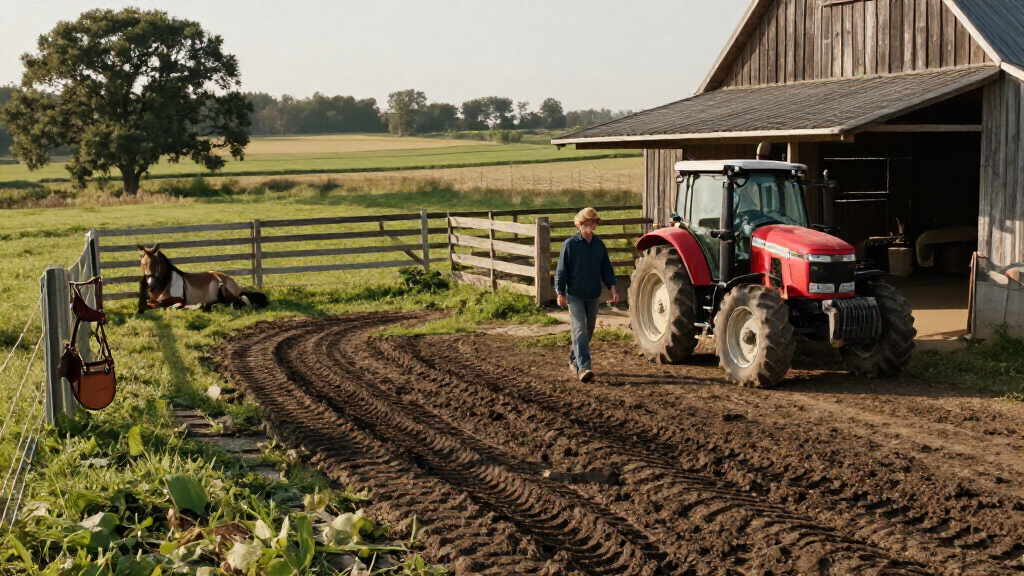

🔍 Read the full analysis: How Tractors Reshaped The Future Of Working Animals on ThorstenMeyerAI.com

Prime made for students and young adults
- Fast, free delivery for dorm and study essentials
- Prime Video and Amazon Music included
- Member-only deals
TL;DR
US farm horses and mules peaked at 26.7 million in 1918, then fell to 3.1 million by 1960 as tractors and other machinery spread. The shift released land previously used to grow animal feed and coincided with a steep decline in farm employment, while the broader economy grew. The historical comparison with automation today is instructive but not a direct forecast for human workers.
A report published November 4, 2026, charts how tractors displaced working horses and mules on US farms: their combined numbers fell from a peak of 26.7 million in 1918 to 3.1 million by 1960. The change released cropland once devoted to animal feed and helped reshape farm work, though the report cautions that the horse-to-tractor story is an analogy—not a reliable rule—for predicting what automation will do to human employment.
Historical estimates cited in the report put the number of horses and mules on US farms at 26.7 million on January 1, 1918, including 21.2 million horses and 5.5 million mules. Horses alone had reached their peak earlier, at 21.4 million in 1915. The animals powered ploughs, seed drills, reapers and wagons, but feeding them also required substantial land: about 93 million acres in 1915, out of 340 million acres of harvested cropland, grew feed for horses and mules.
Tractors were already present before the First World War, but early models were expensive and heavy. The report identifies the Fordson, launched in 1917, as a turning point for smaller farms. The Henry Ford museum describes it as a mass-produced, inexpensive lightweight tractor designed for small farmers. Tractor numbers rose from about 1,000 on US farms in 1910 to 246,000 in 1920 and 4.69 million in 1960. Around 1955, tractors first outnumbered horses and mules, according to the figures cited.
The replacement was part of a wider mechanization of agriculture. Combine harvesters, which cut, threshed and cleaned grain in one pass, increased from about 4,000 on US farms in 1920 to 1.042 million in 1960. By 1960, the farm horse and mule count had fallen to 3.1 million, almost 90% below its 1918 peak. The report says farmers generally did not retrain the animals; they stopped breeding replacements and the working population declined over time.
Land and Labor After the Tractor
The change involved more than replacing one source of power with another. By 1960, the area used to grow feed for farm horses and mules had fallen to about 5 million acres, compared with 93 million acres in 1915. That land could instead grow crops for people or sale. The tractor also did not work alone: combines, corn pickers, balers, milking machines, improved seed and fertilizer contributed to rising output.
Farm employment changed alongside productivity. The report cites US farm employment peaking at 13.6 million in 1916 and falling to 4.5 million by 1970, while the overall US labor force doubled. It also cites a Department of Agriculture estimate that one farm worker supplied 47.1 people with farm products in 1970, up from 7.1 in 1910; that measure includes people abroad supplied through exports. The figures show why the transition matters: mechanization transformed both the amount of land and labor needed to produce food and the places where people worked.
Products Worth Considering

DJI Osmo Mobile 7P Smartphone Gimbal Stabilizer with Mic Mini Transmitter, Infinity Black

Apple AirPods Pro 3 Wireless Earbuds with Active Noise Cancellation

Logitech MX Brio Ultra HD 4K Webcam, Graphite
As an affiliate, we earn on qualifying purchases.
From Animal Power to Machines
The shift unfolded over decades rather than in a single moment. Tractors on US farms rose to 920,000 by 1930, 1.57 million by 1940 and 3.39 million by 1950, while horses and mules declined to 19.1 million, 14.6 million and 7.8 million at those respective points. Around 1955, the counts crossed, with 4.35 million tractors and 4.31 million horses and mules.
The historical figures have some limits. Tractor counts for several census years were taken on dates that differed slightly, and the Department of Agriculture counted horses and mules together from 1951. The estimates cited come from the US Census Bureau’s Historical Statistics of the United States, Colonial Times to 1970, which reprinted Agriculture Department data. They describe a long-running change, not a precise record of every farm’s experience.
The report connects that history to current automation debates, including a 1983 comparison by economist Wassily Leontief between workers and horses replaced by tractors. It also points to present-day farm technology: John Deere’s 16-camera autonomy kit, described as announced in February 2025, performs tillage on selected large tractors. China has said about 74% of ploughing, sowing and harvesting was mechanized in 2023. These are examples of current technology and a reported national measure, not evidence that all farm tasks are autonomous.
“The Fordson was “the first mass-produced and inexpensive lightweight tractor.””
— The Henry Ford museum, as quoted in the report
Limits of the Automation Comparison
The historical counts document the decline in farm horses and mules, but they do not establish that automation will affect people in the same way. The report itself notes the political and social difference between animals and human workers; people can vote, organize and move between occupations. The figures on falling farm employment also do not, by themselves, show how much of that decline was caused by tractors rather than other changes in farming and the wider economy.
The present-day examples are narrower than a fully automated farm. The report says John Deere’s camera-based kit handles tillage on selected large tractors, but it does not provide details on the number of farms using it or its effect on employment. The cited 74% mechanization figure for China is attributed to the country, and the report does not specify how that measure was calculated. The future pace and reach of farm automation remain uncertain.
How Farm Automation Develops
The report describes current farm robots as real but limited in scope. The next useful evidence will be how widely autonomous equipment is adopted, which tasks it can perform reliably, and whether farms use it alongside or instead of human labor. More information on deployment, costs and workforce effects would help distinguish a technology demonstration from a broader change in agricultural work.
For the historical comparison, the key question is not whether human workers are “the next horses,” but which parts of the past are relevant: machines can raise output and reduce demand for some work, while new roles and industries may emerge elsewhere. The report offers the horse economy as a case to examine, not a prediction that settles how modern automation will affect jobs.
Key Questions
When did tractors first outnumber horses and mules on US farms?
They crossed around 1955, when the figures cited in the report show 4.35 million tractors and 4.31 million horses and mules.
How many farm horses and mules were there at the peak?
The combined total peaked at 26.7 million on January 1, 1918, according to historical estimates cited in the report.
What happened to the working horses and mules?
The report says farmers generally stopped breeding replacements. As the animals aged, the working population declined; the source does not describe a single mass event.
Does the history prove that automation will eliminate human jobs?
No. The report presents the horse economy as an analogy, not a law. Its employment figures show a major decline in farm work during a period of mechanization, but they do not establish that tractors alone caused the change or predict the effects of automation on workers today.
Source: ThorstenMeyerAI.com