
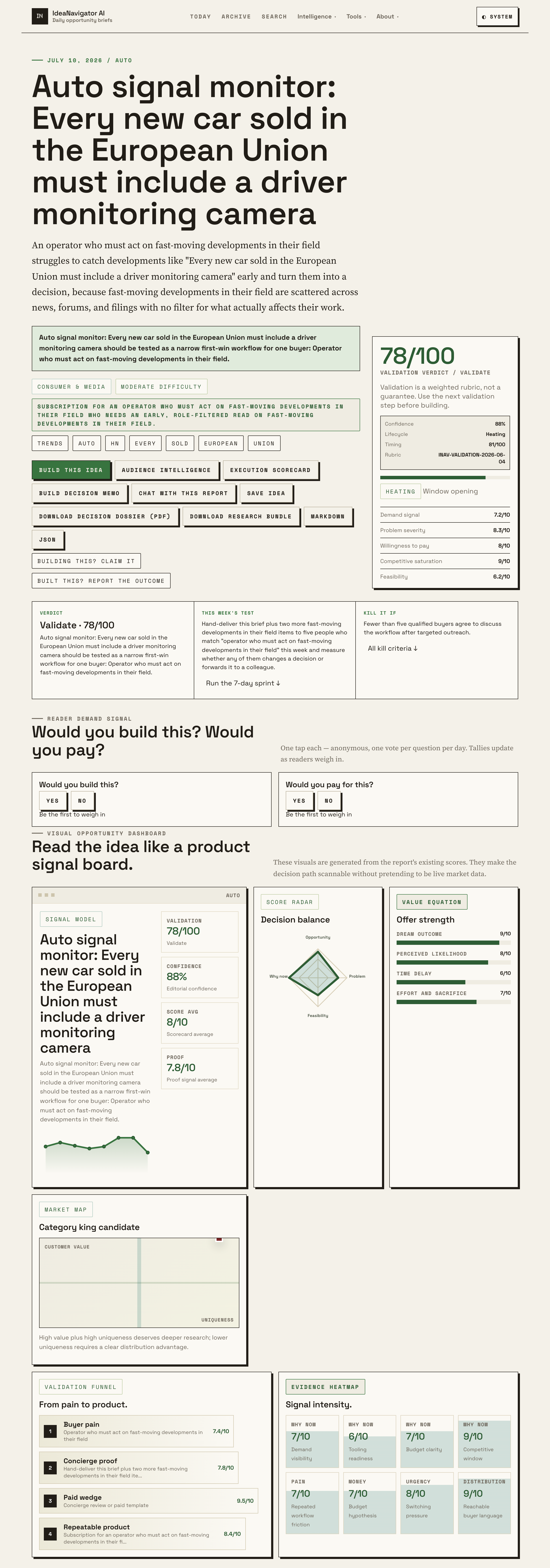
📊 Full opportunity report: How EU Regulations Made Driver Monitoring Cameras Mandatory In New Cars on IdeaNavigator AI — validation score, market gap, and execution plan.

Prime made for students and young adults
- Fast, free delivery for dorm and study essentials
- Prime Video and Amazon Music included
- Member-only deals
TL;DR
European Union safety rules now require new cars sold in the bloc to include driver monitoring systems, with cameras as the most common implementation. The mandate stems from EU road safety policy and affects every automaker selling in Europe.
Every new car sold in the European Union must now include a driver monitoring system, a requirement that has made camera-based technology watching the driver a standard component of new vehicles across the bloc, according to a development brief surfaced by IdeaNavigator AI. The mandate is the product of EU road safety legislation and applies to automakers selling into the European market, marking one of the most visible changes to new car interiors in years.
The requirement flows from the EU’s General Safety Regulation, a package of vehicle safety rules that made a range of driver assistance technologies mandatory on new cars. Among them is a driver drowsiness and attention warning system, which must detect signs of fatigue or distraction and alert the driver. While the regulation sets a performance requirement rather than dictating a specific sensor, driver-facing cameras have become the dominant way automakers meet it, because cameras can track eye movement, eyelid closure, and head position in real time.
According to the brief compiled by IdeaNavigator AI, the core development is that “every new car sold in the European Union must include a driver monitoring camera.” The item was flagged with an 88/100 signal score on Hacker News, indicating strong community attention to the regulatory change. For drivers, the practical effect is that a camera pointed at the driver’s face is now a normal feature of the European new car market rather than an optional extra bundled with premium packages.
The systems are designed to intervene when a driver appears drowsy or distracted, issuing visual and audible warnings. Proponents of the technology, including European road safety agencies, argue that driver inattention is a leading contributor to collisions and that automated warnings can reduce fatigue-related crashes. Privacy advocates have raised concerns about what the cameras record, how long data is stored, and who can access it — questions automakers have answered with varying data retention and processing policies, often processing video on-board rather than transmitting it.
What the Mandate Changes for Drivers and Carmakers
For drivers, the mandate means the cabin of a new European car now includes a sensor watching the person behind the wheel. The system’s stated purpose is safety: detecting drowsiness and distraction before they contribute to a crash. For automakers, the requirement adds cost and engineering work to every vehicle sold in the EU, and it effectively standardises a technology that was previously a differentiating feature, particularly in vehicles with advanced partial-automation systems where monitoring the driver’s engagement is a prerequisite for allowing the system to operate.
The change also has competitive and regulatory ripple effects. Because the EU is one of the world’s largest car markets, suppliers and manufacturers often design to the strictest applicable standard, meaning EU rules frequently shape vehicles sold elsewhere. At the same time, the mandate feeds an ongoing debate about in-cabin data privacy, since a camera that watches the driver collects highly personal information by default. How manufacturers handle that data varies and is not uniformly regulated beyond existing EU data protection law.
How the EU Requirement Came Into Force
The driver monitoring requirement is part of a broader wave of EU vehicle safety rulemaking. The General Safety Regulation, adopted in 2019, introduced a package of mandatory safety technologies for new vehicles, including intelligent speed assistance, lane keeping assistance, emergency braking, and driver drowsiness and attention warning. The rules were phased in over subsequent years, applying to new type approvals first and then to all new vehicles sold in the bloc.
The underlying policy goal, stated by EU institutions, is a reduction in road deaths and serious injuries, aligned with the EU’s longer-term road safety targets. Driver inattention and fatigue have been identified by European road safety bodies as major contributors to collisions, which is the rationale given for mandating warning systems. Camera-based monitoring had already appeared in cars with partial-autonomy features — where regulators and manufacturers agreed a human must remain engaged — before the EU extended the expectation to the broader new car fleet.
Open Questions on Data and Enforcement
Several aspects of the rollout remain unclear or unsettled. It is not uniformly documented how each automaker’s system stores, processes, or deletes driver-facing video, and practices vary between manufacturers. The extent to which authorities can access footage — for example, after a crash investigation — differs by jurisdiction and is still being tested in practice.
It is also not yet clear how effective the warnings are at actually reducing fatigue- and distraction-related collisions; systematic, independent evaluations of the mandated systems in real-world fleets are still limited. Finally, enforcement details — how regulators verify that a given system meets the required performance standard, and how non-compliance is penalised — continue to develop as the rules bed in.
Where Driver Monitoring Goes From Here
Expect the technology to become more capable and more debated. Automakers and suppliers are likely to extend camera-based systems toward more advanced occupant sensing — detecting children left in cars, adjusting airbag deployment, and supporting higher levels of automation — building on the installed base the mandate creates. European regulators, meanwhile, are expected to keep refining technical standards and data handling expectations as experience with the systems accumulates.
For privacy advocates and consumer groups, the next phase is likely to focus on transparency: clear disclosure of what in-cabin cameras record and retention rules. Independent safety bodies may publish real-world effectiveness studies as data becomes available. Readers can expect continued regulatory activity in this space rather than a single settled endpoint.
Source: IdeaNavigator AI
Key Questions
Do all new cars in the EU literally have a driver-facing camera?
The EU mandate requires a driver drowsiness and attention warning system. Camera-based monitoring is the most common way automakers meet that requirement, so the vast majority of new cars use a driver-facing camera, though the regulation is written around performance rather than mandating one specific sensor type.
What does the driver monitoring system actually do?
It watches for signs of fatigue and distraction — such as eyelid closure, gaze direction, and head position — and issues visual and audible warnings when it detects that the driver is drowsy or not paying attention.
Is the camera footage stored or shared?
Practices vary by manufacturer. Many systems process video on-board in real time without storing it, but retention and access policies are not uniform, and it is not always clearly documented — a point of ongoing privacy debate.
Does this apply to cars sold outside the EU?
The requirement applies to cars sold in the European Union. However, because the EU is a major market, manufacturers often design to EU standards globally, so similar systems are appearing in vehicles sold elsewhere.
Why did the EU make this mandatory?
European road safety bodies have identified driver inattention and fatigue as major contributors to collisions. The mandate is part of the EU’s General Safety Regulation package, which introduced a range of mandatory safety technologies intended to reduce road deaths and serious injuries.
Source: IdeaNavigator AI
Fall Picks
fall essentials
As an affiliate, we earn on qualifying purchases.