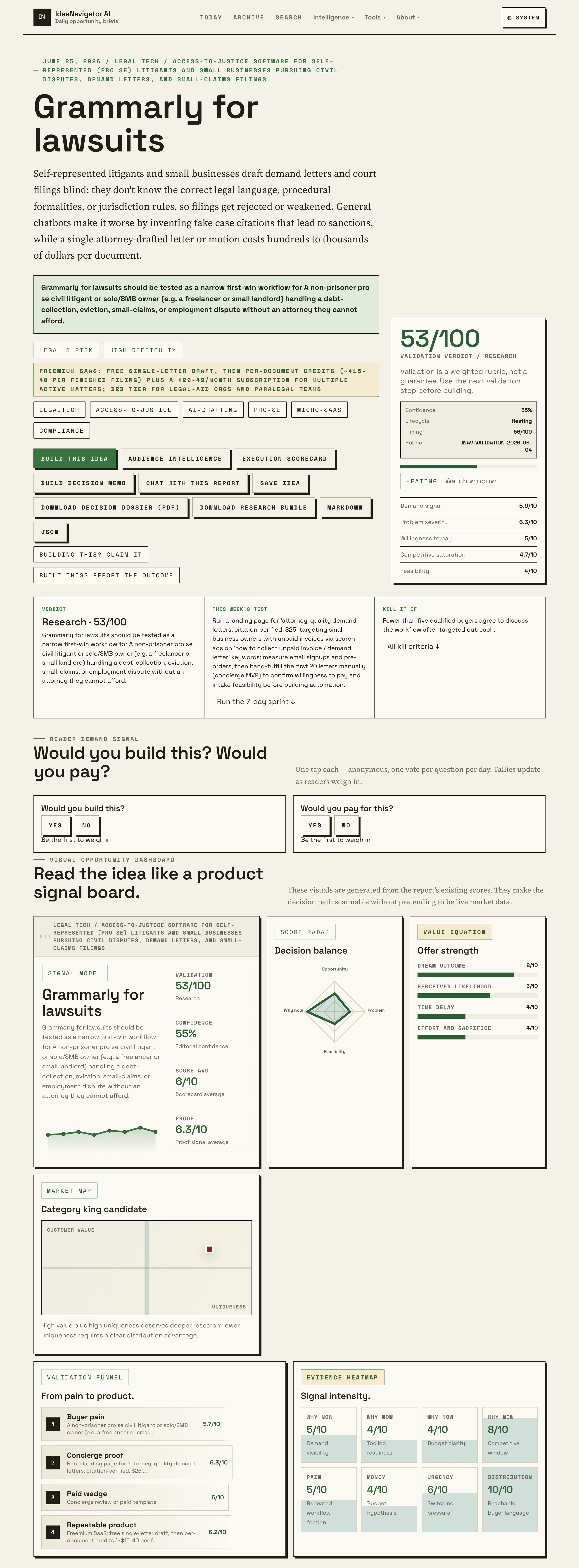
📊 Full opportunity report: Access To Justice Tech: Grammarly As A Self-Help Legal Tool on IdeaNavigator AI — validation score, market gap, and execution plan.
TL;DR
A startup is developing an AI-based web app that functions like Grammarly for legal filings, aimed at helping self-represented litigants and small businesses draft court documents with verified citations. This innovation seeks to address the high error rate and lack of legal expertise among pro se filers, potentially transforming access to justice.
A new AI-powered drafting tool, inspired by Grammarly, is being developed to assist non-lawyer litigants and small business owners in creating court filings with verified legal citations. This innovation aims to improve the quality and accuracy of self-prepared legal documents, addressing a critical gap in access to justice for those who cannot afford legal representation.
The project focuses on a web application tailored to small-business owners, landlords, and individual litigants handling civil disputes such as debt collection, eviction notices, or small claims. Users input relevant case details through a structured form, and the app generates a court-appropriate demand letter or filing. It then performs a ‘lawsuit Grammarly’ check, flagging weak legal language, missing procedural elements, and verifying every citation against a real legal database to prevent hallucinated or incorrect references.
According to sources involved in the project, the tool is designed to mitigate the high rate of citation errors and procedural mistakes made by self-represented parties, which often lead to case rejection or sanctions. The developers aim to create a solution that offers attorney-quality drafting at a fraction of the cost, with a freemium model: a free initial draft and paid options for multiple or complex filings. The initial MVP will focus on demand letters and small-claims statements, with plans to expand to other civil filings as the system matures.
Legal tech experts highlight the importance of citation verification and procedural accuracy, especially given recent data showing that about 39% more hallucination incidents occur with pro se litigants than with attorneys. As courts grapple with an influx of self-represented parties, such tools could provide a critical support layer, reducing errors and improving case outcomes.
Why Verified Legal Drafting Matters for Access to Justice
This innovation could significantly improve access to justice by enabling non-lawyers to produce more accurate, legally sound court documents without expensive legal assistance. By reducing citation errors and procedural mistakes, the tool has the potential to lower rejection rates and sanctions, making civil litigation more accessible and affordable for individuals and small businesses.
It also addresses a growing problem: the widespread use of large language models that generate hallucinated citations, which have flooded courts with inaccuracies. A verification-first approach, as proposed by this project, could set a new standard for AI-assisted legal drafting, emphasizing accuracy and compliance with court rules. If successful, this approach could be adopted broadly, helping millions of Americans who currently navigate civil disputes without legal representation.
As an affiliate, we earn on qualifying purchases.
Background on Self-Representation and Legal Tech Gaps
Roughly 60% of civil cases in the U.S. now involve parties representing themselves, according to recent studies. Despite this, many lack access to affordable legal assistance, leading to a reliance on DIY legal documents that often contain errors. The rise of generative AI tools has created both opportunities and risks: while they can streamline document drafting, many current models produce hallucinated or inaccurate citations, which can jeopardize cases and lead to sanctions.
In response, legal tech developers are exploring ways to integrate verification layers that cross-check citations and procedural requirements against authoritative legal databases. The proposed Grammarly-like tool aims to fill this gap by providing real-time feedback and citation verification, tailored specifically for civil filings by non-lawyers.
This initiative comes amid growing awareness of the need for accessible, reliable legal aid solutions outside traditional law firms. The development aligns with broader efforts to leverage AI for improving access to justice, especially for underserved populations.
“The key challenge is ensuring that AI-generated legal documents are both accurate and compliant with court standards. Our approach emphasizes verification before presentation.”
— an anonymous researcher
Unanswered Questions About System Reliability and Adoption
It is not yet clear how effectively the verification process will prevent hallucinated citations in real-world use, or how courts will respond to AI-generated filings verified by this tool. The scalability and user adoption rate remain uncertain, as the project is still in early testing phases.
Further, the impact on court procedures and whether legal professionals will endorse or resist such automation are still unknown. Long-term legal and regulatory implications have yet to be fully assessed.
Next Steps for Development and User Testing
The project plans to launch initial testing of the MVP in late 2024, focusing on demand letters and small-claims filings. Developers will gather user feedback, refine citation verification accuracy, and expand functionalities based on early results. They also aim to run targeted marketing campaigns to gauge demand among small-business owners and individual litigants, measuring pre-orders and signups.
Following successful pilot testing, the team intends to develop automated workflows, integrate with legal databases more deeply, and explore partnerships with legal aid organizations to scale the solution. Broader adoption and potential regulatory approval will be key milestones in the months ahead.
Key Questions
How does the tool verify citations?
The system cross-checks all legal citations against a real legal database to ensure accuracy and prevent hallucinations, flagging any discrepancies for user review.
Is this tool legally recognized or endorsed?
As a development project, it is not yet officially recognized by courts or legal authorities but aims to meet procedural standards and improve document quality for self-represented litigants.
Who can use this tool initially?
The initial target users are small-business owners, landlords, and individuals handling civil disputes like debt collection, eviction, or small claims, who cannot afford legal counsel.
Will the tool replace lawyers?
No, it is designed as a support tool to improve DIY legal filings, not as a substitute for professional legal advice or representation.
How much will it cost to use?
The basic service will be free for a single draft, with paid options for multiple or more complex filings, estimated at $15-40 per document, plus subscription plans for ongoing use.
Source: IdeaNavigator AI