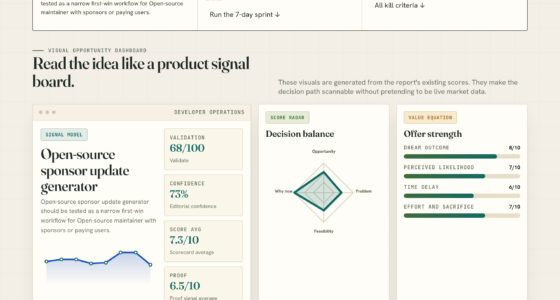

📊 Full opportunity report: When One Agent Isn’t Enough: Claude Now Builds Its Own Team Of Agents On The Fly on ThorstenMeyerAI.com — validation score, market gap, and execution plan.

Prime made for students and young adults
- Fast, free delivery for dorm and study essentials
- Prime Video and Amazon Music included
- Member-only deals
TL;DR
Anthropic’s Claude has launched a new feature allowing it to create and orchestrate its own teams of agents dynamically. This capability aims to improve handling of complex, high-value tasks by overcoming limitations of single-agent workflows.
Anthropic’s Claude has introduced a new feature called dynamic workflows, enabling the AI to build and coordinate its own teams of agents on the fly for complex tasks. This marks a significant development in AI orchestration, aimed at addressing limitations seen in single-agent approaches.
The new capability allows Claude to generate a custom orchestration harness—a small program written in JavaScript—that manages multiple subagents, each with distinct roles and isolated contexts. This enables Claude to perform complex workflows such as dividing tasks, verifying outputs independently, and iterating until completion.
According to Anthropic, this feature is particularly suited for high-value, multi-step projects where single-agent execution often results in failure modes like partial work, self-bias, or goal drift. The system can decide which model to assign to each subtask and whether to run agents in isolated worktrees, allowing for parallel processing and resumption if interrupted.
Claude’s approach involves a set of orchestration patterns—such as classify-and-act, fan-out-and-synthesize, adversarial verification, generate-and-filter, tournament, and loop-until-done—that mirror the methods a skilled human team lead might use to manage complex projects.
When one agent isn’t enough: Claude now builds its own team on the fly
Skills package what you know; loops decide how far you delegate over time. Dynamic workflows are the third axis — within a single task, Claude writes its own harness and assembles a temporary team of subagents. Think of it as Claude drawing an org chart for one job.
The shift is from prompting a worker to commissioning a team — more output, more cost, and a manager’s judgment required. Reach for a workflow when a task is big, parallel, adversarial, or judgment-heavy — and when you can feel a single agent getting lazy, grading its own homework, or losing the plot. Bound it (token budgets, pilot first) — workflows can spawn hundreds of agents and burn far more tokens. For everything else, don’t hire five people to change a lightbulb.
Implications for Complex AI-Driven Workflows
This development enhances AI’s capacity to handle complex, multi-faceted tasks that previously required human oversight or were prone to errors when performed by a single agent. By autonomously creating specialized teams, Claude can improve accuracy, reduce bias, and maintain focus over long or intricate projects.
For organizations, this means more reliable automation in areas like research, verification, code development, and customer support, potentially reducing the need for human intervention in high-value tasks. It also demonstrates a move toward more sophisticated AI orchestration that can adapt dynamically to the demands of each task.
multi-agent AI orchestration tools
As an affiliate, we earn on qualifying purchases.
As an affiliate, we earn on qualifying purchases.
Evolution of AI Workflow Capabilities
Prior to this, AI agents typically operated within a fixed context window, limiting their effectiveness on extended or complex tasks. Anthropic’s previous work introduced the idea of static workflows, but these required manual setup and were less adaptable.
The concept of dynamic workflows builds on earlier advancements in AI orchestration, notably from Anthropic’s Claude Code team, and aligns with broader trends toward autonomous AI management systems. The recent release coincides with the launch of Claude Opus 4.8, which enhances reasoning and planning abilities, enabling Claude to generate its own custom harnesses for specific tasks.
This marks a shift from static, hand-crafted solutions to flexible, self-constructed agent teams, addressing known failure modes and expanding AI’s applicability to high-stakes, multi-step projects.
“Claude’s ability to autonomously generate and coordinate its own teams of agents represents a significant step forward in AI orchestration, especially for complex, high-value tasks.”
— Thorsten Meyer, AI researcher at Anthropic
Unresolved Questions About Deployment and Limitations
It is not yet clear how broadly this feature will be adopted, what specific safeguards will be in place to prevent misuse, or how it performs outside controlled testing environments. The extent of its reliability and efficiency in real-world, large-scale projects remains to be seen.
Further, details about potential limitations, such as token consumption overhead or handling of extremely long or adversarial tasks, are still emerging. The long-term impact on AI safety and control also warrants ongoing monitoring.
Next Steps for Adoption and Evaluation
Anthropic is expected to release more detailed documentation and case studies demonstrating how organizations can implement dynamic workflows in practice. Additionally, testing in real-world scenarios will reveal performance metrics, limitations, and safety considerations.
Further updates may include refinements to the orchestration patterns, expanded capabilities for multi-model coordination, and integration with other AI tools, as the company gathers user feedback and operational data.
Key Questions
How does Claude build its own team of agents?
Claude generates a small JavaScript program, called a harness, that manages multiple subagents, each with specific roles and isolated contexts. It then executes this harness to coordinate the agents during a task.
What types of tasks benefit most from dynamic workflows?
High-value, multi-step, or complex projects such as research synthesis, code refactoring, verification, and multi-agent collaboration are most suited to this approach.
Are there limitations or risks associated with this feature?
Yes, the feature uses more tokens and computational resources, and its reliability outside controlled environments is still being evaluated. Safety and misuse prevention are ongoing concerns.
Will this feature be available to all users?
It is currently in the experimental or controlled rollout phase, with broader availability depending on further testing and validation by Anthropic.
Source: ThorstenMeyerAI.com
Halloween Picks
halloween
As an affiliate, we earn on qualifying purchases.