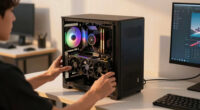
📊 Full opportunity report: Mac vs GPU Tower for Local LLMs: The Heat-and-Noise Tradeoff on ThorstenMeyerAI.com — validation score, market gap, and execution plan.
TL;DR
This article compares Mac Studio with Apple Silicon and GPU towers for running local large language models, focusing on heat, noise, capacity, and performance. Macs are near-silent but limited by model size, while GPU towers offer higher throughput at the cost of heat and noise.
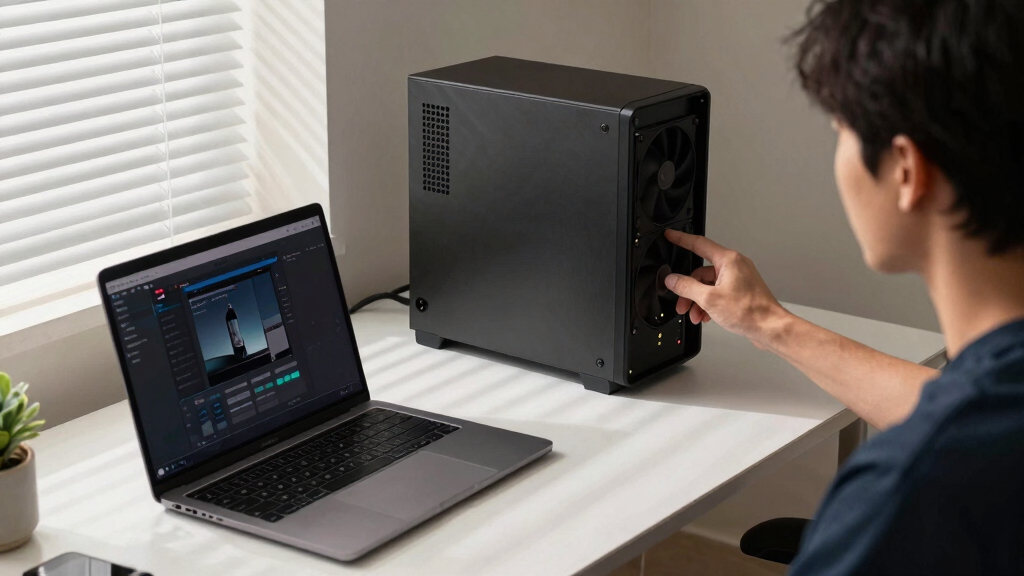
Apple Silicon Macs, such as the Mac Studio with M3 Ultra, offer near-silent operation and low power consumption for local large language model inference, contrasting sharply with GPU towers that generate significant heat and noise.
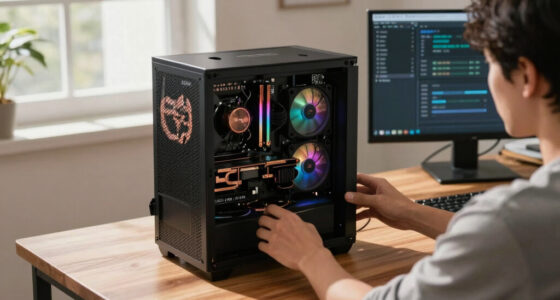
The core distinction lies in architectural design: Macs utilize a unified memory system that allows large models to fit in memory, albeit at slower speeds, while GPU towers prioritize high memory bandwidth for faster inference on models that fit within VRAM. GPU towers, equipped with high-bandwidth RTX GPUs, can deliver 3–4 times more tokens per second for models within VRAM capacity but produce substantial heat—often requiring complex cooling setups—and noise levels that demand ongoing management. Conversely, Apple Silicon chips draw minimal power, operate silently, and are optimized for models that can be loaded entirely into their large unified memory pools, making them ideal for always-on, low-noise environments. The tradeoff hinges on whether the user prioritizes maximum throughput or silent, power-efficient operation.Mac vs GPU tower
for local LLMs.
What if you sidestep the heat entirely with a different kind of machine? A tower is a high-bandwidth furnace you spend five levers quieting. Apple Silicon is near-silent by design — but asks for different tradeoffs. Match your priority in Part 2.
Put the loud, hot machine where its noise doesn’t matter, and the quiet one where you do. SSH into the tower when you need raw power; let the Mac handle everything else, silently.
Implications for AI Infrastructure Choices
This comparison highlights a fundamental decision for AI practitioners: whether to prioritize raw inference speed and upgradeability with GPU towers or to opt for silent, low-power operation with Apple Silicon Macs. For workloads constrained by model size, Macs can handle larger models without additional cooling complexity, making them suitable for office environments. GPU towers remain essential for latency-sensitive tasks and fine-tuning, where throughput and ecosystem support are critical. Understanding these tradeoffs influences hardware investments, workspace planning, and operational costs for local AI deployment.
Apple MacBook Pro Laptop with M5 Max, 18‑core CPU, 40‑core GPU: Standard 16.2-inch Display, 128GB Unified Memory, 2TB SSD Storage; Space Black
- Powerful CPU and GPU: Next-gen 18-core CPU with 40-core GPU
- Enhanced AI Performance: Built-in Neural Accelerators for AI tasks
- Fast SSD Storage: Up to 2x faster SSD speeds
As an affiliate, we earn on qualifying purchases.
As an affiliate, we earn on qualifying purchases.
Evolution of Hardware for Local AI Deployment
Historically, high-performance AI inference has relied on GPU towers with multiple NVIDIA cards, offering high bandwidth and extensive upgrade paths. Recent advances in Apple Silicon, especially the M-series chips, have introduced a new paradigm with large unified memory pools and near-silent operation, challenging traditional GPU-centric setups. The debate over heat, noise, and capacity reflects broader shifts in AI hardware design, balancing performance, usability, and environmental impact. This comparison builds on ongoing discussions about optimizing local AI infrastructure for diverse needs, from research to enterprise deployment."The heat-and-noise dimension is one of the sharpest differences between a GPU tower and an Apple Silicon machine, fundamentally shaping how they are used."
— Thorsten Meyer
Unresolved Questions About Long-Term Scalability
It remains unclear how future iterations of Apple Silicon might improve capacity and inference speed, and whether software ecosystem support will expand to match GPU capabilities for fine-tuning and training. Additionally, the long-term cost-effectiveness of large Mac setups versus GPU towers is still being evaluated as hardware prices and software tools evolve.
Upcoming Hardware and Software Developments
Expect ongoing improvements in Apple Silicon's memory capacity and inference performance, potentially narrowing the gap with GPU towers for certain workloads. Simultaneously, GPU manufacturers are working on more power-efficient, quieter cards, and software ecosystems continue to evolve, which could influence hardware choices in the near future. Monitoring these developments will clarify the long-term viability of each approach for local AI deployment.
Key Questions
Can a Mac handle large language models as effectively as a GPU tower?
Macs can run large models that fit within their unified memory, such as 70B+ quantized models, but may do so more slowly than GPU towers optimized for speed within VRAM limits.
Is heat and noise a significant concern with GPU towers?
Yes. GPU towers generate substantial heat and noise, requiring complex cooling and noise management, especially with multi-GPU setups.
Will Apple Silicon improve to support larger models or faster inference?
Future iterations may increase memory capacity and inference speed, but current designs prioritize low power and silent operation over raw throughput.
Which hardware is better for fine-tuning models?
GPU towers with CUDA ecosystem support currently excel at fine-tuning, training, and complex model development, while Macs are more suited for inference on large models that fit in memory.
Source: ThorstenMeyerAI.com