
For students who want to examine leaves, insects, rocks, or classroom slides, portable digital microscopes for students range from simple pocket optics to handheld models with built-in screens. My best overall pick is the TOMLOV P50, whose 2.4-inch IPS screen gives students a direct way to view specimens without relying on a separate device. The BEAVERLAB Finder stands out for its larger 4.0-inch display, while the Carson MicroBrite Plus is the simpler choice for students who value pocket-sized viewing over digital capture. The main tradeoff is between convenient on-device viewing, phone or computer connectivity, and the portability of a non-screen microscope. Read on for the full breakdown and advice on choosing a model that fits your student’s projects.

Prime made for students and young adults
- Fast, free delivery for dorm and study essentials
- Prime Video and Amazon Music included
- Member-only deals
Key Takeaways
- Built-in screens change the learning experience: The TOMLOV P50, BEAVERLAB Finder, ASPOVEN, and BMDSAE let students view specimens on the microscope itself, while the Jiusion and SKYBASIC rely on a connected device for viewing.
- A bigger display is not the same as better portability: The BEAVERLAB Finder’s 4.0-inch screen offers a more shared viewing area, but compact options such as the Carson MicroBrite Plus are easier to carry in a pocket.
- Magnification claims do not tell the whole story: The Carson’s 60x–120x range suits small-scale observation, while high-magnification handheld models are more dependent on careful focus, stable handling, and appropriate specimens.
- Accessories shape classroom readiness: The BEBANG PM1000 includes a 32GB card and EVA case, which can help with storage and transport; buyers should still check what else is supplied for their intended lessons.
- Connectivity creates a real choice: Wi-Fi or USB models such as Jiusion and SKYBASIC may suit students who want to view on a larger device, while screen-equipped models reduce setup friction for quick observations.
| BEBANG PM1000 Kids Digital Microscope STEM Kit with 32GB Card and EVA Case |  | Best Overall for a Ready-to-Go Student Kit | Magnification: 200x–1000x; five adjustable levels | Display: 4K screen | Included storage: 32GB memory card | VIEW LATEST PRICE | See Our Full Breakdown |
| ASPOVEN 4K Handheld Digital Microscope for Kids with 2.0″ IPS Screen (Blue) |  | Best for Simple Handheld STEM Exploration | Magnification: 200–1000x | Camera resolution: 4K HD | Display: 2.0-inch IPS | VIEW LATEST PRICE | See Our Full Breakdown |
| Jiusion 4K WiFi USB Digital Handheld Microscope with Metal Stand |  | Best for Students Using Phones or Computers | Video resolution: 3840 × 2160 (4K) | Maximum magnification: 1000× | Connectivity: WiFi and USB | VIEW LATEST PRICE | See Our Full Breakdown |
| BEAVERLAB Finder 4.0-Inch Handheld Digital Microscope for Kids, 100x–1600x Magnification |  | Best for a Larger Built-In Screen | Display: 4.0-inch IPS | Magnification: 100x–1600x | Image resolution: 1920 × 1080 | VIEW LATEST PRICE | See Our Full Breakdown |
| BMDSAE 1000x Handheld Digital Microscope for Kids with 2.0-Inch IPS Screen |  | Best for Basic On-Device Recording | Magnification: Up to 1000x | Camera resolution: 2MP | Screen: 2.0-inch IPS | VIEW LATEST PRICE | See Our Full Breakdown |
| Carson MicroBrite Plus LED Pocket Microscope, 60x–120x (MM-300) |  | Best for Simple Field Exploration | Magnification: 60x–120x | Illumination: Built-in LED | Design: Compact, lightweight handheld pocket microscope | VIEW LATEST PRICE | See Our Full Breakdown |
| TOMLOV P50 Handheld Digital Microscope with 2.4-Inch IPS Screen |  | Best Compact Digital Pick | Screen: 2.4-inch IPS | Focus: Adjustable | Lighting: 6 built-in LEDs with 4 brightness levels | VIEW LATEST PRICE | See Our Full Breakdown |
| Pozifu 1000X Handheld Digital Microscope for Kids |  | Best for Young Beginners | Magnification: 50X–1000X | Display: 2.0-inch IPS | Camera: 1080P, 2MP | VIEW LATEST PRICE | See Our Full Breakdown |
| MatataStudio MX2-AS Handheld Digital Microscope for Kids |  | Best for Guided Classroom Projects | Magnification: 100x–1600x continuous zoom | Screen: 4.3-inch 1080p LCD | Lighting: Incident and transmitted light | VIEW LATEST PRICE | See Our Full Breakdown |
| SKYBASIC Wireless Digital Microscope, 50x–1000x, with Adjustable Stand |  | Best for Phone or Computer Viewing | Magnification: 50x–1000x | Sensor: 2MP HD CMOS | Lighting: 8 adjustable LED lights | VIEW LATEST PRICE | See Our Full Breakdown |
| portable digital microscopes for student | Magnification | Lighting | Connectivity |
|---|---|---|---|
| BEBANG PM1000 Kids Digital Mic | 200x–1000x; five adjustable levels | — | — |
| ASPOVEN 4K Handheld Digital Mi | 200–1000x | 8 built-in LEDs; 3 brightness levels | PC connection; photo and video playback |
| Jiusion 4K WiFi USB Digital Ha | — | 8 built-in LED lights | WiFi and USB |
| BEAVERLAB Finder 4.0-Inch Hand | 100x–1600x | 8 adjustable lights | Built-in hotspot |
| BMDSAE 1000x Handheld Digital | Up to 1000x | 8 adjustable LEDs; 3 brightness modes | USB-C; compatible with Windows XP/Vista/7/8/10/11 and Mac 11.0 or later |
| Carson MicroBrite Plus LED Poc | 60x–120x | — | — |
| TOMLOV P50 Handheld Digital Mi | — | 6 built-in LEDs with 4 brightness levels | — |
| Pozifu 1000X Handheld Digital | 50X–1000X | 8 adjustable LED lights | — |
| MatataStudio MX2-AS Handheld D | 100x–1600x continuous zoom | Incident and transmitted light | USB-C and Wi-Fi via Matataxplore app |
| SKYBASIC Wireless Digital Micr | 50x–1000x | 8 adjustable LED lights | Wi-Fi for iOS and Android; USB for Windows and Mac |
More Details on Our Top Picks
BEBANG PM1000 Kids Digital Microscope STEM Kit with 32GB Card and EVA Case
The BEBANG PM1000 earns my best-overall spot for students who need a portable microscope with useful classroom extras already included. Its five magnification levels from 200x to 1000x offer more adjustment than the BMDSAE’s up-to-1000x range, while the 32GB card gives students room to save photos and video without relying on a computer right away. Real glass prepared slides also provide a straightforward starting point for early observations.
The fitted EVA case and neck strap make it easier to carry between home and class. Its roughly 2.5-hour battery life is longer than the BMDSAE’s stated two hours, though still calls for charging between longer sessions. Manual focus and LED adjustments take practice, so this is less immediate for very young users than a simple fixed-view toy.
Pros:- Five selectable magnification levels offer flexibility for everyday specimen viewing.
- Includes real glass prepared slides and a 32GB memory card for recording observations.
- Fitted EVA case and neck strap support carrying and storage.
- Approximately 2.5 hours of continuous use per charge.
Cons:- Manual focus, viewing distance, and LED settings take practice to tune.
- Battery life may not cover an extended field-study day without recharging.
Best for: Students who want a portable microscope kit with prepared slides, ample included storage, and a protective case for school or home use.
Not ideal for: Young children who need nearly effortless focusing, or students who routinely need longer than about 2.5 hours of use between charges.
- Magnification:200x–1000x; five adjustable levels
- Display:4K screen
- Included storage:32GB memory card
- Battery life:Approximately 2.5 hours of continuous use
- Charging:Type-C cable
- Weight:0.34 lb
- Included accessories:EVA case, five glass prepared slides, neck strap, Type-C cable, user manual
- Warranty:1 year
Our verdict“Choose the BEBANG PM1000 for a student-ready portable kit with strong included accessories, provided manual focusing is acceptable.”
ASPOVEN 4K Handheld Digital Microscope for Kids with 2.0″ IPS Screen (Blue)
The ASPOVEN inskam382 suits students who want a straightforward handheld viewer they can carry from a desk to an outdoor observation spot. Its 2.0-inch IPS screen, 4K camera, and eight built-in LEDs put viewing and recording on the device, while three brightness settings help adapt illumination to different specimens. Compared with the BEAVERLAB Finder’s larger 4.0-inch display, this screen is less suitable for showing details to a group, but the ASPOVEN’s lighter handheld format is easier for one student to carry.
Photo and video capture, playback, and PC connectivity give students a path to save or manage work. The tradeoff is a fixed 200–1000x range and a small display, which limit its appeal for careful group analysis or advanced study. I’d pick it for individual exploration, not as a shared classroom demonstration screen.
Pros:- 4K camera supports photo and video capture for documenting observations.
- IPS display and eight LEDs with three brightness levels provide on-device viewing with adjustable illumination.
- Neck strap and 0.5 lb weight make it convenient to carry.
- Playback and PC connectivity support reviewing and managing saved files.
Cons:- The 2.0-inch display is small for group demonstrations or detailed shared viewing.
- The stated 200–1000x range may not meet advanced work requiring more precise control.
Best for: Younger students who want a light, self-contained microscope for individual indoor and outdoor STEM activities, with PC file transfer available.
Not ideal for: Teachers or students who need a large screen for group viewing or more precise, advanced microscopy controls.
- Magnification:200–1000x
- Camera resolution:4K HD
- Display:2.0-inch IPS
- Lighting:8 built-in LEDs; 3 brightness levels
- Weight:0.5 lb
- Power:USB-C charging
- Connectivity:PC connection; photo and video playback
- Warranty:2 years
Our verdict“Pick the ASPOVEN for portable, individual STEM exploration, but choose the BEAVERLAB Finder if a larger viewing screen matters more.”
Jiusion 4K WiFi USB Digital Handheld Microscope with Metal Stand
The Jiusion 4K WiFi USB microscope stands apart from the screen-based handhelds here: it sends its view to a compatible phone, tablet, or computer rather than relying on a built-in display. That makes it a better fit for students who want to review observations on a larger device or save 3840 × 2160 video. Wireless phone and tablet connections add flexibility, while USB support extends compatibility to several computer operating systems.
Against the ASPOVEN, Jiusion offers a broader device-based viewing setup but requires a separate compatible screen; against the BEAVERLAB Finder, it gives up the convenience of an integrated 4.0-inch display. The included stand, focus control, and adjustable LEDs help with stable tabletop viewing. One limitation matters in class: its zoom buttons work with phones and tablets, not computers. The plastic enclosure is also less reassuring for frequent student handling than a more substantial build.
Pros:- Captures video at 3840 × 2160 resolution.
- WiFi and USB connections support phones, tablets, and a range of computer systems.
- Included stand and focus adjustment support steadier tabletop observation.
- Eight built-in LEDs have adjustable brightness.
Cons:- Requires a separate compatible phone, tablet, or computer for viewing.
- Zoom buttons do not work when connected to a computer.
- Plastic enclosure may be less suited to rough classroom handling.
Best for: Students who already use a compatible phone, tablet, or computer and want to capture or share microscope video on that device.
Not ideal for: Students who need a self-contained microscope with its own screen, or who expect zoom-button control while connected to a computer.
- Video resolution:3840 × 2160 (4K)
- Maximum magnification:1000×
- Connectivity:WiFi and USB
- Compatible devices:iPhone, iPad, Android phones and tablets, Mac, Windows, Linux, Chrome OS
- Lighting:8 built-in LED lights
- Controls:Focus and brightness adjustment knobs; zoom buttons for phones and tablets
- Included items:Microscope, stand, USB cable, instruction manual
- Warranty:Lifetime warranty
Our verdict“Choose Jiusion if students already have a compatible screen and value device-based viewing over the BEAVERLAB Finder’s built-in display.”
BEAVERLAB Finder 4.0-Inch Handheld Digital Microscope for Kids, 100x–1600x Magnification
The BEAVERLAB Finder is my pick for students who need to see their observations on a larger built-in display. Its 4.0-inch IPS screen is twice the listed diagonal size of the ASPOVEN’s 2.0-inch screen, making it more practical for a parent, teacher, or student partner to follow along. The 100x–1600x range also starts below the 200x minimum listed for the ASPOVEN and BEBANG PM1000, offering more flexibility at the lower end.
Its 1080p imaging is less detailed on paper than the 4K capture specified for the Jiusion and ASPOVEN, so students prioritizing recording resolution may prefer those models. The built-in hotspot and included 8GB card support sharing and storage, though the BEBANG includes a larger 32GB card. A missing charging adapter adds a small setup requirement, and this model is described as designed for indoor use, limiting it for field trips.
Pros:- 4.0-inch IPS display is larger than the 2.0-inch screens on the ASPOVEN and BMDSAE.
- 100x–1600x magnification range provides a broad stated range for specimen viewing.
- Eight adjustable lights support illumination changes.
- Built-in hotspot and included 8GB TF card support sharing and saving observations.
Cons:- 1080p image resolution is lower than the stated 4K capture on the Jiusion and ASPOVEN.
- Charging adapter is not included.
- Designed for indoor use, which limits outdoor student activities.
Best for: Younger students and classroom pairs who benefit from a larger built-in screen for examining specimens together indoors.
Not ideal for: Students who need a field-ready outdoor microscope, a bundled charging adapter, or higher-resolution capture than 1080p.
- Display:4.0-inch IPS
- Magnification:100x–1600x
- Image resolution:1920 × 1080
- Image sensor:2MP CMOS
- Lighting:8 adjustable lights
- Connectivity:Built-in hotspot
- Storage:8GB TF card included
- Dimensions:7.4 × 4.5 × 1.59 inches
- Charging adapter:Not included
Our verdict“Choose the BEAVERLAB Finder for shared indoor viewing on a large built-in screen, not for outdoor use or the highest listed capture resolution.”
BMDSAE 1000x Handheld Digital Microscope for Kids with 2.0-Inch IPS Screen
The BMDSAE 382 is a compact option for students who want a built-in screen and basic photo or video capture without depending on a phone. Its eight adjustable LEDs offer three brightness modes, and USB-C lets students transfer saved files to compatible Windows or Mac computers. Compared with the BEBANG PM1000, it is a more limited recording package: the BMDSAE has 32MB of built-in storage, while the BEBANG includes a 32GB card and prepared slides. That difference matters if students plan to keep many observations on the microscope.
The 2.0-inch IPS display keeps the device self-contained, but it is less suited to group viewing than the BEAVERLAB Finder’s 4.0-inch screen. Manual focus can also demand patience from younger users. Its stated battery life of up to two hours is the shortest explicit runtime in this group, so I’d treat it as a short-session learning tool rather than an all-day field companion.
Pros:- 2.0-inch IPS screen supports direct viewing without a separate phone or computer.
- Eight adjustable LEDs offer three brightness modes.
- Stores photos and AVI videos and supports USB transfer to compatible Windows or Mac computers.
- Lanyard and USB-C cable are included.
Cons:- 32MB of storage is far less than the 32GB card included with the BEBANG PM1000.
- Up to two hours of battery life may limit longer classroom or field sessions.
- Manual focus may take practice, especially for younger students.
Best for: Students who want a simple handheld microscope with its own screen and USB file transfer for short observation sessions.
Not ideal for: Students who need substantial onboard storage, longer sessions between charges, or an easy-to-share large display.
- Magnification:Up to 1000x
- Camera resolution:2MP
- Screen:2.0-inch IPS
- Lighting:8 adjustable LEDs; 3 brightness modes
- Storage:32MB; stores 200+ photos or AVI videos
- Battery:600mAh; up to 2 hours
- Connectivity:USB-C; compatible with Windows XP/Vista/7/8/10/11 and Mac 11.0 or later
- Included items:Microscope, instruction manual, lanyard, USB-C data cable
- Warranty:1 year
Our verdict“Pick the BMDSAE for basic, short-session viewing and file transfer, but choose the BEBANG for more included storage and a fuller student kit.”
Carson MicroBrite Plus LED Pocket Microscope, 60x–120x (MM-300)
For students who want to inspect leaves, fabric, or prepared slides without carrying a screen and cables, the Carson MicroBrite Plus keeps the kit genuinely pocketable. Its 60x–120x magnification and built-in LED are a simpler setup than the TOMLOV P50, which adds a display and photo and video capture. That simplicity is useful on a nature walk, but it also means students cannot save observations or view them together on a screen. The handheld format makes quick checks easy; compared with the MatataStudio MX2-AS, though, it offers less support for steady, extended viewing and fewer tools for documenting classroom work. I’d choose it for lightweight, direct observation rather than a project that needs images, a large display, or advanced specimen lighting.
Pros:- Compact handheld design is easy to carry in a school bag or field kit
- 60x–120x magnification suits basic close-up exploration
- Built-in LED illuminates specimens without a separate light source
Cons:- Handheld viewing can be less stable during longer observations
- No display or photo and video capture is specified
- Lower magnification range offers less room to explore fine details than digital models such as the MatataStudio MX2-AS
Best for: Students who want a lightweight, no-screen microscope for quick observations during field trips or classroom activities
Not ideal for: Students who need to capture and share images, view specimens on a display, or hold the microscope steady for longer investigations
- Magnification:60x–120x
- Illumination:Built-in LED
- Design:Compact, lightweight handheld pocket microscope
- Model:MM-300
- Use:Prepared slides and everyday objects
- Portability:Handheld design for field or classroom use
Our verdict“Choose the Carson for students who value pocket-sized, direct observation over screen viewing and saved images.”
TOMLOV P50 Handheld Digital Microscope with 2.4-Inch IPS Screen
The TOMLOV P50 gives students a useful middle ground: it is a 3-ounce handheld microscope with its own screen, so observations do not depend on a phone or computer. Adjustable focus and four LED brightness levels let a student tune the view for different small objects, while built-in photo storage makes it possible to keep images without adding a card. Compared with the Carson MicroBrite Plus, the P50 is much better for screen-based viewing and documenting work; compared with the MatataStudio MX2-AS, it is smaller and simpler but has a much smaller display and fewer supplied specimen tools. Video recording requires a microSD card that is not included, and the 2.4-inch screen can feel cramped when sharing a view. It suits portable projects more than group demonstrations.
Pros:- Lightweight 3-ounce design includes an EVA case and lanyard
- Adjustable focus and four LED brightness levels suit varied close-up subjects
- Built-in photo storage and 16MP photo capture support project documentation
- Connects to Windows and macOS for larger-screen viewing
Cons:- Video recording requires a microSD card that is not included
- The 2.4-inch screen is less suitable for group viewing than the MatataStudio MX2-AS display
- Up to 120 minutes of battery runtime may not cover longer sessions
Best for: Students who want a lightweight, self-contained digital microscope for individual observations and occasional photo or video projects
Not ideal for: Classes that need a large shared viewing screen or students who want video recording without buying a separate microSD card
- Screen:2.4-inch IPS
- Focus:Adjustable
- Lighting:6 built-in LEDs with 4 brightness levels
- Photo resolution:16MP
- Video resolution:1080p
- Weight:3 oz
- Dimensions:4.1 x 2.4 inches
- Battery runtime:Up to 120 minutes
- Computer compatibility:Windows and macOS
Our verdict“Pick the P50 for portable, individual digital observation when a small built-in screen matters more than a larger classroom display.”
Pozifu 1000X Handheld Digital Microscope for Kids
The Pozifu handheld microscope is aimed at younger students who benefit from simple controls and an included case and lanyard. Its broad stated 50X–1000X magnification range and eight adjustable LEDs offer flexibility for casual exploration, while the rechargeable battery keeps it usable away from an outlet. Compared with the TOMLOV P50, it advertises a wider magnification range and more LEDs, but its 2-inch display is smaller and its camera is listed as 2MP rather than 16MP photos. It can record photos and videos and connect to a computer by USB, but saving pictures depends on a separately purchased TF card. I’d treat the magnification range as a feature for experimenting, not a promise of consistently detailed viewing at every setting. It is a basic starter option, not the strongest choice for documenting school projects.
Pros:- Simple controls and lightweight construction suit young users
- 50X–1000X stated magnification range supports varied close-up exploration
- Eight adjustable LEDs help adapt illumination to different subjects
- Rechargeable battery, lanyard, and protective case support portable use
Cons:- TF card is not included, so picture storage requires an extra purchase
- The 2-inch display is smaller than the TOMLOV P50 screen
- 2MP camera resolution is modest for students who need detailed saved images
Best for: Younger students who want a simple rechargeable microscope for guided exploration at home or in class
Not ideal for: Students who need a larger screen, included storage media, or higher-resolution image capture for formal project presentations
- Magnification:50X–1000X
- Display:2.0-inch IPS
- Camera:1080P, 2MP
- Lighting:8 adjustable LED lights
- Storage:Up to 200 pictures with a TF card; card not included
- Computer connection:USB
- Battery:Rechargeable 600mAh
- Charging port:Type-C
- Included accessories:Lanyard and protective case
Our verdict“Choose the Pozifu as a straightforward starter for younger students who accept a small screen and separate storage card.”
MatataStudio MX2-AS Handheld Digital Microscope for Kids
For students doing more than quick inspections, the MatataStudio MX2-AS is the most classroom-ready option in this group. Its 4.3-inch 1080p screen is easier to share than the TOMLOV P50’s 2.4-inch display, and handheld and stand modes let students switch between field observations and steadier desk work. Incident and transmitted lighting, continuous zoom, prepared slides, and observation chambers support a broader range of lessons than the simpler Carson MicroBrite Plus. It also arrives with an 8GB microSD card, avoiding the separate-card issue found with the Pozifu. The tradeoffs are a more involved setup for wireless viewing, which uses the Matataxplore app, and battery life of just over three hours. Its feature set makes the most sense for guided projects, though it may be more than a casual observer needs.
Pros:- Large 4.3-inch 1080p screen is easier to view and share than smaller handheld displays
- Handheld and stand modes suit fieldwork and steadier desk observations
- Incident and transmitted lighting support different specimen types
- Includes prepared slides, observation chambers, and an 8GB microSD card
Cons:- Wireless viewing requires the Matataxplore app and a compatible device
- Battery life is just over three hours per charge
- Larger screen and accessory-rich kit are less minimal than the TOMLOV P50
Best for: Students aged 8–12 and classrooms that need a larger display, specimen accessories, and both handheld and stand-based observation
Not ideal for: Students seeking the lightest, simplest pocket microscope or anyone who wants longer sessions without planning around battery life
- Magnification:100x–1600x continuous zoom
- Screen:4.3-inch 1080p LCD
- Lighting:Incident and transmitted light
- Connectivity:USB-C and Wi-Fi via Matataxplore app
- Compatible devices:Mobile phones, tablets, and PCs
- Built-in storage:8GB microSD card
- Battery capacity:2600mAh
- Battery life:Over 3 hours
- Included accessories:5 prepared slides, 2 observation chambers, USB-C cable, exploration manual, calibration ruler, user guides, and storage bag
Our verdict“Choose the MX2-AS for structured student investigations that benefit from a large screen, multiple lighting modes, and included specimens.”
SKYBASIC Wireless Digital Microscope, 50x–1000x, with Adjustable Stand
The SKYBASIC Wireless Digital Microscope suits students who would rather use a phone or computer screen than look through a small built-in display. Wi-Fi connects it to iOS and Android devices, while USB supports Windows and Mac, giving it more screen flexibility than the self-contained TOMLOV P50. Its adjustable stand and eight LEDs help with desk-based close-ups, and one-button capture makes basic documentation accessible. The main limitation is its fixed-focus design: students need to keep objects 3–60 mm from the lens, so it is less forgiving than the adjustable-focus P50 or the continuous-zoom MatataStudio MX2-AS. Image resolution also varies by connection—up to 1920 × 1080 on smartphones and 720p on computers. I’d choose it for casual shared viewing, not for precise or highly repeatable microscopy.
Pros:- Wi-Fi supports iOS and Android viewing, while USB supports Windows and Mac
- Included stand and base help stabilize desk observations
- Eight adjustable LEDs provide control over specimen illumination
- One-button photo and video capture supports basic project records
Cons:- Fixed focus requires objects to stay 3–60 mm from the lens
- Computer image resolution is limited to 720p, below the stated smartphone resolution
- Power adapter is not included
Best for: Students who already have a compatible phone or computer and want to view and capture casual close-ups on a larger screen
Not ideal for: Students who need adjustable focus, reliable detail at changing distances, or a fully self-contained microscope with its own display
- Magnification:50x–1000x
- Sensor:2MP HD CMOS
- Lighting:8 adjustable LED lights
- Image resolution:Up to 1920 × 1080 on smartphones; 720p on computers
- Connectivity:Wi-Fi for iOS and Android; USB for Windows and Mac
- Focal length range:3–60 mm
- Focus type:Fixed focus
- Included components:Microscope, USB cable, bracket, base, and user manual
- Power adapter:Not included
Our verdict“Pick the SKYBASIC if phone or computer viewing is the priority and its fixed-focus working distance fits your student’s projects.”
How We Picked
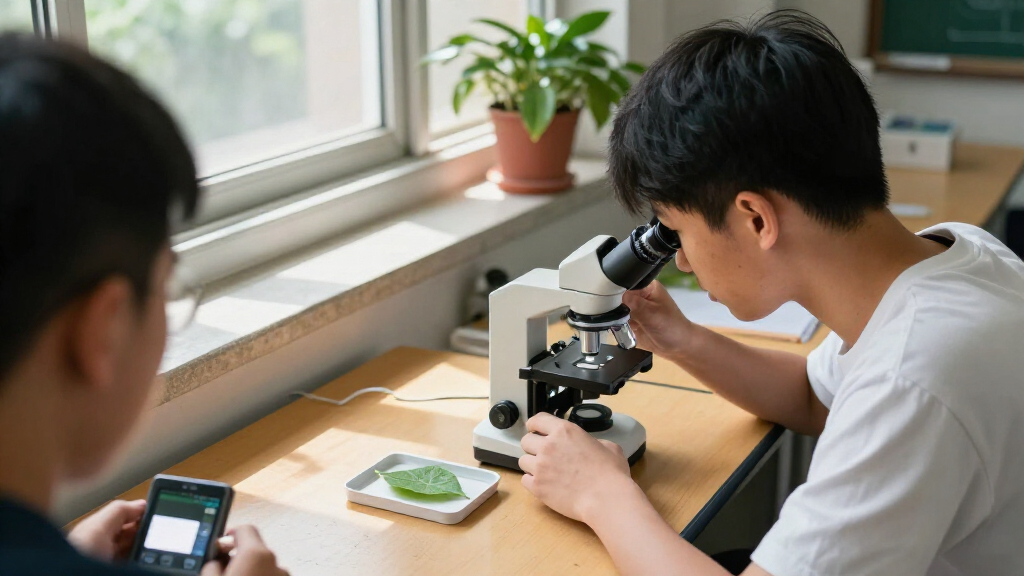
I compared these ten models through the needs of students: how quickly a learner can start viewing, how practical the microscope is to carry, how specimens can be illuminated and focused, and whether images can be reviewed or saved. I also weighed display size and type, connection requirements, included accessories, and the difference between a dedicated screen and a phone- or computer-based workflow. Magnification figures were treated as one part of the picture, not a standalone measure of useful detail.
The order favors models that balance straightforward use, on-device viewing, and portability for a wide range of school and home projects. Models with a larger screen or student-oriented accessories earn attention for specific needs, while pocket optics and connected microscopes rank for narrower priorities. Since feature lists alone cannot establish image quality, durability, or classroom performance, I focus on the practical tradeoffs buyers can verify before choosing.
| portable digital microscopes for student | Connectivity |
|---|---|
| BEBANG PM1000 Kids Digital Mic | — |
| ASPOVEN 4K Handheld Digital Mi | PC connection; photo and video playback |
| Jiusion 4K WiFi USB Digital Ha | WiFi and USB |
| BEAVERLAB Finder 4.0-Inch Hand | Built-in hotspot |
| BMDSAE 1000x Handheld Digital | USB-C; compatible with Windows XP/Vista/7/8/10/11 and Mac 11.0 or later |
| Carson MicroBrite Plus LED Poc | — |
| TOMLOV P50 Handheld Digital Mi | — |
| Pozifu 1000X Handheld Digital | — |
| MatataStudio MX2-AS Handheld D | USB-C and Wi-Fi via Matataxplore app |
| SKYBASIC Wireless Digital Micr | Wi-Fi for iOS and Android; USB for Windows and Mac |
Factors to Consider When Choosing Portable Digital Microscopes For Students
A student microscope should fit the way a learner will actually use it: at a desk, in a classroom group, or outdoors collecting observations. Before choosing, decide whether the priority is independent viewing, sharing images, easy transport, or close-up work with prepared samples.
Choose How the Student Will View the Image
A built-in screen lets a student look at a specimen without pairing the microscope to a phone or computer, which can make short study sessions easier to begin. A larger screen may help a small group observe together, but it adds bulk to the handheld unit. Wi-Fi and USB models can make a laptop or phone useful as a larger display, though connection steps and device compatibility can slow a lesson. Check whether the student has permission to use a personal device in class before paying for connectivity that may go unused. For independent homework or quick demonstrations, a screen-equipped microscope is often the lower-friction arrangement; for image review on a computer, a connected model may fit better.
Match Magnification to the Specimens
Students do not need the highest stated magnification for every project. Leaves, fabric, coins, and insect surfaces can be engaging at modest magnification, while prepared slides and finer structures call for more careful optics and stable focus. Very high figures can sound appealing but may describe digital enlargement rather than a corresponding increase in visible detail. Think about the actual assignments and specimens first, then check how the microscope focuses and illuminates them. A model with a usable range and manageable focus can teach more than one chosen mainly for its largest number.
Decide Whether Portability Means Pocketable or Self-Contained
Portability has two meanings in this category: a very small optical tool that fits in a pocket, or a handheld digital device that carries its own display and controls. The Carson MicroBrite Plus leans toward pocket carry, while screen-equipped microscopes take more space but can work without a separate viewing device. For field trips, compare the complete kit rather than the microscope alone, including its case, cables, stand, and any storage media. A larger setup can still be practical if it travels in a protective case, but a student who walks between classes may prefer fewer pieces. Avoid treating a compact body as proof that a model is ready for outdoor use; lighting and support matter too.
Plan for Stability and Lighting
Handheld viewing is flexible, but small movements can make high-magnification images difficult to hold steady. A stand or a stable work surface can help students focus and compare specimens without constantly correcting the image. Built-in illumination is useful when classroom or outdoor light changes, yet brightness and specimen placement still affect what appears on screen. For repeated slide work, consider whether the package supports a stable setup rather than assuming the handheld form will suit every task. Students who mainly inspect larger objects may value handheld freedom more than a stand, while detailed desk work benefits from steadier positioning.
Check Capture, Storage, and Sharing Needs
Some student projects require only live viewing; others ask learners to document observations and include images in reports. Before choosing, check how photos or video are captured, where files are stored, and how they move to a computer or classroom platform. Included storage, such as the 32GB card listed with the BEBANG PM1000, may reduce setup work, but it does not answer every question about file transfer or format. Wireless viewing can simplify sharing during a demonstration, while a memory card can be convenient when a student works away from Wi-Fi. Match the workflow to school rules and the student’s existing devices to avoid buying features that create extra steps.
Prioritize Ease of Use Over Feature Count
Young students benefit from controls they can learn quickly: clear focus adjustment, simple lighting controls, and an obvious way to begin viewing. A long feature list can distract from the basics if a child needs adult help to connect, focus, or save every observation. Check the product instructions and the included accessories for clues about setup, and consider whether the student can carry and operate the device independently. For a first microscope, ease of handling may matter more than advanced connectivity or an expansive magnification claim. Older students with a defined project may get more value from those added functions once they know how they will use them.
Frequently Asked Questions
Should I choose a microscope with its own screen or one that connects to a phone or computer?
Choose a built-in screen if the student needs to start viewing quickly or may not have access to a separate device during class. A connected model makes more sense when the student wants to review images on a larger display or use a computer-based workflow. Check whether the connection method works with the devices the student is allowed to use, and whether setup requires an app or cable. A phone connection can be convenient, but it may add pairing steps and compete with other school tasks. If uncertain, a self-contained screen is usually the simpler route for casual observation.
Is a 1000x or 1600x handheld microscope automatically better for schoolwork?
No. A larger magnification claim does not by itself show how much useful detail the student will see, especially if digital enlargement contributes to the figure. The sample, focus stability, lighting, and image quality all affect the result. Many classroom objects are clear and interesting at lower magnifications, so a microscope that is easy to focus can be more useful than one chosen for a headline number. Start with the specimens in the student’s projects, then compare how each model is intended to handle them.
Can a pocket microscope replace a digital model for a student?
A pocket microscope can suit quick, personal inspection when image saving and group viewing are not priorities. The Carson MicroBrite Plus is the lineup’s compact optical option, but it does not serve the same role as models with a screen or device connection. Digital models make it easier to show observations to classmates and may support image capture, depending on the product. For a student who needs evidence for a report or shared class discussion, a digital workflow is more appropriate. For lightweight observation on a nature walk, pocket optics may be enough.
What accessories should I check before buying a student microscope?
Look for the items that match the student’s routine: a protective case for transport, a stand for stable desk work, and storage or cables if image capture is part of the assignment. Do not assume every model includes all of these, even when the product name highlights digital features. The BEBANG PM1000 lists a 32GB card and EVA case, while the SKYBASIC listing names an adjustable stand; those details may influence readiness for particular tasks. Also check whether the student will need a separate device, compatible software, or batteries. Confirming the complete package can prevent a microscope from arriving without a piece needed for class use.
Which features matter most for a student using a microscope outdoors?
For field use, portability and a simple setup matter as much as magnification. A protective case can help with transport, and a built-in screen avoids depending on a phone connection in places with limited connectivity. Stable illumination is useful when ambient light changes, while a stand may help when the student can work at a table or flat surface. Consider whether the device can be carried comfortably alongside notebooks and other school supplies. If the student will record findings, check how images are saved and transferred before leaving home.
Conclusion
For the broadest mix of student-friendly viewing and portability, I recommend the TOMLOV P50 as best overall, with its built-in 2.4-inch IPS screen avoiding the need for a separate display. The BEBANG PM1000 is my best value-style pick for a ready-to-carry kit because its listed memory card and EVA case address storage and transport needs; check the rest of the package against your class requirements. For a more expansive on-device view, the BEAVERLAB Finder is my best premium-style choice among these options, thanks to its 4.0-inch screen. The ASPOVEN is a sensible beginner pick for students who want a straightforward handheld unit with its own screen, while the Carson MicroBrite Plus is best for pocket-first observation when digital capture is not required. Choose Jiusion or SKYBASIC instead if connecting to another device fits the student’s workflow better, and favor the stand-equipped option when steadiness matters more than carrying the smallest setup.