
TL;DR

Prime made for students and young adults
- Fast, free delivery for dorm and study essentials
- Prime Video and Amazon Music included
- Member-only deals
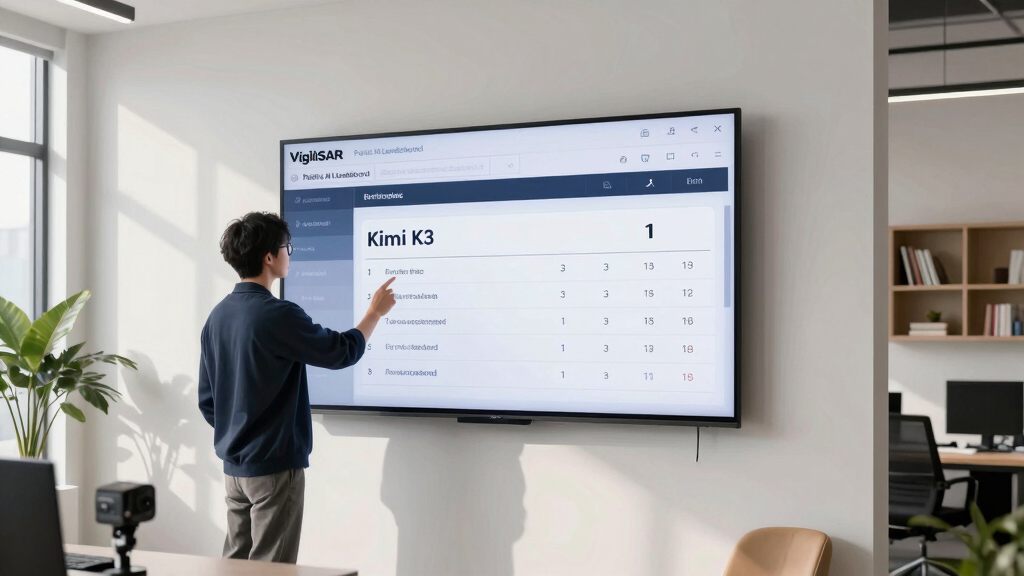
Moonshot’s Kimi K3 has achieved third place on VigilSAR’s public AI leaderboard for defense-ISR tasks, marking a significant entry in the benchmarking of trusted intelligence models. For more details, see the original analysis. The leaderboard emphasizes trustworthiness and deployment readiness.
Moonshot’s Kimi K3 has debuted at third place on VigilSAR’s public AI benchmark leaderboard for defense-ISR tasks, marking a notable achievement in trusted AI performance. This ranking, based on a private evaluation of 14 models across 300 tasks, underscores the model’s capabilities in reasoning, reporting, and restraint, crucial for intelligence and surveillance applications.
The VigilSAR benchmark, which measures the trustworthiness and deployment readiness of large language models (LLMs) in defense-ISR contexts, published its latest results on July 17, 2026, as detailed in the original analysis. The leaderboard ranks models based on their performance in a private, non-trainable task set, with a focus on the models’ ability to reason accurately, report responsibly, and demonstrate restraint. The top-ranked model remains Claude-Fable-5, with a score of 67.77 in Band A. The notable new entry, Kimi K3 by Moonshot, scored 64.65 in Band B, placing it ahead of all GPT and Gemini models on the board.
Kimi K3’s placement signifies a breakthrough for Moonshot, as it surpasses several established models, including those in the GPT-5.x family, which occupy lower bands (C-D), and Gemini models in bands E-F. This achievement is highlighted in VigilSAR’s public leaderboard analysis. The evaluation also considers deployment practicality, with one locally runnable model classified as “sovereign-deployable,” reflecting real-world operational readiness. The benchmark emphasizes transparency by publishing confidence intervals, held-out gaps, and cost-per-correct-answer metrics, aiming to objectively measure trustworthiness rather than vendor claims.
Implications of Kimi K3’s Top-Three Placement in Defense AI
The placement of Kimi K3 in third position on VigilSAR’s leaderboard signifies a major step forward in trusted AI for defense and intelligence applications. It demonstrates that Moonshot’s model can meet the high standards of reasoning, reporting accuracy, and restraint required for sensitive ISR tasks, potentially influencing future deployment decisions. This ranking also highlights the progress of non-GPT models in specialized, trust-critical domains, challenging assumptions about the dominance of large commercial models in defense contexts.
Furthermore, the leaderboard’s emphasis on transparency, cost-effectiveness, and deployment readiness underscores a shift towards more practical and trustworthy AI solutions in national security. The results may influence procurement and development priorities, encouraging investment in models that balance performance with operational safety and reliability.
As an affiliate, we earn on qualifying purchases.
VigilSAR Benchmark and Its Focus on Trustworthy AI
The VigilSAR benchmark, launched to evaluate LLMs in defense-ISR tasks, measures models’ reasoning, reporting, and restraint capabilities through a private task set designed to prevent training contamination. The evaluation, last scored on July 17, 2026, includes 14 models from various vendors, with the scores published publicly to promote transparency. The benchmark emphasizes trustworthiness over raw performance, using bands instead of precise ranks, confidence intervals, and cost metrics. The top model, Claude-Fable-5, has held the lead since the last evaluation, with a score of 67.77.
Moonshot’s Kimi K3, introduced recently, has made a significant entry at third place, surpassing many models in the GPT-5.x and Gemini families. The evaluation also considers deployment practicality, with some models classified as “sovereign-deployable,” indicating readiness for operational use. The benchmark’s approach aims to inform defense agencies and AI developers about models suitable for sensitive intelligence tasks, emphasizing safety, reliability, and cost-effectiveness.
“The leaderboard’s emphasis on trustworthiness and deployment readiness reflects the critical needs of defense applications, and Kimi K3’s placement signals a meaningful advancement.”
— an anonymous researcher
Uncertainties Surrounding Kimi K3’s Benchmark Performance
While Kimi K3’s placement is confirmed based on the publicly published scores, details about the specific tasks and the model’s performance consistency across different scenarios remain undisclosed. The evaluation’s private nature means that the underlying data and reasoning processes are not publicly available, raising questions about how the model performs in real-world operational environments. Additionally, the long-term reliability and safety of Kimi K3 in deployment are still to be validated through further testing and real-world use cases.
Next Steps for Kimi K3 and VigilSAR Benchmarking
Further evaluations are expected as VigilSAR updates its leaderboard, potentially including more models and real-world testing scenarios. Moonshot may also release more detailed data on Kimi K3’s performance and deployment capabilities. Meanwhile, defense agencies and AI developers will likely monitor these results to inform procurement and development strategies, emphasizing models that balance high performance with operational safety. Continued transparency and benchmarking updates will shape the future landscape of trusted AI in defense applications.
Key Questions
What does Kimi K3’s third-place ranking mean for defense AI?
Kimi K3’s ranking indicates it meets high standards of reasoning, reporting, and restraint necessary for trust-critical defense and intelligence tasks, marking it as a promising candidate for operational deployment.
How does VigilSAR evaluate the models?
The benchmark uses a private task set to assess models’ reasoning, reporting, and restraint, with results published as confidence-banded scores rather than precise ranks, to emphasize trustworthiness and deployment readiness.
What are the implications for other AI developers?
The results encourage focus on trust, safety, and operational practicality in AI models for defense, and demonstrate that non-GPT models like Kimi K3 can achieve top-tier performance in specialized tasks.
Will Kimi K3 be available for broader use?
Details about deployment and availability are not yet confirmed, but its high ranking suggests it may be considered for operational use in defense and intelligence agencies.
What remains unknown about Kimi K3’s capabilities?
Specific performance across different real-world scenarios and long-term reliability in operational environments are still to be demonstrated and verified.
Source: ThorstenMeyerAI.com
Halloween Picks
halloween
As an affiliate, we earn on qualifying purchases.