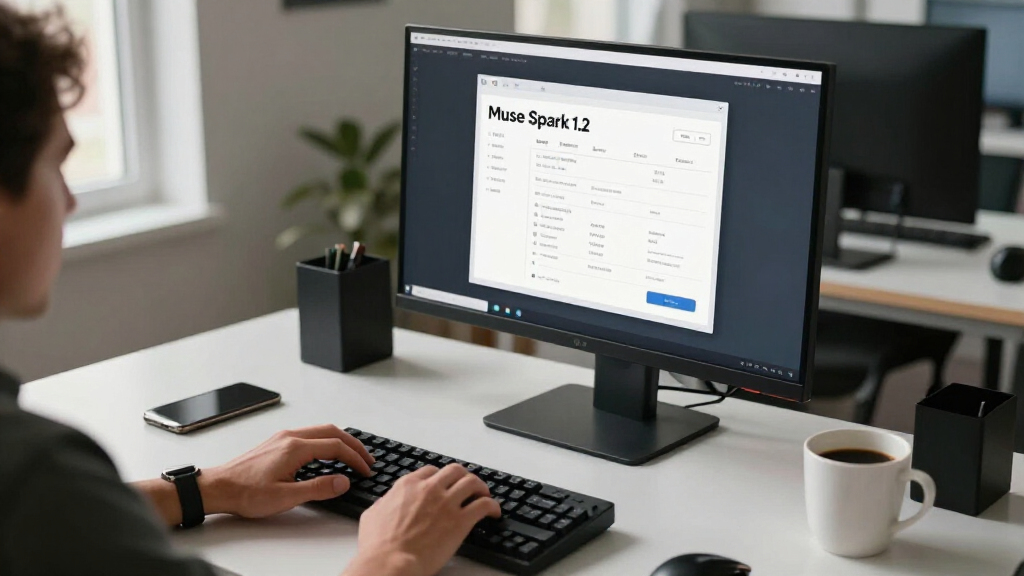

📊 Full opportunity report: Meta's Latest AI Tool, Muse Spark 1.2, Signals A New Coding Era on ThorstenMeyerAI.com — validation score, market gap, and execution plan.

Prime made for students and young adults
- Fast, free delivery for dorm and study essentials
- Prime Video and Amazon Music included
- Member-only deals
TL;DR
Meta has introduced Muse Spark 1.2 and Muse Code, its first co-trained coding model and autonomous agent, emphasizing improved long-horizon coding and tool use. The release signals Meta’s entry into high-end developer AI tools, with promising benchmarks and cost advantages, though some trade-offs in model confidence are noted.
Meta has officially released Muse Spark 1.2 and Muse Code, its first integrated coding-focused AI model and autonomous agent, designed to enhance software development workflows. The launch, announced by CEO Mark Zuckerberg, signals Meta’s entry into the competitive space of professional developer tools, directly challenging offerings from OpenAI, Anthropic, and other AI labs.
The core innovation is the co-training of Muse Spark 1.2 and Muse Code, which Meta claims results in better tool use, fewer retries, and higher-quality outputs. The models were trained together on long-horizon coding tasks, such as repository-wide generation and end-to-end project planning, emphasizing the importance of models understanding their operational environment.
Muse Code features a persistent, restart-safe runtime with a local event log, allowing it to resume precisely after crashes—making it suitable for long, autonomous tasks. It ships with three default skills—/plan, /grill, and /goal—and can run parallel background agents, indicating a serious engineering effort rather than a mere wrapper around existing models.
Benchmark results from Artificial Analysis show Muse Spark 1.2 achieving an overall score of 54 on the Intelligence Index, up 3 points from Muse Spark 1.1, and comparable to GPT-5.5 and Grok 4.5. Its agentic coding performance improved significantly, with a 260 Elo point increase on the GDPval-AA v2 benchmark, placing it fifth among tested models and ahead of Claude Opus 4.8. The model’s tool use accuracy rose to 80%, and its cost per benchmark task remains highly competitive at approximately $0.40, undercutting rivals like Kimi K3 and GPT-5.5.
Meta shipped a coding model and its first coding agent on the same day, co-trained together. The pairing is the story — and it puts Meta straight into competition with Claude Code and Codex. Parts are genuinely strong; one part cuts against how I build.
▲ Capability claims are Meta’s own · benchmarks independentMuse Code and Muse Spark 1.2 were co-trained — harness and model together — for better tool use and fewer retries than a generic wrapper. Three default skills ship with it.
Vendor benchmarks are worth nothing until someone independent runs the model. Artificial Analysis already has, on a coding- and agent-heavy index.
One finding a launch post will never tell you — and it matters more than the headline score.
The pricing has a tell. Below the standard tier sits a contributor tier at a tenth of the price — in exchange for one thing. (The two-panel pattern below mirrors §03 by design.)
The choice here isn’t “sovereign or not” — it’s which frontier vendor’s pipeline your code flows into.
- Frontier-adjacent coding model, co-trained with a crash-safe agent
- Priced below the competition; one-command install on macOS + Linux
- The event-log runtime is a genuinely good idea
- Closed, API-only, from a company whose model is data harvesting
- Same hosted tradeoff as Claude Code / Codex — pick your pipeline
- Thin track record: replaced Llama months ago; 1.2 is a fast follow on a weeks-old 1.1
The cheapest number on the pricing page is the one that costs the most.
Meta's Strategic Shift Toward Developer-Centric AI Tools
The release of Muse Spark 1.2 and Muse Code marks Meta’s deliberate move into the professional AI developer market, aiming to capture developer share by offering a cost-effective, high-performance alternative. The focus on integrated training and robust runtime features suggests a long-term strategy to compete with established AI coding tools, potentially reshaping how software is developed with AI assistance. The emphasis on agentic capabilities and long-horizon tasks indicates a push toward autonomous, reliable AI-driven coding workflows, which could accelerate software production and change industry standards.
As an affiliate, we earn on qualifying purchases.
Meta’s Rapid Development of AI Coding Models and Market Competition
Meta has been rapidly iterating its AI models, releasing multiple versions within months, with Muse Spark 1.2 being its third major update since April. The company’s focus on agentic AI — models capable of autonomous task management — aligns with broader industry trends where AI tools are increasingly used for complex, long-term projects. Prior to this, competitors like OpenAI and Anthropic have released models with similar capabilities, but Meta’s co-training approach and emphasis on runtime robustness differentiate its offering. The AI development landscape remains highly competitive, with benchmarks serving as key indicators of progress, though independent testing remains essential for validation.
"Meta’s co-training approach and focus on long-horizon coding tasks represent a significant engineering bet, aiming to produce more reliable and efficient AI coding agents."
— Thorsten Meyer
Uncertainties Surrounding Real-World Performance and Adoption
While benchmark scores are promising, independent testing on diverse, real-world coding tasks remains limited. The long-term robustness of the runtime features and the true capabilities of the models in complex development environments are still unproven. Additionally, the impact of the increased abstention rate on overall productivity and the actual quality of code generated under different conditions require further validation.
Next Steps for Validation and Industry Adoption
Independent researchers and early adopters will need to evaluate Muse Spark 1.2 and Muse Code across various real-world projects to confirm performance claims. Meta is expected to release more detailed benchmarks and user feedback in the coming months. Meanwhile, competitors will likely accelerate their own AI tool development, intensifying the race for market dominance in AI-assisted coding.
Key Questions
How does Muse Spark 1.2 differ from previous Meta models?
Muse Spark 1.2 is co-trained with Muse Code, focusing on long-horizon, autonomous coding tasks with a persistent runtime, unlike earlier models that lacked integrated agent capabilities and restart safety.
What advantages does Muse Code offer developers?
It provides a reliable, restart-safe environment for long autonomous tasks, with improved tool use, planning, and goal-driven capabilities, potentially reducing manual oversight.
Are there any concerns about the model’s accuracy or safety?
While hallucination rates have decreased, the model now abstains more often, which may impact productivity. Its accuracy in real-world coding tasks remains to be validated through independent testing.
Will Meta’s pricing make this accessible for developers?
Yes, at roughly $0.40 per benchmark task, Meta’s offering is cost-competitive, aiming to attract developer adoption through affordability and performance.
What is the significance for the broader AI industry?
This release signals Meta’s intent to compete directly in the high-end AI developer tools market, potentially influencing industry standards and accelerating AI-assisted software development.
Source: ThorstenMeyerAI.com
Fall Picks
fall essentials
As an affiliate, we earn on qualifying purchases.





![Discover Better Ways To Tie Gym Shorts Based On Consumer Trends [Video]](https://kwatsjpedia.org/wp-content/uploads/2026/09/discover-better-ways-to-tie-gym-shorts-based-on-consumer-trends-video-featured-260x140.jpg)