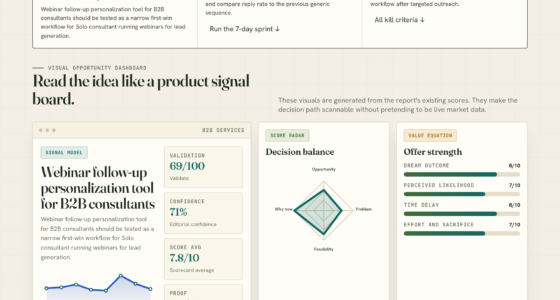

📊 Full opportunity report: IdeaClyst: The Validation Council on ThorstenMeyerAI.com — validation score, market gap, and execution plan.

Prime made for students and young adults
- Fast, free delivery for dorm and study essentials
- Prime Video and Amazon Music included
- Member-only deals
TL;DR
IdeaClyst has launched a new validation council that employs opposing AI models to rigorously stress-test ideas before they are approved for development. This structured process aims to improve decision accuracy and reduce costly failures.
IdeaClyst has introduced a new AI-driven validation council that uses opposing models to rigorously evaluate ideas before they are approved for development, aiming to improve decision quality and reduce costly failures. You can learn more about how IdeaClyst functions as the engine that decides what’s worth building.
The validation council is built around two models, Claude and Codex, which are tasked with cross-examining ideas from opposing perspectives. Before deliberation, a research pre-step gathers relevant context and evidence, ensuring discussions are evidence-based. The council then follows a five-step process: framing the idea, steelmanning it, red-teaming it, checking evidence, and providing an auditable verdict. This process aims to identify weak ideas early, saving resources and preventing flawed projects from proceeding. IdeaClyst is developed privately and is not publicly available. It runs locally, making it cost-effective and provider-agnostic, as models can be swapped or combined freely. For a deeper understanding of the platform, see A War Room for Your Next Idea: Inside IdeaClyst. While it cannot guarantee market validity or eliminate all errors, it offers a structured, repeatable way to improve decision-making accuracy and accountability in idea validation.IdeaClyst — the validation council
Most ideas don’t die from being bad — they die from being plausible and untested. A research pre-step, then two models cross-examining the idea before it earns a roadmap slot.
Independent commentary, produced with AI assistance under human editorial oversight. The views are the author’s own and may change. IdeaClyst is developed privately and is not publicly available. The council’s research, deliberation and verdicts are produced by automated models and may contain errors or shared blind spots — a verdict is auditable reasoning, not validated demand; verify independently before committing. Product and company names are trademarks of their respective owners; mention does not imply endorsement.
Why Structured Model Disagreement Improves Decision-Making
By employing opposing AI models, IdeaClyst’s validation council introduces a formal mechanism for structured disagreement, which helps surface weaknesses in ideas that might otherwise be overlooked. This approach reduces the risk of costly failures stemming from unchallenged assumptions or groupthink. It also enhances transparency, as the reasoning behind decisions is fully auditable. For businesses, this means more reliable early-stage vetting, potentially saving time and resources, and improving the quality of strategic choices. The provider-agnostic design further ensures that the system can be integrated into diverse workflows without vendor lock-in, fostering broader adoption of rigorous idea evaluation practices. To see how IdeaClyst fits into innovative decision-making, visit A War Room for Your Next Idea: Inside IdeaClyst.
As an affiliate, we earn on qualifying purchases.
Background on Idea Validation and AI Model Use
Traditional idea validation often relies on subjective judgment or single-model AI assessments, which can be prone to confirmation bias and overconfidence. Recent developments in AI have shown that using multiple models with contrasting perspectives can improve reliability, but structured frameworks for such disagreement are rare. IdeaClyst builds on this trend by formalizing a multi-model, evidence-based process designed to catch weak ideas early. Its approach aligns with broader efforts to make AI-assisted decision-making more transparent, accountable, and effective, especially in high-stakes or resource-intensive environments.
“Using opposing models to evaluate ideas ensures that only the most robust concepts survive the stress test, reducing costly errors downstream.”
— Thorsten Meyer, founder of IdeaClyst
Limitations of Model-Based Disagreement in Idea Validation
While the council’s structure promotes rigorous evaluation, it cannot guarantee the correctness of ideas or eliminate all biases shared among models. Both Claude and Codex can share training blind spots, and their disagreement does not necessarily reflect real-world validity. Additionally, the process may create an appearance of rigor that could obscure underlying uncertainties, making it essential for operators to interpret results critically. The effectiveness of the council depends on the quality of research inputs and the diversity of models used, which are still evolving aspects.
Next Steps for Adoption and Improvement of IdeaClyst
Following its launch, IdeaClyst plans to expand its model ecosystem, integrating additional AI models to diversify perspectives. User feedback and case studies will inform refinements to the five-step process and research inputs. The team aims to promote adoption among early users, particularly in high-stakes industries like tech and finance, where rigorous idea validation can significantly reduce risks. Future updates may include enhanced transparency features, better evidence integration, and educational resources to maximize the system’s utility and trustworthiness.
Key Questions
How does IdeaClyst differ from traditional idea evaluation methods?
Unlike subjective or single-model assessments, IdeaClyst employs a structured, multi-model debate process that emphasizes evidence and transparent reasoning, reducing biases and increasing reliability.
Can the validation council guarantee the market viability of an idea?
No, the council can only evaluate internal consistency, evidence, and robustness of the idea. Market validation still depends on external factors and real-world testing.
Is IdeaClyst vendor-agnostic?
IdeaClyst is developed privately and is not publicly available. It is designed to run locally on owned hardware, supporting model interchangeability and avoiding vendor lock-in.
What are the main limitations of the model disagreement approach?
Models can share blind spots and produce confidently wrong conclusions. Disagreement does not ensure truth and may create an illusion of certainty if not critically interpreted.
How will IdeaClyst improve decision-making in organizations?
By providing a repeatable, transparent process for early-stage idea vetting, it helps organizations avoid costly mistakes and make more informed strategic choices.
Source: ThorstenMeyerAI.com
Fall Picks
fall essentials
As an affiliate, we earn on qualifying purchases.