
📊 Full opportunity report: Acoustic Dampening, Placement, and the “Rig in the Closet” Setup on ThorstenMeyerAI.com — validation score, market gap, and execution plan.
TL;DR
This article explains the most effective methods to reduce noise from high-power AI workstations, emphasizing placement strategies like moving the rig to another room and using the ‘rig in the closet’ setup with proper ventilation. It highlights the importance of distance, isolation, and airflow to manage heat and sound.
Putting an AI workstation in a closet or another room, coupled with proper ventilation, is the most effective way to drastically reduce noise levels in a workspace, according to technical experts.
Experts emphasize that the most impactful method to dampen noise from high-power AI rigs is to increase the physical distance between the machine and the user. Moving the rig into a separate room, such as a closet or basement, eliminates the need for complex acoustic treatments on the workstation itself, as the sound no longer reaches the workspace directly. Moving the rig into a separate room, such as a closet or basement, eliminates the need for complex acoustic treatments on the workstation itself, as the sound no longer reaches the workspace directly.
The ‘rig in the closet’ setup involves placing the machine in a sealed or semi-sealed enclosure. While this significantly reduces airborne noise, it introduces heat management challenges. Without proper ventilation, trapped heat can cause the hardware to throttle, increase fan noise, and risk overheating. Experts recommend integrating active ventilation, such as exhaust fans and ducted airflow, to maintain safe operating temperatures.
Additionally, the article discusses the importance of addressing structure-borne noise through anti-vibration pads and rubber feet, which can eliminate hums transmitted through desks or floors. Combining these strategies results in a quieter, more efficient setup that does not rely solely on acoustic foam or other absorption materials, which are less effective for airborne and structure-borne noise.
Acoustic dampening
& the rig in the closet.
The most powerful noise fix isn’t a material — it’s a floor plan. A rig you can’t hear because it’s in another room beats any amount of foam. Tap the approaches in Part 1 to see what actually works.
(another room)
(levers 1–4)
(door / barrier)
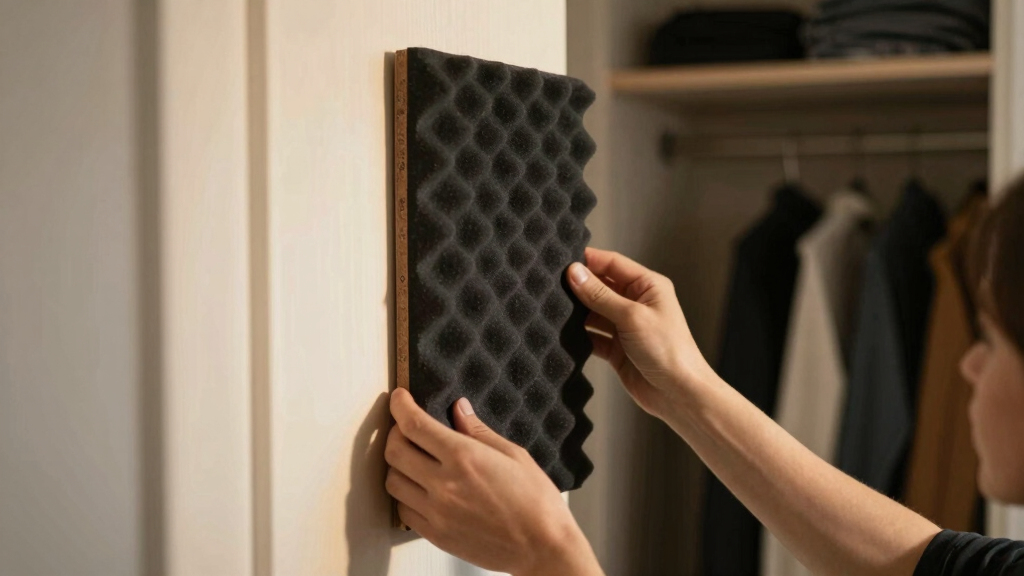
(acoustic foam)
Contain the noise, not the heat
Why Placement and Ventilation Are Critical for Quiet AI Workstations
Implementing strategic placement and proper ventilation techniques can dramatically improve workspace comfort by reducing noise and heat. This approach is especially relevant for professionals who use AI rigs regularly, as it minimizes distractions and preserves hardware longevity. The 'rig in the closet' method, when done correctly, offers a practical and scalable solution that can be adapted to various environments, making it a key consideration for anyone deploying high-power AI hardware.

TroyStudio Portable Sound Proof Box, 16" x 12" x 16.2" Noise Reduction Enclosure, Light Blocking Quiet Cover, Soundproof Barrier for Ultrasonic Cleaner, Air Pump, Rock Tumbler & Generator
- Dimensions and Components: 16x12x16.2 inch foldable design
- Noise Reduction Capability: Reduces noise up to 21.5dB
- Light Blocking: Prevents light leakage for sleep
As an affiliate, we earn on qualifying purchases.
As an affiliate, we earn on qualifying purchases.
Background on Noise Management for High-Power AI Rigs
Traditionally, noise mitigation for high-performance hardware has focused on acoustic foam and soundproofing within the same room. However, experts increasingly recommend moving the hardware away from the workspace entirely. Recent discussions highlight the effectiveness of physical separation, especially as AI workloads generate significant heat and noise, which are difficult to control solely through passive materials. The concept of placing rigs in closets or dedicated enclosures has gained popularity as a practical solution, provided heat dissipation is managed properly.
"The most effective way to reduce noise isn't just absorption — it's moving the rig into another room or closet where sound can't reach you. Proper ventilation is essential to prevent overheating."
— Thorsten Meyer, AI hardware expert
Remaining Challenges in Noise and Heat Management
While the advantages of moving the rig to another room are clear, the optimal design of ventilated enclosures and soundproof cabinets remains an area of ongoing development. Specific best practices for ducting, airflow control, and material choices are still being refined, and costs can vary significantly based on setup complexity.
Additionally, the impact of different hardware configurations on heat dissipation in enclosed spaces is still being studied. It is not yet confirmed how different GPU models and workloads influence the effectiveness of ventilation strategies in a closet or cabinet environment.
Next Steps in Implementing Quiet AI Workstation Setups
Hardware manufacturers and acoustic engineers are expected to develop more integrated solutions, such as purpose-built soundproof cabinets with optimized airflow and temperature control. Users should monitor advances in active cooling systems and enclosure designs to improve their setups.
Practitioners are advised to test different ventilation configurations and measure ambient temperatures to ensure hardware safety. Future research may also clarify the best practices for balancing noise reduction with effective heat dissipation in enclosed environments.
Key Questions
Is placing my AI rig in a closet enough to make it silent?
Placing the rig in a closet can significantly reduce noise, but proper ventilation is essential to prevent overheating. Without active airflow, heat buildup can cause throttling and hardware damage.
What are the main challenges of a 'rig in the closet' setup?
The primary challenge is managing heat. Sealed or semi-sealed enclosures require ducted airflow, exhaust fans, and temperature controls to keep the hardware cool and functioning optimally.
Can I use acoustic foam instead of moving the rig to another room?
Acoustic foam primarily reduces reflections and echo within a room but is ineffective at blocking airborne or structure-borne noise. Moving the rig away is far more effective for noise reduction.
What hardware modifications are recommended for quiet operation?
Using anti-vibration mounts, rubber feet, and low-noise fans can help reduce structure-borne noise. Ensuring adequate ventilation is also critical to prevent overheating and noise from fans ramping up.
Source: ThorstenMeyerAI.com