
TL;DR
IdeaClyst is a local-first AI tool that acts as a personal war room for your ideas. It combines structured debate, research, and planning to help you pick the best path forward, faster and more confidently. It’s like having a boardroom of critics on your laptop—without the cloud or subscription fuss.
Ever been stuck staring at three promising ideas, unsure which one will actually fly? Or maybe you’ve seen startups pour six months and thousands of dollars into the wrong product, just because they didn’t question their assumptions enough. That’s where a war room — not a battlefield, but a strategic hub — becomes your secret weapon.
And now, thanks to tools like IdeaClyst, you don’t need a physical war room with whiteboards and sticky notes. Instead, you get a digital, local-first space that acts as your brain’s best critic and co-pilot. This isn’t about just brainstorming; it’s about making decisions you can defend to investors, your team, or even your future self. Ready to see how it works? Let’s dive into this game-changing idea-planning hub.
A war room for your next idea
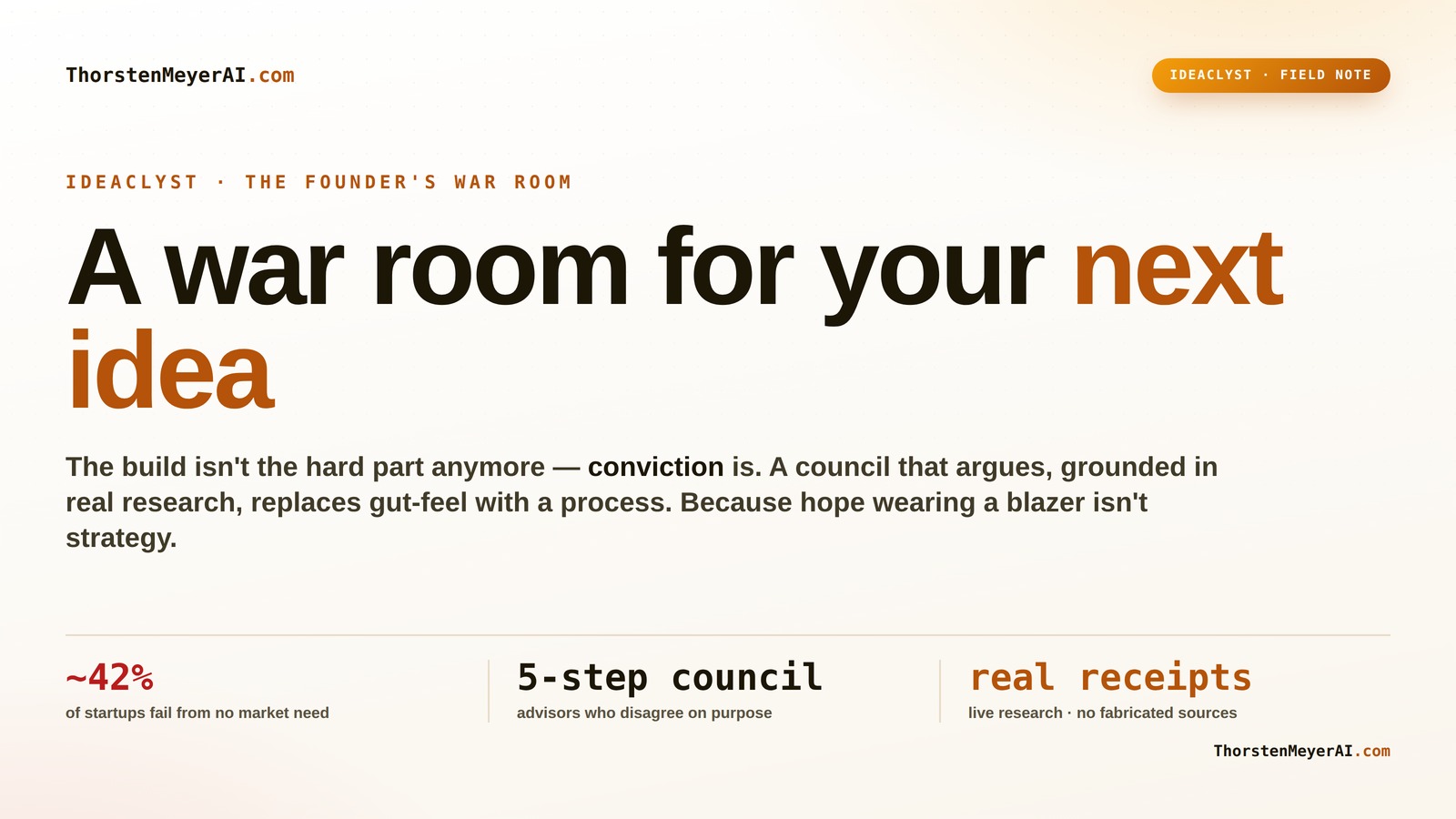
The build isn’t the hard part anymore — conviction is. Knowing which idea deserves the next six months, and being able to defend it. Most founders answer with gut feel and optimistic math. That’s hope wearing a blazer. IdeaClyst replaces it with a process.
The most expensive decision is what to build
The single most valuable thing a tool can do is talk you out of the wrong six months. The numbers make the case better than any pitch.
Three tools in one — on your own machine
Strip away the framing and IdeaClyst is three things at once, all running locally with nothing leaving your laptop.
An AI council
Pressure-tests an idea you bring it — advisors who argue on purpose.
A discovery engine
Finds ideas you didn’t know to look for by hunting real demand signals.
A founder’s workspace
Carries winners from “interesting” all the way to “ready to build.”
Advisors who disagree on purpose
Not one confident, agreeable answer — a structured five-step deliberation where models play different roles and turn on their own work. The disagreement is the feature.
The five-step deliberation
A council that leads with the bad news surfaces the objections you’d otherwise find the expensive way, on month five.
Product strategy
Who’s it for, what’s the wedge, why now, what’s the business model.
Technical architecture
What would it actually take to build — and where’s the risk.
Critique pass
The council turns on its own work. Where’s the hand-waving? What kills this?
Second, independent critique
A different voice, a different angle — so blind spots don’t survive.
Final synthesis
Everything into one coherent founder packet: strategy, architecture, validation, plan.
When IdeaClyst cites a source, it actually fetched it
The hard departure from “ask an AI what it thinks of my startup.” It runs in a strict, real-data-only mode — if it can’t gather genuine evidence, it says so plainly rather than inventing a plausible paragraph.
Confidence with receipts
No fabricated statistics, no imaginary competitors, no made-up citations. The packet survives a skeptical co-founder or a sharp investor because the reasoning has receipts.
Market research first
Scouts the landscape before the council reasons about anything.
Competitor read
Real positioning, pricing signals, feature claims — differentiation vs. reality.
Validation with links
Not “talk to customers” — concrete signals & sources you can click.
From the blank page to build-ready
Evaluation is half the problem; the blank page is the other half. And a plan is worthless if it dies in a tab you never reopen.
Bring a space, not an idea
“AI for accountants,” “tools for indie game studios” — plus your goal and real capacity. It hunts demand signals across HN, Reddit, Product Hunt, GitHub, pricing pages.
- An honest market read — leads with the bad news when a space is hard
- An opportunity map — high pain, thin competition
- Ranked candidates — wedge, who pays, effort, risk, confidence
- each with KILL CRITERIA — when to walk away
A home and a forward path
Every promising idea gets carried forward, with every artifact in plain files on your disk.
- Validation tooling — sprint board, interview list, evidence browser
- Founder profile — a personal-fit lens; same discovery, different advice
- Build workspaces — funnel, personas, landing draft, version history
- “Build this idea” → a PRD + task queue, ready for a coding agent
Key Takeaways
- A structured war room, like IdeaClyst, surfaces hidden risks and assumptions early, saving you months and thousands of dollars.
- Grounding debates in real-time web research prevents costly mistakes based on outdated or inaccurate info.
- A local-first setup keeps your ideas private, giving you full control over your data and collaboration.
- The AI council’s structured disagreement reveals flaws most founders miss, making your plans more defendable.
- Set up your war room with clear sections, regular updates, and honest debate to stay focused and effective.
digital whiteboard for idea planning
As an affiliate, we earn on qualifying purchases.
As an affiliate, we earn on qualifying purchases.
What Is an IdeaClyst War Room — and Why You Need One
An IdeaClyst war room is a structured, private space—digital or physical—where you and your team gather to debate, validate, and refine your ideas. Unlike a simple project board or meeting, it’s designed to surface weaknesses and strengthen your plan through a series of deliberate, high-stakes discussions.
Imagine a startup founder, Alex, who’s torn between launching a new app or pivoting to a different market. Instead of relying on gut feeling, Alex feeds the idea into IdeaClyst. The tool’s AI council debates the market size, technical risks, and customer fit, revealing blind spots and giving Alex a clearer picture. That’s the power of a war room — making sure your best idea isn’t just the loudest one in the room, but the smartest.
Having a dedicated war room like this matters because it shifts decision-making from intuition to a deliberate, evidence-based process. It encourages founders to challenge their assumptions openly, which reduces the risk of costly mistakes. The tradeoff, however, is that it requires discipline to maintain and update the space regularly—without that, the insights can become outdated or superficial. In essence, it’s about creating a culture of honest critique and continuous improvement that can dramatically improve your chances of success.
How IdeaClyst’s AI Council Turns Idea Validation Into a Debate
IdeaClyst’s secret sauce is its AI council — a structured debate between models playing different roles. It’s like having a panel of expert critics, each with their own perspective, arguing the merits and flaws of your idea.
Here’s how it works: you start by submitting a brief idea. The council then runs through five steps: product strategy, technical risk, a harsh critique, a second independent critique, and finally, a synthesis of insights into a clear, actionable plan. Instead of a single, often overly optimistic answer, you get a balanced debate that highlights weak spots and overlooked risks.
This debate format is powerful because it mimics real-world decision-making, where different stakeholders and experts challenge each other. It exposes assumptions that might seem obvious but are actually fragile, forcing you to defend your idea against scrutiny. The tradeoff is that this process takes time and requires honest engagement from all team members. However, the payoff is a more robust, well-vetted plan that’s less prone to surprises or failures once in the market.
Why Grounding in Real Research Matters — Not Just Model Vibes
Many AI tools offer confident-sounding answers that are more about vibes than facts. Not IdeaClyst. It’s grounded in real-time web research, pulling in fresh data to challenge or confirm assumptions.
Say you’re exploring a new vertical. Instead of relying on outdated industry reports, IdeaClyst fetches the latest news, trends, and competitive landscapes. This ensures your debates are anchored in current realities rather than assumptions based on stale data. The implication is that your decisions are more accurate and timely, reducing the risk of pursuing strategies that no longer fit the market conditions. The tradeoff is that real-time research can sometimes introduce noise or conflicting data, so it’s crucial to interpret findings critically. Nonetheless, this approach helps you avoid the common pitfall of building on outdated or inaccurate information, which often leads startups astray.
The Local-First Difference — Why It’s a Game-Changer
Most AI tools rely on the cloud, but IdeaClyst keeps everything on your machine. No cloud, no subscriptions, no data leaving your laptop. That’s a big deal for founders who value privacy and control.
Imagine working on a secret project for months, knowing your ideas stay safe on your own disk. Or collaborating with a team that’s skeptical of cloud storage. IdeaClyst writes all reports, critiques, and plans as plain Markdown files—yours to keep, version, and even customize.
This local-first approach isn’t just about privacy. It’s about trust. By keeping data on your device, you avoid vulnerabilities associated with cloud breaches and data leaks, which are increasingly common concerns. Additionally, it allows you to work offline without interruption, crucial for remote or field work where internet access may be unreliable. The tradeoff is that you’re responsible for managing your data, but with good organization, this provides a higher level of security and control. Overall, it empowers founders to build and refine their ideas in a private, flexible environment that adapts to their workflow.
Building Your Own Digital War Room — Best Tips for Setup
- Choose a dedicated, highly visible workspace—digital or physical—that everyone can access easily, like a shared Notion workspace.
- Keep it simple: use clear, concise labels and organize information logically—product, tech risks, customer feedback.
- Update regularly: treat it like a living document. The war room is a process, not a one-time setup.
- Encourage honest debate: use the AI council’s critiques to challenge assumptions, not just confirm them.
- Integrate with your existing tools: link to customer data, prototype files, or project trackers to keep everything connected.
Common Mistakes and How to Avoid Them
One big trap is turning the war room into clutter — a place where ideas go to die. Keep it focused. Regularly review and prune outdated or irrelevant info. Make sure every entry serves a purpose.
Another mistake is relying too much on the AI council without human judgment. Remember, the tool is a guide, not the final boss. Use your intuition and customer conversations to validate and refine the AI’s critique.
Lastly, avoid the temptation to skip the debate stage. The structured disagreement is what reveals hidden flaws. Without it, you risk building on shaky ground.
For instance, a founder who ignored the council’s critique on technical risk ended up with a product that couldn’t scale — costly lessons learned the hard way.
Your Questions About Building and Using a War Room Answered
Q1: Do I need a physical space for a war room?
A: Not necessarily. A digital or portable setup works just as well, especially for remote teams. The key is visibility and regular use.
Q2: What should I put inside my war room?
A: Focus on core info: product ideas, technical risks, customer feedback, critiques, and action plans. Keep it simple and updated.
Q3: How often should I revisit the war room?
A: Regularly. Weekly or bi-weekly reviews help keep ideas fresh and decisions sharp — it’s a living document, not a static file.
Q4: Can small or remote teams use this effectively?
A: Absolutely. Digital, local-first war rooms are perfect for distributed teams. They foster collaboration and transparency, no matter where you are.
Conclusion
Think of your idea war room as the command center for your next big move. It’s where you turn gut feelings into confident decisions, armed with real research and honest critique. With tools like IdeaClyst, you get a private, debate-driven space that helps you see what others overlook — a true advantage in a crowded market.
Start building your digital war room today. Your future self — and your next big idea — will thank you for it.