TL;DR

Prime made for students and young adults
- Fast, free delivery for dorm and study essentials
- Prime Video and Amazon Music included
- Member-only deals
NASA says four volunteers in its CHAPEA Mission 2 simulation are scheduled to leave their habitat on Oct. 31, completing 378 days in isolation at Johnson Space Center. The agency says the mission’s health and performance data may help prepare for future lunar and deep-space missions; the simulation is not a Mars flight.
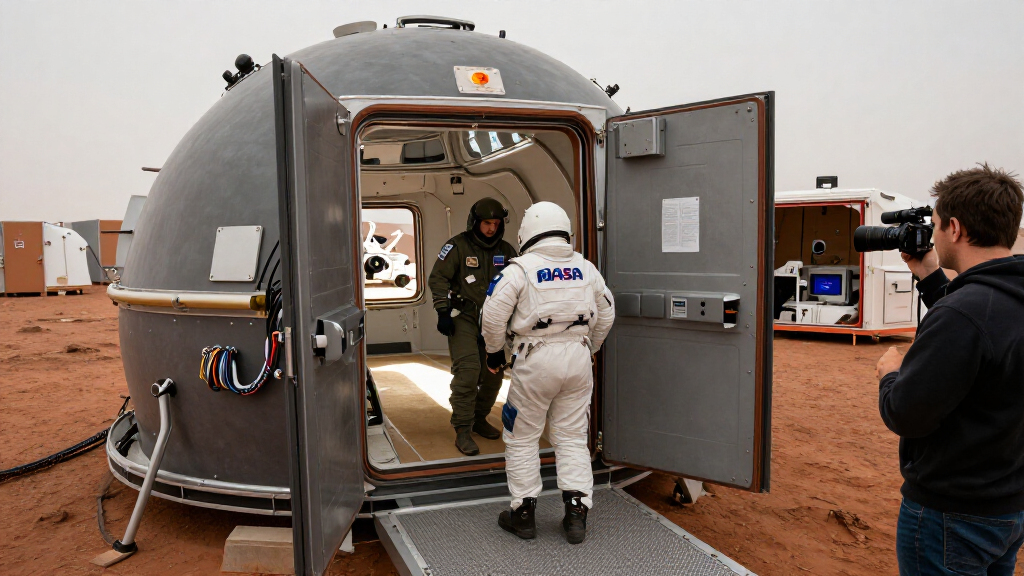
NASA says four volunteers in its second Crew Health and Performance Exploration Analog mission are scheduled to leave a simulated Mars habitat at Johnson Space Center in Houston on Oct. 31, completing 378 days in isolation. The agency has invited media to watch the exit, which marks the planned end of a yearlong study of how people live and work under conditions designed to resemble a deep-space mission.
The crew members—Ross Elder, Ellen Ellis, James Spicer and Matthew Montgomery—have lived in a 1,700-square-foot, 3D-printed facility while NASA researchers collected health and performance data. NASA’s announcement says the crew carried out simulated mission operations, including spacewalk exercises, habitat maintenance, exercise and plant growing. The activities took place under constraints intended to reflect some pressures of future missions, including communication delays, limited resources and isolation.
NASA plans to provide live coverage of the crew’s departure beginning at 3 p.m. EDT on Oct. 31, through NASA Johnson’s YouTube channel and social media accounts. Johnson Space Center Director Vanessa Wyche and NASA astronaut Jack Hathaway are scheduled to give remarks, as are the four crew members. In-person media may watch the ceremony on a screen outside the hangar that houses the habitat and, afterward, speak with a subject matter expert. NASA says media will also be able to capture the crew stepping outside after more than a year inside.
The agency’s notice says U.S. media seeking in-person access, or journalists seeking a virtual conversation with crew members in the days after the mission, must contact the Johnson Space Center newsroom by 2 p.m. EDT on Friday, Oct. 30. The notice describes the departure as planned; it does not report that the crew has already exited.
How the Simulation Informs Lunar Missions
The study is intended to help NASA understand how mission conditions can affect crew health, performance and daily operations. The agency says its data may inform preparation for future Artemis missions and possible lunar base operations, even though CHAPEA is a ground-based simulation rather than a journey to Mars or the Moon.
NASA identifies several practical areas where findings could be useful: food system design, crew time management and communications bandwidth on the Deep Space Network. Researchers may also use the results to strengthen medical care and behavioral support for people on space missions. These needs become more demanding when crews are far from Earth and communication delays or restricted resources limit immediate support.
The mission’s value lies in testing routines and gathering human-performance information under controlled constraints. It cannot reproduce every feature of a real spaceflight, but it gives NASA a setting to study how volunteers respond to extended isolation and operational demands before planning longer missions.
Products Worth Considering

Apple iPad Air 11-inch (M2), 512GB, Wi-Fi, Space Gray

Apple iPad Air (2025) 13‑inch Wi‑Fi 256 GB – Space Gray (M3 chip)

DJI Osmo Pocket 4 Gimbal Camera Pro Kit, 18-Piece Bundle
As an affiliate, we earn on qualifying purchases.
Inside the 378-Day CHAPEA Mission
CHAPEA stands for Crew Health and Performance Exploration Analog. NASA operates the program at Johnson Space Center, using a habitat designed to simulate selected aspects of living on another world. Mission 2 began on Oct. 19, 2025, according to the agency’s announcement, and the planned exit date is Oct. 31 after 378 days.
During the simulated mission, the crew followed a schedule of activities intended to reflect mission work and habitat life. NASA says the volunteers conducted simulated spacewalks, exercised, maintained their living space and grew plants. The agency also imposed conditions such as communication delays, resource limits and isolation, which are relevant to planning for crews operating far from Earth.
NASA describes CHAPEA as one source of information for future human exploration, including Artemis and potential Moon Base missions. The program’s findings are intended to support planning for the demands of deep-space living; the announcement does not say that this single mission will establish a definitive solution to those challenges.
Limits of the Mission’s Findings
NASA’s announcement describes the planned schedule and intended uses of the data, but does not provide specific results, measurements or study findings from Mission 2. It is not yet clear when the agency will publish a detailed analysis or how researchers will distinguish the effects of individual stressors such as isolation, delays and resource restrictions.
The simulation also does not reproduce all conditions of an actual lunar or Mars mission. The announcement does not claim that the habitat replicates launch, microgravity, radiation exposure or the full risks of operating on another world. The extent to which the findings will apply to real missions will depend on the data and how NASA assesses them.
The Oct. 31 departure is described as scheduled, rather than completed. NASA’s notice does not state whether any changes to the timing or event arrangements are expected.
Crew Exit and Data Analysis
NASA’s next public milestone is the scheduled Oct. 31 crew exit, with live coverage beginning at 3 p.m. EDT. The agency says the crew and NASA officials will speak during the ceremony, and an expert will be available to answer questions for attending media. Journalists seeking access must meet the Oct. 30 newsroom deadline set in NASA’s notice.
After the crew leaves the habitat, NASA says media may be able to speak virtually with the participants in the following days. The agency has not given a timetable in this notice for releasing research results. Further information on the mission and program is available through NASA’s CHAPEA materials.
Key Questions
When are the CHAPEA volunteers scheduled to leave the habitat?
NASA says the four volunteers are scheduled to exit on Saturday, Oct. 31, after 378 days in isolation. Live coverage is scheduled to start at 3 p.m. EDT.
Who are the four crew members?
The Mission 2 crew members are Ross Elder, Ellen Ellis, James Spicer and Matthew Montgomery, according to NASA.
Was this an actual mission to Mars?
No. CHAPEA is a ground-based simulation at Johnson Space Center in Houston. The crew lived in a habitat and performed simulated mission activities; they did not travel to Mars.
What does NASA hope to learn from the simulation?
NASA says the health and performance data may help inform food systems, crew schedules, communications planning, medical care and behavioral support for future lunar and deep-space missions.
When will NASA release the study’s findings?
The announcement does not provide a publication date or detailed results. It says the data can support future planning, but the timing and contents of a formal analysis remain unclear.
Source: nasa.gov