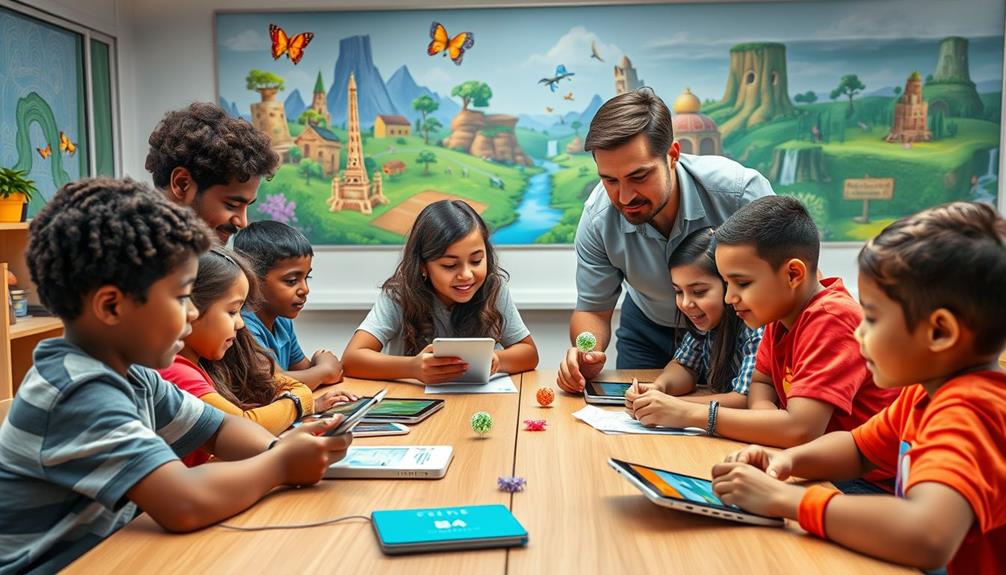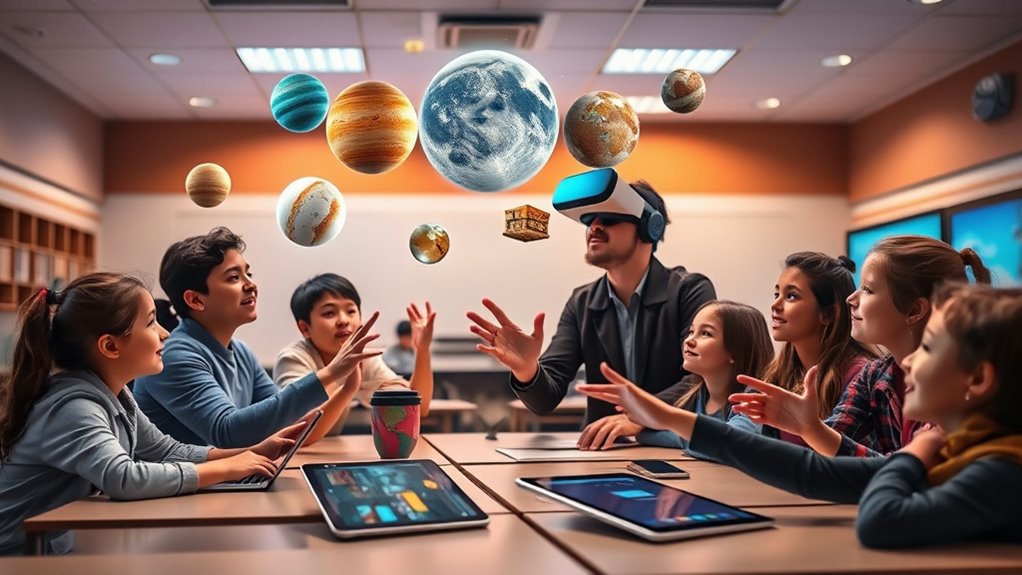

Augmented reality in education allows you to create immersive, interactive learning experiences that boost engagement and understanding in your classroom. By incorporating AR tools, you can transport students to distant locations, manipulate 3D models, and explore complex systems firsthand. This technology makes lessons more dynamic, encourages curiosity, and supports collaboration among students. As AR continues evolving, you’ll discover even more ways to make learning fun and effective—keep exploring to see how it transforms your teaching.
Key Takeaways
- AR transforms traditional lessons into immersive, interactive experiences, increasing student engagement and retention.
- Virtual field trips with AR allow students to explore distant or complex locations without leaving the classroom.
- AR-enhanced textbooks incorporate 3D models and animations for deeper understanding of complex concepts.
- Collaborative AR activities promote teamwork, communication, and problem-solving skills among students.
- The integration of AR in classrooms fosters personalized, gamified learning tailored to diverse student needs.
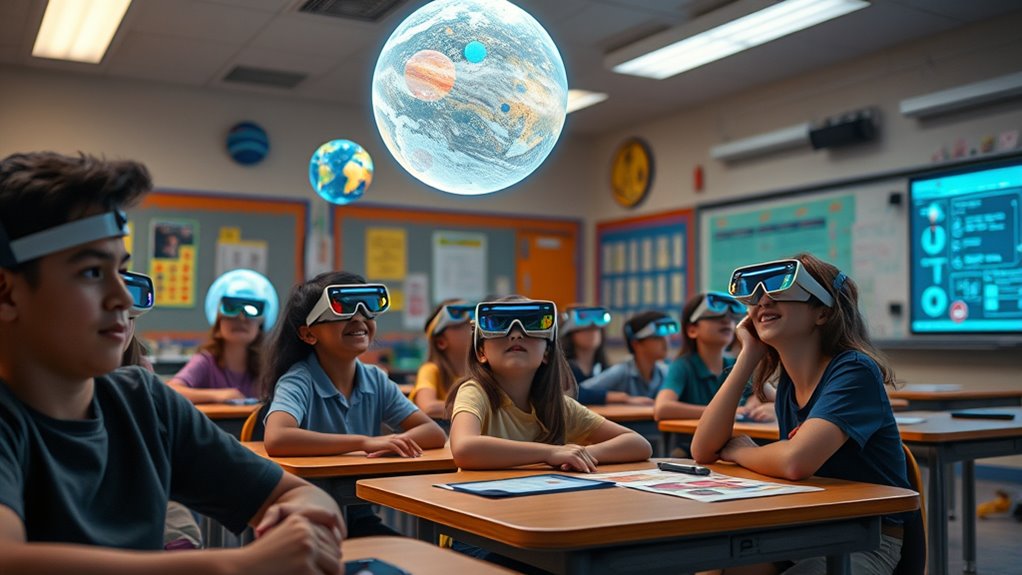
Augmented reality (AR) is transforming education by bringing immersive and interactive experiences directly into the classroom. Instead of relying solely on textbooks or lectures, you now have the opportunity to explore virtual field trips that transport you to distant places without leaving your seat. With AR devices, you can walk through ancient ruins, tour the inside of a human body, or visit the surface of Mars, all from your classroom. These virtual excursions make learning more engaging and memorable, helping you grasp complex concepts by experiencing them firsthand. No longer are you limited by physical constraints or geographic boundaries; AR makes it possible to explore the world in ways that were once impossible.
AR brings immersive virtual field trips into classrooms, making learning engaging and memorable without leaving your seat.
In addition to virtual field trips, AR enhances traditional materials by turning them into immersive textbooks. These textbooks don’t just contain words and static images—they come alive with 3D models, animations, and interactive elements. When you open an AR-enabled textbook, you can manipulate a 3D model of a cell, observe the layers of the Earth, or see how a machine works through interactive simulations. This active engagement helps you understand subjects more deeply, as you can explore content from different angles and test hypotheses in real time. The integration of AR into textbooks also caters to different learning styles, making education more personalized and accessible. Incorporating educational technology like AR transforms the way students interact with content, leading to more effective learning outcomes. Additionally, secure data management ensures that your progress and interactions are protected during these immersive experiences. Furthermore, continuous advancements in AR hardware are making these tools more affordable and easier to use in classroom settings.
As you use AR tools, you’ll notice that lessons become more dynamic and participatory. Instead of passively absorbing information, you’re encouraged to explore, ask questions, and experiment. This hands-on approach boosts retention and makes learning fun. Teachers can tailor AR experiences to suit various curricula, making lessons more relevant and enthralling. For example, in science class, you might virtually dissect a frog, or in history, you could walk through a reconstructed ancient city. These experiences foster curiosity and critical thinking, because you’re actively involved in your own learning process. Additionally, integrating high-quality visual content like 3D models and animations significantly enhances comprehension and retention. Using interactive learning tools also encourages students to develop problem-solving skills and adapt to new technologies, preparing them for future challenges.
Moreover, AR encourages collaboration. You and your classmates can work together on interactive projects or explore virtual environments collectively. This shared experience promotes communication and teamwork, essential skills for the modern world. As AR continues to advance, expect even more innovative applications in education—like gamified learning modules and personalized AR tutors—that will make education more engaging, effective, and tailored to your needs. Overall, AR is revolutionizing the way you learn by making education more immersive, interactive, and fun.
Top picks for "augment reality education"
Open Amazon search results for this keyword.
As an affiliate, we earn on qualifying purchases.
Frequently Asked Questions
How Affordable Is Augmented Reality Technology for Schools?
You might wonder about the affordability of augmented reality technology for schools. Conducting a cost analysis helps you understand expenses, including devices and software. Funding options like grants, partnerships, or government programs can make AR more accessible. While initial costs vary, many schools find that investing in AR provides valuable interactive learning experiences, ultimately justifying the expense through improved student engagement and understanding.
What Training Do Teachers Need to Implement AR?
When implementing AR, you need proper teacher training to guarantee effective use. Focus on curriculum integration strategies that align AR tools with learning objectives. You’ll benefit from workshops, hands-on practice, and ongoing support to build confidence. By mastering AR applications and lesson planning, you can seamlessly incorporate this technology into your teaching, enriching student learning experiences and making lessons more interactive and engaging.
ARe There Privacy Concerns With AR in Classrooms?
You should consider privacy concerns when using AR in classrooms, especially around student privacy and data security. AR apps often collect personal data, which could be vulnerable if not properly protected. To guarantee safety, you need to review the app’s privacy policies, implement secure data handling practices, and inform students and parents about how their information is used. Prioritizing these steps helps protect student privacy and maintains trust.
How Do Students With Disabilities Benefit From AR?
You see, students with disabilities benefit from AR through assistive tools that enhance their learning experience. AR provides accessibility benefits by offering customized visual, auditory, and tactile support, making lessons more inclusive. It helps students better understand complex concepts, improves engagement, and promotes independence. By integrating AR, you create a more equitable classroom environment where every student has the opportunity to thrive and learn effectively.
What ARe the Technical Requirements for AR Integration?
Imagine building a bridge where hardware compatibility is the foundation and software development is the architecture. To integrate AR, you need compatible devices like tablets or smart glasses, guaranteeing they work seamlessly with your system. You also require robust software development to create interactive content. This combination ensures smooth, engaging AR experiences in classrooms, making learning more immersive and accessible, just like a well-constructed bridge connecting ideas and students effortlessly.
Conclusion
As you explore augmented reality in education, you realize how this technology transforms learning into an unforgettable experience. It’s incredible to think that just when you needed a new way to engage students, AR appeared, making lessons come alive right before your eyes. This coincidence reminds you that innovation often arrives when you least expect it, opening doors to a future where education is not just taught but truly experienced. Embrace this change—your students will thank you.