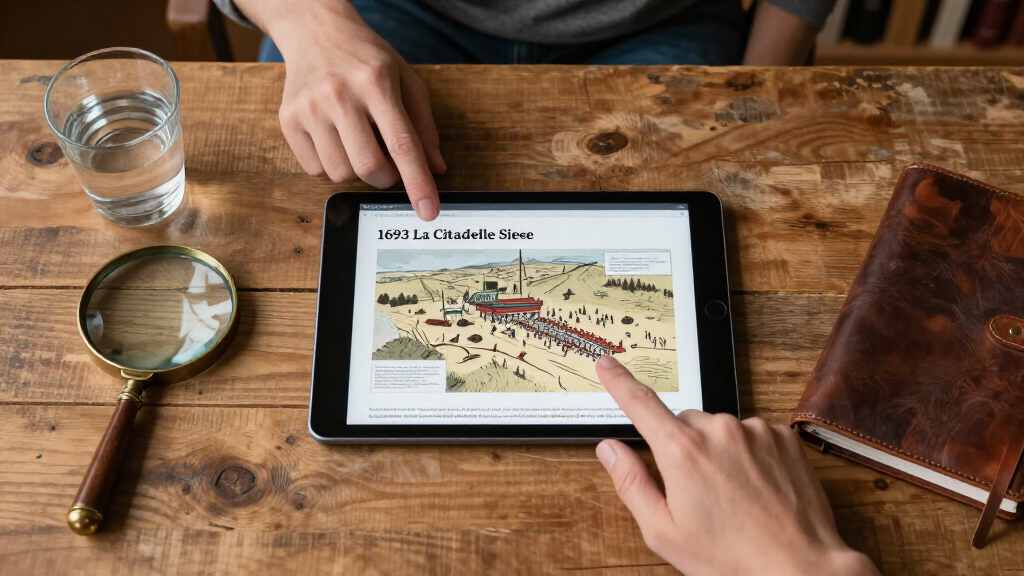
🔍 Read the full analysis: Reviving History With AI: The 1693 La Citadelle Siege Digital Archive on ThorstenMeyerAI.com
TL;DR
An AI-created digital archive offers an interactive simulation of the 1693 La Citadelle siege, combining layered SVGs, CSS, and canvas elements. It aims to preserve and present history in a dynamic, cinematic format. The project is live and accessible for exploration.
A new AI-driven digital archive has been launched, offering an interactive reconstruction of the 1693 siege of La Citadelle in Montfaucon. Developed using layered SVGs, CSS, and canvas elements, the project provides a cinematic, scroll-driven experience that visualizes military movements and terrain with high fidelity. This initiative aims to preserve and interpret a key historical event through innovative digital storytelling, making it accessible to a broad audience.
The project, titled La Citadelle — An Anatomy of Siege, 1693, is hosted as an interactive exhibition that simulates the siege of a star-fortress using AI-powered site logic. It employs a layered architecture of SVG maps, animated trajectories, and textured overlays to recreate the event in a cinematic format without static images, ensuring scalability and responsiveness across devices. The development process involved a three-stage pipeline: initial construction, iterative critique driven by AI analysis, and final approval by an art director, ensuring both historical accuracy and aesthetic quality.According to the developers, the site uses a restrained color palette rooted in parchment and fortress ink tones, with vivid red accents to highlight key elements. The typography combines classical and modern fonts—Cinzel, EB Garamond, and Space Mono—to create a layered textual hierarchy. The signature interaction involves a multi-layered SVG siege map, where each layer—grid, fortress, trenches—is animated through JavaScript functions that simulate earthworks, artillery fire, and structural breaches. The cinematic ambiance is further enhanced through CSS transforms, parallax effects, and animated textures modeled after historical engravings, all built without external image assets.
Thorsten Meyer, the project’s lead, explained that the entire build process was guided by AI, from initial design to critique and refinement, with a focus on balancing educational content with artistic storytelling. The site’s full design notes are documented in a comprehensive guide, emphasizing layered architecture, precise interactions, and emotional depth rooted in the fictional siege narrative, as detailed in the original analysis. The project is hosted at https://fable-25-830.netlify.app/sites/citadelle and is designed to be flawlessly responsive at various screen widths.
Innovative Use of AI for Historical Preservation
This project demonstrates how AI can be harnessed to create immersive, educational experiences that bring history to life in new ways. By reconstructing a complex 17th-century siege using code-driven visualizations, it offers a scalable, dynamic alternative to static images or text-based history. The approach could influence future digital history projects, making historical events more accessible and engaging, especially for educational purposes. It also showcases how AI can streamline the creative process, ensuring both accuracy and aesthetic quality without traditional assets or external frameworks.
interactive history digital archive
As an affiliate, we earn on qualifying purchases.
As an affiliate, we earn on qualifying purchases.
Historical and Technological Foundations of the Digital Archive
The siege of La Citadelle in 1693 was a significant military event, involving complex fortification and siege tactics typical of the late 17th century. Historically, the event has been documented through engravings, maps, and scholarly analysis, but no interactive digital reconstruction existed until now. Recent advances in AI, web technologies, and digital storytelling have enabled the creation of highly detailed, cinematic simulations of historical events, blending visual fidelity with narrative depth. This project builds on prior efforts to digitize history but stands out for its fully code-driven, image-free approach that emphasizes scalability and artistic storytelling.
The development process involved a rigorous pipeline: initial layered SVG construction, iterative AI critique for visual coherence and historical plausibility, and final approval by an art director. The site’s design draws inspiration from engraved siege atlases and Vauban’s fortress geometry, translating these into animated, interactive diagrams that simulate military maneuvers, artillery fire, and structural damage. The project aligns with broader trends in digital humanities, where AI and web tech are used to reimagine how history is experienced and studied.
“This project exemplifies how AI can transform historical storytelling into an immersive, cinematic experience, making the past both accessible and visually compelling.”
— Thorsten Meyer
Remaining Questions About the Digital Reconstruction
While the project is live and accessible, details about the accuracy of the military movements depicted, the extent of AI’s role in critique and refinement, and the potential for future updates remain unclear. Developers have emphasized historical fidelity, but independent verification of the simulation’s accuracy has not been publicly provided. Additionally, it is not yet known how the project will be used in educational settings or whether similar approaches will be adopted for other historical events.
Future Developments and Potential Expansions
The team plans to monitor user engagement and gather feedback to refine the experience further. There is potential for expanding the archive to include more detailed narratives, interactive quizzes, or augmented reality components. Developers also aim to explore how AI can assist in creating similar reconstructions for other historical sieges and battles, potentially establishing a new standard for digital history exhibits. Further scholarly review and peer validation are expected to follow as the project gains visibility.
Key Questions
How accurate is the digital reconstruction of the 1693 siege?
The developers state that the simulation is based on historical maps, engravings, and military analysis, but independent verification of precise troop movements or artillery trajectories has not been published. It aims to balance historical plausibility with artistic storytelling.
Can I explore the site on any device?
Yes, the site is designed to be fully responsive and scalable across devices, including desktops, tablets, and smartphones, with optimized performance at various screen widths.
Will this project be expanded or updated?
The team plans to gather user feedback and may add more detailed narratives, interactive features, or expand to other historical events in future iterations.
Is the site suitable for educational use?
While designed to be educational, the site’s primary aim is to offer an immersive experience. Educators may find it useful as a visual supplement, but it is not a formal curriculum tool yet.
Source: ThorstenMeyerAI.com