
🔍 Read the full analysis: 15 AI Automation Tools To Consider For Small Business Operations on ThorstenMeyerAI.com

Prime made for students and young adults
- Fast, free delivery for dorm and study essentials
- Prime Video and Amazon Music included
- Member-only deals
TL;DR
This is a roundup of 15 books about applying AI automation to small-business work, not a list of software platforms. The source compares them by their stated topics and audiences; it does not verify their contents, integrations, or business results.
ThorstenMeyerAI.com has compared 15 books on AI automation for small businesses, presenting them as learning resources for owners considering changes to marketing, sales, customer service, and routine operations, as detailed in the original analysis. The roundup does not identify 15 automation products: readers would still need to choose the software and configure it to perform any workflow.
The roundup’s top overall choice is AI Automation for Small Businesses: A Practical Guide to Automating Marketing, Sales, Customer Service, Operations, and Everyday Work. The source favors its stated coverage across several business functions, while noting that this breadth may be less immediately guided than a narrower beginner resource.
For owners seeking a more structured entry point, the list highlights AI Automation Made Simple for Small Business, whose title signals a no-code focus, and ChatGPT for Business: The 10X Playbook, described as emphasizing workflow ideas that readers can adapt. Other titles point to themes such as practical implementation, everyday work, business growth, and set-up-yourself learning. The source does not provide enough information to confirm the books’ specific instructions or examples.
The comparison says it ranks titles using their stated audience, promised format, and named topics, rather than hands-on testing—a useful distinction when choosing AI tools for small-business tasks. It gives weight to practical workflow coverage, accessibility for nontechnical owners, and relevance to common business functions. No pricing, publication dates, independent reviews, or verified performance results are supplied.
The 15 picks
- 1
 Smart AI for Small Business: 50 Simple Hacks to Grow Revenue, Cut Costs, and…View on Amazon →
- 2
 The Small Business Owner’s AI Handbook: How to Use Artificial Intelligence to…View on Amazon →
- 3
 AI Tools for Small Business: A Practical Guide to Automation, Saving Time, an…View on Amazon →
- 4
 AI-Powered Automation and Workflows for Small Business OwnersView on Amazon →
- 5
 ChatGPT for Business: The 10X Playbook — 100 AI Workflows to Save Time, Grow…View on Amazon →
- 6
 AI Automation for Small Businesses: Build Smarter Workflows, Save Time, Reduc…View on Amazon →
- 7
 Claude AI Made Practical: A Beginner’s Guide to Everyday Work, Small-Business…View on Amazon →
- 8
 AI Automation for Small Businesses: A Practical Guide to Save Time, Work Smar…View on Amazon →
- 9
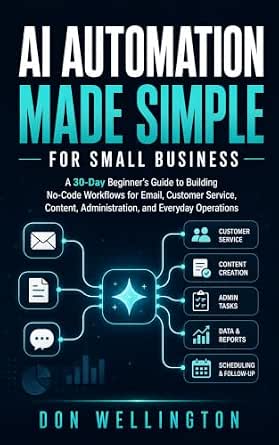 AI Automation Made Simple for Small Business: A 30-Day Beginner’s Guide to No…View on Amazon →
- 10
 AI Automation for Small Business: Simple AI Workflows for Everyday TasksView on Amazon →
- 11
 AI Automation for Small Business: A Practical Guide to Automating Marketing,…View on Amazon →
- 12
 AI for Small Business, Volume I: Getting Started — Set It Up Yourself, No Tec…View on Amazon →
- 13
 AI for Small Business: From Marketing and Sales to HR and OperationsView on Amazon →
- 14
 AI Automation for Small Businesses: Build Semi-Passive Income Systems Without…View on Amazon →
- 15
 AI for Entrepreneurs and Small Business Owners: How to Compete with Larger Bu…View on Amazon →
Choosing a Guide Before a Tool
For small-business owners, the distinction between a learning guide and working software affects what a purchase can deliver. A book may help a team identify a repetitive process or plan a workflow, but it will not necessarily connect the company’s email, calendar, customer database, payments, or task systems.
The practical decision is to match the resource to a real operational need. Owners may benefit from first identifying a task that consumes time, documenting its steps, and checking whether a proposed automation fits existing software. Customer-facing or sensitive work also needs human review rules, since reducing manual steps does not remove the need to check outputs.
Products Worth Considering

Amazon Kindle Scribe Colorsoft 64GB with Premium Pen

Logitech MX Mechanical Wireless Illuminated Keyboard, Tactile Quiet, Graphite

Anker SOLIX C300 DC Portable Power Station, 288Wh, 300W
As an affiliate, we earn on qualifying purchases.
How the Fifteen Were Compared
The source frames the list as a comparison of books, not AI platforms. Its ranking logic favors titles whose names suggest broad business coverage and hands-on use, while recognizing that a focused book may suit a reader seeking one particular tool or learning style.
The descriptions are limited. The source says title wording alone cannot establish the level of setup detail, software compatibility, or likely results. It advises prospective readers to check available descriptions or sample pages and verify integrations with software providers before building a workflow around them.
“These are learning resources, not automation platforms.”
— ThorstenMeyerAI.com roundup
What the Titles Cannot Confirm
The supplied material does not include full reviews, excerpts, or a complete item-by-item account of all 15 selections. It is therefore not possible to verify how detailed each book’s instructions are, which software integrations it covers, how current its examples may be, or whether readers can reproduce particular results.
The roundup also provides no testing of the books against business workflows and no evidence that following them saves time or increases revenue. Those outcomes depend on a company’s processes, software, data, and oversight. The source’s ranking should be read as a guide based on available title information, not as a measured comparison of performance.
Checks Before Putting Advice to Work
Owners considering one of the books can start by choosing a specific recurring task, such as sorting inquiries or preparing routine reports, and describing the steps and desired result. They can then compare that need with the book’s available description and sample pages, while checking whether its guidance fits their existing applications.
Before using automation on customer messages, financial details, or sensitive records, businesses should decide which outputs require approval and how errors will be caught. The source does not announce a follow-up review or testing milestone; implementation and results remain for each business to assess.
Key Questions
Are these 15 AI automation tools?
No. The roundup covers 15 books about AI automation. It says readers must separately select and configure the software used to run workflows.
Which book does the roundup rank highest overall?
It names AI Automation for Small Businesses: A Practical Guide to Automating Marketing, Sales, Customer Service, Operations, and Everyday Work as its top overall pick, based on the broad scope signaled by the title.
Which titles are presented as beginner options?
The source points to AI Automation Made Simple for Small Business for a no-code learning path and ChatGPT for Business: The 10X Playbook for workflow ideas readers can adapt. Their exact level of instruction is not independently confirmed in the supplied material.
Does the roundup verify integrations or business results?
No. It does not test software compatibility or report measured results. Readers are advised to check tool coverage and integration details with the book’s description and relevant software providers.
Source: ThorstenMeyerAI.com