
This checklist is for backyard observers who want a practical starting point for exploring the night sky in 2026, whether they are choosing their first telescope or rounding out an observing kit. Use it to match each item to your experience and setup.

Prime made for students and young adults
- Fast, free delivery for dorm and study essentials
- Prime Video and Amazon Music included
- Member-only deals
The sections follow the main roles of the listed picks: telescope, binoculars, star atlas, red flashlight, eyepiece, and Moon filter. The star atlas section offers selection advice because no specific atlas is named.
Before buying, check the product details for what is included and whether each accessory fits your equipment. Treat the picks as a shopping checklist: compare specifications, confirm compatibility, and prioritize the items that address your observing needs.
Beginner Telescope
A telescope is the central piece of an observing setup, so the first step is to decide whether its design and mount suit the way you expect to observe. The listed pick is the MEEZAA 150EQ Newtonian Reflector Telescope with Equatorial Mount. Read the product listing carefully for its specifications, included accessories, assembly requirements, and any guidance about setup. The product name alone does not establish what comes in the box or how it will perform for a particular observer.
A common buying mistake is choosing by the word “beginner” or by appearance without checking practical details. Consider where you will store and use the telescope, how much setup you are comfortable with, and whether the mount’s operation makes sense for you. Confirm the telescope’s dimensions and the space needed for its parts, then check that any eyepieces or other accessories you plan to add are compatible. If this is your first telescope, make sure the instructions explain the setup and controls clearly. Verify the full configuration before treating the named pick as a complete observing package.
What to look for:
- Confirm the listed specifications and included accessories.
- Check dimensions and storage needs against your available space.
- Review assembly instructions and mount operation.
- Verify that planned eyepieces and accessories are compatible.
MEEZAA 150EQ Newtonian Reflector Telescope with Equatorial Mount
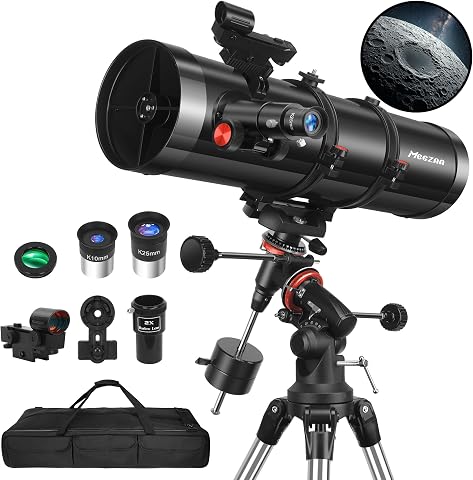
This 150 mm aperture telescope has a 650 mm focal length and includes two eyepieces and a 2× Barlow lens for 26× to 130× magnification. It features a manual German equatorial mount, adjustable stainless steel tripod, red dot finderscope, moon filter, phone adapter, and carry bag.
Pros:
- Large 150 mm aperture for light gathering
- Includes eyepieces, Barlow lens, moon filter, and phone adapter
- Equatorial mount has slow-motion controls for manual tracking
- Carry bag supports storage and transport
Cons:
- Manual focus and tracking require user adjustment
- The provided information does not describe setup or viewing performance in user reviews
Best for: Beginners comparing a reflector telescope with an equatorial mount
Not ideal for: Shoppers who need a confirmed all-in-one package without checking included items
Bottom line: Review the specifications, setup needs, and accessory compatibility before choosing the MEEZAA 150EQ.
Binoculars
Binoculars can offer a straightforward way to look at the sky without setting up a telescope, but the listed pick has a specific configuration: Celestron SkyMaster 25×100 Astronomy Binoculars. Before choosing it, check the product listing for its dimensions, weight, included accessories, and any support equipment it requires. The name gives the magnification and objective size, but does not by itself tell you how comfortable the binoculars will be for your observing position or what else you may need.
A frequent mistake is assuming that any binoculars will be easy to hold steadily for extended viewing. Consider how you plan to use them, where you will set them up, and whether the required support is part of your budget and storage plan. Confirm that the product’s fit and handling suit the people who will use it, and check instructions for setup and care. If you intend to use the binoculars alongside other equipment, verify how they fit into your observing routine rather than assuming they replace a telescope. Check support needs first, then decide whether this configuration works for your space and use.
What to look for:
- Confirm the product’s dimensions and weight.
- Check which accessories are included and whether support equipment is needed.
- Consider observing position and handling comfort.
- Review setup and care instructions before purchase.
Celestron SkyMaster 25×100 Astronomy Binoculars

These giant binoculars combine 25x magnification with 100 mm objective lenses and BaK-4 prisms for astronomy and long-distance terrestrial viewing, including in low light. They have multi-coated optics, rubber-armored water-resistant housing, and a built-in tripod adapter; a tripod is recommended due to their size and weight.
Pros:
- 100 mm objectives and 25x magnification suit astronomy and long-distance viewing.
- BaK-4 prisms and multi-coated optics support bright, sharp views in low light.
- Rubber-armored, water-resistant housing provides grip and protection.
- Fold-down eyecups accommodate eyeglass wearers.
Cons:
- Large size and weight make tripod mounting advisable.
- Tripod is not included.
Best for: Observers comparing a named astronomy binocular configuration
Not ideal for: Anyone who wants a grab-and-go setup without checking support requirements
Bottom line: Check handling, support needs, and included items before selecting the Celestron SkyMaster 25×100.
Star Atlas
A star atlas helps turn an observing session into a plan: it gives you a reference for deciding what to look for and where to direct your attention. No specific product is named for this section, so compare atlases by the way their charts are presented and whether they suit your experience. Check sample pages or a clear product description for readable charts and labels, along with an explanation of how the material is organized.
A common mistake is choosing a charting resource without considering when and where it will be used. Think about whether you want a printed reference or a digital one, how easily you can consult it in your observing spot, and whether its level of detail feels approachable. Check that directions for using the charts are understandable and that the format suits your available lighting and handling preferences. If you already have a telescope or binoculars, consider whether the atlas’s guidance aligns with the way you intend to observe, and avoid assuming a particular atlas supports a device or app without confirming it. Preview the format before buying so it works for your planning style.
What to look for:
- Preview chart layout, labels, and readability.
- Choose a format that suits your observing location.
- Check how the atlas is organized and explained.
- Match the level of detail to your experience and equipment.
Red Flashlight
A red flashlight can be a useful item to consider for handling notes or equipment during an observing session. The listed pick is the OLIGHT ArkPro Lite EDC Pocket Flashlight Rechargeable with UV Light, O. Its name mentions a rechargeable design and UV light, but check the complete listing for the exact model details, controls, included charging accessories, and operating instructions. Do not assume the product’s features or contents beyond what the seller specifies.
A common buying mistake is focusing on a feature list without checking how the light is operated in practice. Review how to select its modes and whether you can use the intended light setting without confusion. Consider where you will keep it, how you plan to recharge it, and whether its controls are manageable in your observing setup. If you are buying specifically for astronomy, verify that the available light mode suits your intended use; the product name alone does not confirm that. Also check care and charging guidance before relying on it during an outing. Confirm the exact model and operation details, especially because the provided product name ends with “O.”
What to look for:
- Verify the full model name and listing details.
- Check how the light modes are selected.
- Confirm what charging accessories are included.
- Review charging and care instructions for your intended use.
OLIGHT ArkPro Lite EDC Pocket Flashlight Rechargeable with UV Light, Orange

The OLIGHT ArkPro Lite is a versatile, rechargeable pocket flashlight featuring white, UV, and red lights for various tasks, including night reading, emergency rescue, and stain detection. Its compact design includes dual charging options, a built-in battery, and user-friendly features for easy handling and portability.
Pros:
- Versatile three-in-one lighting functions for various uses
- Rechargeable with dual charging options for convenience
- Compact, lightweight, and easy to carry with user-friendly design
Cons:
- Non-removable battery may limit replacement options
- Limited to 10 days of continuous use in moonlight mode
- Orange color may not appeal to all users
Best for: Shoppers considering a rechargeable pocket flashlight with UV light
Not ideal for: Anyone who needs a confirmed astronomy-specific red mode without checking the listing
Bottom line: Confirm the complete model and light operation before choosing this OLIGHT flashlight for observing.
Telescope Eyepiece
An eyepiece is an important compatibility check when building a telescope kit. The named pick is the UNISTELLAR Odyssey Pro Smart Telescope with Nikon Electronic Eyepiece. Its title describes a smart telescope and an electronic eyepiece, so first determine whether you are shopping for a complete telescope or an eyepiece accessory. Read the full listing to establish exactly what is included and how the product is intended to be used.
A common mistake is assuming that an item called an eyepiece will fit a different telescope or work as a standalone accessory. Confirm compatibility with your telescope model and check the manufacturer’s instructions before purchase. If you already own a telescope, verify whether this listing offers a replacement or add-on that can be used with it; do not infer that from the product name. If you are evaluating the smart telescope itself, compare its setup requirements and included components with your existing equipment and observing plans. Check the intended configuration before treating this pick as a conventional eyepiece.
What to look for:
- Determine whether the listing is for a telescope, an eyepiece, or a bundle.
- Confirm compatibility with your specific telescope model.
- Check exactly which components are included.
- Review setup instructions and intended use.
UNISTELLAR Odyssey Pro Smart Telescope with Nikon Electronic Eyepiece

The Odyssey Pro is a smart telescope with 85 mm optics, a 320 mm focal length, and a Nikon electronic eyepiece for viewing enhanced night-sky images. Its app-based sky finder, autofocus, and automatic tracking help locate and follow planets and deep-sky objects, while the included tripod and rechargeable battery support portable observing.
Pros:
- Nikon electronic eyepiece supports direct viewing and sharing through a compatible device
- Autofocus and automatic target tracking simplify observing
- Smart Star Finder locates catalog objects without star hopping
- Includes tripod and offers up to 5 hours of rechargeable battery use
Cons:
- Requires the UNISTELLAR app and a compatible Android or iOS device
- Telescope and tripod weigh 14.3 lb combined
Best for: Shoppers evaluating the named smart telescope and electronic eyepiece
Not ideal for: Anyone seeking a universal eyepiece without verifying telescope compatibility
Bottom line: Clarify the listing’s configuration and compatibility before adding it to an existing telescope setup.
Moon Filter
A Moon filter is an accessory to evaluate in the context of the telescope and eyepieces you already own. The listed pick is Telescope Accessory Kit – 1.25" Telescope Eyepiece and Filter Set with. Because the supplied name is incomplete, check the full product listing to identify the included filters, eyepieces, and any other parts. The title mentions 1.25-inch accessories, but that alone does not establish compatibility with your telescope or describe the kit’s complete contents.
A common buying mistake is purchasing a set because its title mentions a filter without checking whether the included items match the observing setup. Confirm the focuser or accessory size your telescope accepts, then compare that with the listing’s specifications. Read the full contents list and instructions, and verify which item is intended as the Moon filter rather than assuming every filter in the set serves the same purpose. If you only need one accessory, consider whether the kit’s other components are useful to you. Match the size and contents to your equipment before choosing a set.
What to look for:
- Find the full product name and complete contents list.
- Confirm your telescope accepts 1.25-inch accessories.
- Identify the specific filter intended for lunar viewing.
- Check whether the other included items suit your setup.
Telescope Accessory Kit – 1.25" Telescope Eyepiece and Filter Set with Sturdy Ca

The CelticBird telescope accessory kit provides a complete set of visual and imaging tools for 1.25" telescopes, including five Plossl eyepieces, a 2x Barlow lens, seven filters and a durable metal carrying case. The assorted color, polarizing, and moon filters enhance planetary and lunar detail, while the T‑adapter enables DSLR astrophotography.
Pros:
- Comprehensive set includes eyepieces, filters, Barlow lens and case for great value.
- Durable metal carrying case with foam lining protects accessories.
- Filters and Barlow lens expand both visual observation and DSLR astrophotography capabilities.
- Wide range of eyepiece focal lengths covers planetary to deep‑sky targets.
Cons:
- All accessories are limited to 1.25" thread size, not compatible with larger formats.
- Case adds bulk and weight for portable observing sessions.
Best for: Observers whose telescope accepts the listed accessory size
Not ideal for: Shoppers who need a single confirmed filter and cannot verify the kit contents
Bottom line: Confirm the full kit contents and telescope fit before buying this accessory set.
Build your checklist in a practical order: first confirm the telescope or binocular setup you plan to use, then choose a star atlas that fits your planning style, and check accessory compatibility before adding an eyepiece or filter kit. Consider the flashlight after confirming its exact model and controls. This order helps you prioritize equipment that fits together.
You do not need to choose every item at once. Start with the setup that matches your experience and observing plans, check each listing carefully, and add compatible items as your needs become clearer. A little attention to fit and included details makes it easier to build a useful backyard astronomy checklist.