
TL;DR

Prime made for students and young adults
- Fast, free delivery for dorm and study essentials
- Prime Video and Amazon Music included
- Member-only deals
NASA and SpaceX are targeting no earlier than Oct. 13 for the launch of SpaceX’s 35th Commercial Resupply Services mission to the International Space Station. The Dragon spacecraft is scheduled to carry more than 6,300 pounds of cargo, including research experiments and the final pair of station solar arrays; it is expected to return to Earth about a month after arrival.
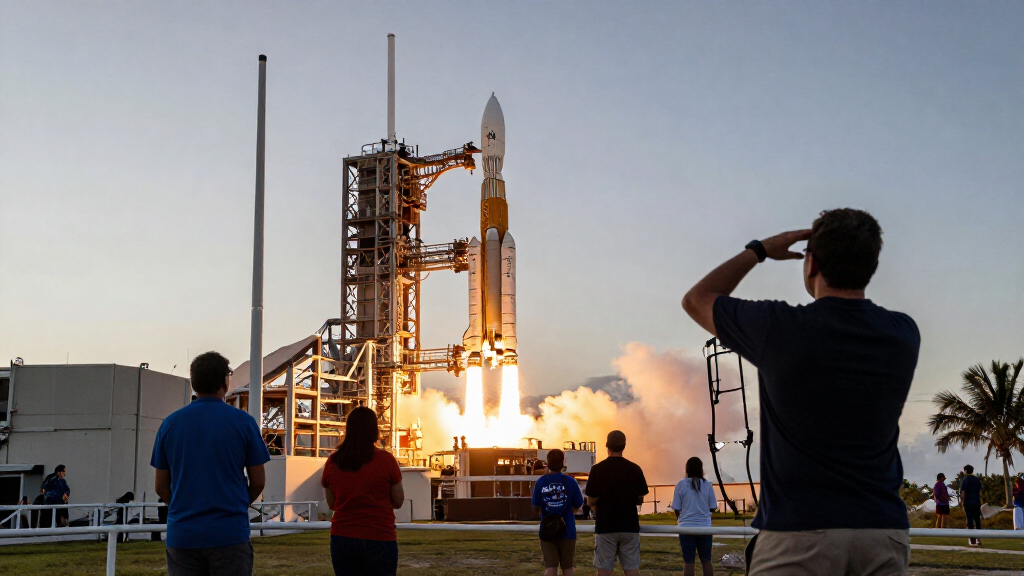
NASA and SpaceX are targeting no earlier than Tuesday, Oct. 13, to launch the company’s 35th Commercial Resupply Services mission to the International Space Station, carrying more than 6,300 pounds of supplies, equipment and scientific investigations. The Dragon spacecraft is scheduled to launch on a Falcon 9 rocket from Space Launch Complex 40 at Cape Canaveral Space Force Station in Florida, supporting station operations and research while delivering the final pair of planned roll-out solar arrays.
NASA says Dragon will travel to the station and autonomously dock at the space-facing port of the Harmony module. Astronauts Anil Menon and Jessica Watkins will monitor its arrival. The agency plans to provide launch and docking coverage through its online platforms; the launch date remains a target rather than a confirmation that liftoff will occur that day.
The science cargo includes LambdaVision-1, which will test making artificial retinas in microgravity, building them in thin layers. NASA says reduced settling in that environment may allow more uniform, stable layers. The proposed benefit for patients with retinal disease remains a potential application, not a demonstrated treatment outcome. Other investigations will examine three-dimensional human heart tissue models, unconventional glass formation, and brain organoids made from cells representing multiple people.
The flight also carries the last pair of International Space Station Roll-Out Solar Arrays for installation, according to NASA. They are intended to complete the augmentation of the station’s power system. Additional cargo includes a demonstration unit and support hardware for NASA’s Artemis III mission, station maintenance equipment, and replacement items for onboard systems. After about a month attached to the station, Dragon is expected to splash down in the Pacific Ocean, returning research and hardware for examination on Earth.
Cargo for Research and Station Power
The mission links routine station resupply with research that could inform both Earth-based medicine and future space missions. The retina, heart-tissue and brain-organoid investigations are experiments, not clinical treatments. Their results may help researchers assess how microgravity affects biological systems and whether those conditions offer useful ways to develop models for disease research or drug testing.
The solar arrays have a separate operational role. NASA says this final pair will complete the station’s solar-array augmentation, supporting critical operations, including a safe and controlled deorbit. That makes the cargo relevant beyond the immediate needs of the crew: it supports the power infrastructure of an aging orbital laboratory whose research has continued for more than 25 years.
NASA SpaceX Dragon spacecraft model
As an affiliate, we earn on qualifying purchases.
As an affiliate, we earn on qualifying purchases.
A Long-Running Station Supply Link
NASA describes the International Space Station as a research platform that has operated for more than 25 years. Researchers from more than 110 countries have used the station, where NASA says more than 4,000 experiments have been conducted in microgravity. The agency says station research also contributes to preparation for longer missions to the Moon under the Artemis program and eventual missions to Mars.
CRS-35 is part of the ongoing commercial cargo relationship between NASA and SpaceX. Dragon is designed to carry cargo to the station and return items to Earth, allowing researchers and engineers to recover samples, equipment and hardware for ground analysis. On this flight, that return function includes a failed joint from the station’s Canadarm2 robotic arm, which was replaced during a spacewalk on June 30.
Launch Timing and Experiment Outcomes
The Oct. 13 date is the earliest targeted launch date, and NASA’s overview does not confirm a final liftoff time or say that the flight has launched. Dates and operations may change; the agency has not provided a revised schedule in the supplied material.
The eventual scientific results are also unknown. NASA describes questions the experiments will investigate and possible benefits, but it does not report findings from this mission. In particular, whether microgravity produces more useful retina layers, vascular networks or glass properties will require analysis. The overview does not specify the precise docking date, splashdown date, or final disposition of all returned equipment.
Launch, Docking and Mid-November Return
NASA and SpaceX plan to launch Dragon no earlier than Oct. 13 from Cape Canaveral. If the flight proceeds, the spacecraft will approach the station for autonomous docking at Harmony, with Menon and Watkins monitoring arrival. NASA says it will stream launch and docking coverage through its online platforms.
After roughly one month at the station, Dragon is scheduled to depart and splash down in the Pacific, with return planned for mid-November. Among the items coming back will be the Canadarm2 joint for ground analysis and possible refurbishment, a spacesuit for refurbishment, and equipment from the station’s urine- and water-processing systems. Researchers and engineering teams will then be able to examine returned samples and hardware on Earth.
Key Questions
What is NASA’s SpaceX 35th Commercial Resupply mission?
It is a planned cargo flight to the International Space Station using a SpaceX Dragon spacecraft launched on a Falcon 9 rocket. NASA says the spacecraft will carry more than 6,300 pounds of cargo.
When and where is the launch planned?
NASA and SpaceX are targeting launch no earlier than Tuesday, Oct. 13, from Space Launch Complex 40 at Cape Canaveral Space Force Station in Florida. The date is a target, not confirmation of liftoff.
What research will Dragon deliver?
The planned investigations include tests of artificial retina production, three-dimensional heart tissue models, unconventional glass formation and brain organoids. NASA describes potential research applications, but results have not yet been reported.
What is expected to return to Earth?
Dragon is expected to return in mid-November with research and equipment, including the failed Canadarm2 joint for analysis, a spacesuit for refurbishment, and hardware from station water- and urine-processing systems.
Source: primary
Fall Picks
fall essentials
As an affiliate, we earn on qualifying purchases.