
Robotic coding kits for kids range from simple, screen-free builds to Arduino projects that ask children to write and revise code. I’d choose the Makeblock mBot STEM Coding Robot Kit as the best overall starting point for its balance of guided coding and hands-on robot control. The Thames & Kosmos Kids First Coding & Robotics STEM Kit suits younger beginners, while the ELEGOO UNO R3 Smart Robot Car Kit V4 with Camera offers more room for older kids to explore hardware and programming. The main tradeoff is between an easier first build and a kit with more room to experiment, which may demand adult setup and troubleshooting. Read on for the full breakdown and recommendations by age, experience, and project style.

Prime made for students and young adults
- Fast, free delivery for dorm and study essentials
- Prime Video and Amazon Music included
- Member-only deals
Key Takeaways
- The Makeblock mBot STEM Coding Robot Kit is my best overall pick for a balance of guided coding and robot movement; the mBot Arduino Robot Kit with Scratch Coding Box offers a more structured route for kids who benefit from extra coding guidance.
- Younger beginners have a different best fit from aspiring makers: Thames & Kosmos Kids First emphasizes accessible first steps, while the ELEGOO UNO R3 car and tank kits suit children ready for more involved electronics and code.
- Build variety does not always mean coding depth. The Sillbird 5-in-1 and BeAndge 6-in-1 emphasize multiple robot forms, while Arduino- and Scratch-compatible options put more emphasis on programming and control.
- Not every robotics kit centers on a programmable car. The TEACH TECH Hydrobot Arm focuses on hydraulic mechanics, and the Mech-5 uses mechanical coding concepts, giving children different ways to explore cause and effect.
- Age labels alone do not settle the choice. Controller type, instructions, assembly demands, and the child’s appetite for troubleshooting are stronger clues to whether an app-based, screen-free, or Arduino-style kit will fit.
| ELEGOO UNO R3 Smart Robot Car Kit V4 with Camera (Arduino Compatible) |  | Best for Camera-Driven Exploration | Controller board: ELEGOO UNO R3 | Camera and Wi-Fi module: ESP32-WROVER-based | Battery: 2000 mAh rechargeable lithium-ion | VIEW LATEST PRICE | See Our Full Breakdown |
| Kyanio 3-in-1 STEM Robotics Building Kit for Kids Ages 8-14, Remote/APP Control & Programmable |  | Best for Multi-Model Building | Pieces: 560 | Buildable models: 3: machine gun robot, armored tracked vehicle, and mechanical cannon tank | Age range: 8–14 years | VIEW LATEST PRICE | See Our Full Breakdown |
| ELEGOO Conqueror Robot Tank Kit with UNO R3, Compatible with Arduino |  | Best for Growing Coding Skills | Controller: UNO R3, Arduino compatible | Camera: OV2640 with servo-mounted adjustable angle | Wireless module: ESP32-WROVER Wi-Fi | VIEW LATEST PRICE | See Our Full Breakdown |
| TEACH TECH Hydrobot Arm STEM Hydraulic Robot Building Kit |  | Best for Hands-On Mechanics | Age range: 12+ | Power source: Water hydraulics | Batteries required: No | VIEW LATEST PRICE | See Our Full Breakdown |
| ACEBOTT Smart Robot Car Kit for Kids Ages 8-16, Arduino & Scratch Compatible STEM Coding Robot |  | Best for Beginner-to-Advanced Coding | Model: QD106 | Controller: ESP32 | Programming languages: Scratch, Arduino, and Python | VIEW LATEST PRICE | See Our Full Breakdown |
| Sillbird 5-in-1 STEM Robot Building Kit with Remote Control |  | Best for Multi-Model Building | Piece count: 488 | Builds: Robot, dinosaur, car, tank, and more | Control methods: Remote control and Bluetooth app | VIEW LATEST PRICE | See Our Full Breakdown |
| Makeblock mBot Arduino Robot Kit with Scratch Coding Box for Kids Ages 8-12 |  | Best for a Guided Coding Progression | Recommended age: 8–12 years | Assembly time: About 15 minutes | Programming languages: Scratch (block-based) and Arduino | VIEW LATEST PRICE | See Our Full Breakdown |
| Thames & Kosmos Kids First Coding & Robotics STEM Kit |  | Best Screen-Free Starter | Recommended age: 4–8 years | Grade level: K–2 | Lessons: 30 | VIEW LATEST PRICE | See Our Full Breakdown |
| Makeblock mBot STEM Coding Robot Kit for Kids Ages 8-12 | 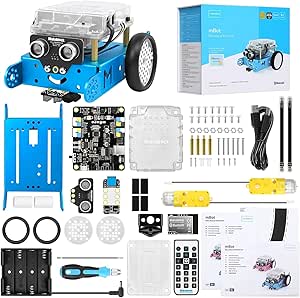 | Best for Expandability | Model number: 90053 | Recommended age: 8 years and up | Programming languages: Scratch and Arduino | VIEW LATEST PRICE | See Our Full Breakdown |
| Thames & Kosmos My Robotic Pet: Coding Chameleon STEM Building & Experiment Kit |  | Best for Screen-Free Interactive Coding | Recommended age: 8+ with adult help; 12+ independently | Model length: 15 inches | Sensors: Color sensor and infrared sensor | VIEW LATEST PRICE | See Our Full Breakdown |
| TEACH TECH Mech-5 Mechanical Coding Robot Building Kit |  | Best for Screen-Free Coding | Brand: Teach Tech | Recommended age: 10+ years | Coding method: Mechanical coding wheel with snap-on buttons | VIEW LATEST PRICE | See Our Full Breakdown |
| BeAndge 6-in-1 STEM Robotics Kit for Kids Age 8-12 |  | Best for Project Variety | Recommended age: 8–12 years | Number of projects: 6 | Included projects: Reptile robot, balance car, bubble machine, fiber lamp, and buzzer wire game | VIEW LATEST PRICE | See Our Full Breakdown |
| ACEBOTT 4-in-1 Smart Robot Arm & Tank Car STEM Coding Kit for Kids Ages 12-16 |  | Best for Advanced Builds | Recommended age: 12–16 years | Controller: ESP32 | Robotic arm: 5 degrees of freedom | VIEW LATEST PRICE | See Our Full Breakdown |
| ACEBOTT Robot Kit – STEM Robotics for Kids Ages 8-16, Remote & App Control, Arduino & Scratch Compatible (Yellow) |  | Best Expandable Starter Kit | Recommended age: 8–16 years | Controller: ESP32 | Coding compatibility: Arduino and Scratch | VIEW LATEST PRICE | See Our Full Breakdown |
| ACEBOTT Smart Robot Car Kit with ESP32 Controller |  | Best for Autonomous Modes | Model: QD001 | Recommended age: 12 years and up | Controller: ESP32 | VIEW LATEST PRICE | See Our Full Breakdown |
| robotic coding kits for kid | Recommended age |
|---|---|
| ELEGOO UNO R3 Smart Robot Car | 12 years and up |
| Kyanio 3-in-1 STEM Robotics Bu | — |
| ELEGOO Conqueror Robot Tank Ki | 10 years and up |
| TEACH TECH Hydrobot Arm STEM H | — |
| ACEBOTT Smart Robot Car Kit fo | 8–16 years |
| Sillbird 5-in-1 STEM Robot Bui | 8+ |
| Makeblock mBot Arduino Robot K | 8–12 years |
| Thames & Kosmos Kids First Cod | 4–8 years |
| Makeblock mBot STEM Coding Rob | 8 years and up |
| Thames & Kosmos My Robotic Pet | 8+ with adult help; 12+ independently |
| TEACH TECH Mech-5 Mechanical C | 10+ years |
| BeAndge 6-in-1 STEM Robotics K | 8–12 years |
| ACEBOTT 4-in-1 Smart Robot Arm | 12–16 years |
| ACEBOTT Robot Kit | 8–16 years |
| ACEBOTT Smart Robot Car Kit wi | 12 years and up |
More Details on Our Top Picks
ELEGOO UNO R3 Smart Robot Car Kit V4 with Camera (Arduino Compatible)
The ELEGOO UNO R3 Smart Robot Car Kit V4 makes sense for older kids who want to see their code affect a moving robot in real time. Its ESP32 camera and Wi-Fi connection add a first-person driving option, while line tracking and ultrasonic obstacle avoidance introduce practical sensor projects. Compared with the ACEBOTT QD106, which offers Scratch, Arduino, and Python, this kit centers on Arduino IDE learning and may be a steeper first coding experience. Keyed connectors and an illustrated guide help with assembly, but they do not remove the need for adult help when a younger builder gets stuck. I’d choose it for a family ready to support hands-on electronics work; the 12+ recommendation and more demanding programming make it a weaker fit for beginners who want a gentle coding start.
Pros:- Camera and Wi-Fi add a first-person driving mode
- Line tracking and obstacle avoidance support sensor experiments
- Keyed connectors and illustrated instructions guide assembly
- Rechargeable battery and core components are included
Cons:- Arduino IDE may be a steep starting point for new coders
- Assembly and programming can call for adult guidance
- The listed age recommendation is 12 years and up
Best for: Families with a builder aged 12 or older who wants camera-assisted driving, sensor projects, and an introduction to Arduino programming.
Not ideal for: Younger beginners or children who need block-based coding to get started, since Arduino IDE programming can be challenging.
- Controller board:ELEGOO UNO R3
- Camera and Wi-Fi module:ESP32-WROVER-based
- Battery:2000 mAh rechargeable lithium-ion
- Sensors:Line-tracking and ultrasonic
- Connectors:Keyed XH2.54
- Recommended age:12 years and up
- Warranty:6 months
Our verdict“Choose this ELEGOO car for an older learner ready to pair Arduino coding with camera and sensor experiments.”
Kyanio 3-in-1 STEM Robotics Building Kit for Kids Ages 8-14, Remote/APP Control & Programmable
The Kyanio kit’s strongest draw is rebuilding the same 560-piece set into three models: a machine gun robot, tracked vehicle, or cannon tank. That gives kids a mechanical construction project before they explore app programming or drive with the 2.4GHz remote. Compared with the ELEGOO UNO R3 Smart Robot Car, Kyanio puts more emphasis on rebuilding and model variety than camera feeds and sensor-based coding. Its color-coded, step-by-step instructions can help younger builders follow the process, though 560 pieces may still stretch the patience of an eight-year-old working alone. The weapon-themed designs are also a real part of the experience, so this is not a universal fit for every family. I’d shortlist it for kids who enjoy assembling different tracked machines and can handle a substantial build.
Pros:- One set can be rebuilt into three distinct models
- Combines app programming with 2.4GHz remote control
- Color-coded, step-by-step instructions support assembly
- Type-C charging avoids a proprietary charging connector
Cons:- Weapon-themed models may not suit every household
- The 560-piece build can be demanding for younger children
- Its model variety emphasizes mechanical rebuilding more than camera or sensor coding
Best for: Kids aged 8–14 who enjoy detailed construction, rebuilding models, and trying remote control alongside app programming.
Not ideal for: Families avoiding weapon-themed play, or younger builders who may find a 560-piece assembly project frustrating.
- Pieces:560
- Buildable models:3: machine gun robot, armored tracked vehicle, and mechanical cannon tank
- Age range:8–14 years
- Control:2.4GHz remote and app
- Material:ABS
- Charging:Type-C
Our verdict“Pick Kyanio for a child who values rebuilding several tracked machines as much as programming them.”
ELEGOO Conqueror Robot Tank Kit with UNO R3, Compatible with Arduino
The Conqueror is a strong fit for a learner who wants a clear path from block coding to Arduino IDE. Its UNO R3 controller drives a tracked metal tank, while five modes—including obstacle avoidance, line tracking, auto-follow, and Wi-Fi camera driving—give each new skill a visible purpose. Compared with the ELEGOO UNO R3 Smart Robot Car V4, the Conqueror adds auto-follow and a metal chassis, and its app-based block coding offers a more approachable first step before text-based programming. That progression comes with a substantial assembly job, even though no soldering is required. FPV driving also depends on a compatible phone. I’d place it ahead of simpler remote-control kits for a patient builder who wants room to advance, but its complexity makes it less suitable as an independent first project for a younger child.
Pros:- Block coding and Arduino IDE support a gradual learning path
- Five modes provide varied ways to explore sensors and control
- Metal tracked chassis with suspension offers a sturdy build
- No-solder kit includes tools, instructions, and core components
Cons:- Assembly may be challenging for younger builders
- FPV mode requires a compatible phone
- The multi-mode build can take more patience than a simpler robot car
Best for: Ages 10 and up, especially learners ready to move from block-based coding toward Arduino IDE projects.
Not ideal for: Children who want a quick, mostly ready-to-drive toy or do not have access to a compatible phone for FPV mode.
- Controller:UNO R3, Arduino compatible
- Camera:OV2640 with servo-mounted adjustable angle
- Wireless module:ESP32-WROVER Wi-Fi
- Battery:7.4V
- Recommended age:10 years and up
- Assembly:Required; no soldering
- Modes:FPV driving, IR remote control, obstacle avoidance, line tracking, and auto-follow
Our verdict“Choose the Conqueror for a learner who wants a substantial tracked robot and a progression from blocks to Arduino.”
TEACH TECH Hydrobot Arm STEM Hydraulic Robot Building Kit
The HydroBot is the lineup’s distinct pick for learning how a robot arm moves without screens, code, or motors. Water-powered hydraulics and hand-operated levers let builders control six axes, so the cause and effect is easy to see as the arm rotates, lifts, and grips. Compared with the ELEGOO Conqueror Robot Tank, this is a slower, stationary project: it trades app coding and autonomous modes for a mechanical lesson in movement and force. The interchangeable gripper and suction parts add variety, but the arm can lift only up to 50g, and assembly is a multi-hour project aimed at ages 12 and up. I’d choose it for a patient older child curious about mechanisms; families specifically seeking a programmable coding kit should look to the UNO-based options instead.
Pros:- Hydraulic controls demonstrate movement without batteries or motors
- Six axes and 270-degree base rotation offer varied arm motions
- Interchangeable gripper and suction components support different tasks
- Animated instructions guide a hands-on assembly project
Cons:- Does not offer coding or motorized operation
- Multi-hour assembly requires patience and fine motor work
- Lifting capacity is limited to 50g
Best for: A mechanically curious builder aged 12 or older who wants to assemble and operate a hydraulic arm.
Not ideal for: Families seeking programmable coding activities, a motorized robot, or a short build with substantial lifting capacity.
- Age range:12+
- Power source:Water hydraulics
- Batteries required:No
- Axes of movement:6
- Base rotation:270 degrees
- Vertical reach:16.35 in
- Lifting capacity:50g
Our verdict“Choose the HydroBot for an older child who wants to build and operate a mechanical arm rather than code a mobile robot.”
ACEBOTT Smart Robot Car Kit for Kids Ages 8-16, Arduino & Scratch Compatible STEM Coding Robot
The ACEBOTT QD106 stands out for the range of coding paths it offers: Scratch for a visual start, then Arduino or Python as a learner’s skills grow. Sixteen story-based tutorials give projects a sequence and context, while app or IR remote control lets kids see the car respond before writing more complex programs. Compared with the ELEGOO UNO R3 Smart Robot Car V4, QD106 is more welcoming to beginners because it includes Scratch, though ELEGOO includes a rechargeable battery and camera module. ACEBOTT’s no-solder assembly also lowers the setup barrier, but batteries are not included, adding a separate preparation step. The broad age range can suggest a longer runway, yet younger children may still need help with setup and coding. I’d favor it for families seeking a kit that can grow with a child’s coding experience.
Pros:- Scratch, Arduino, and Python offer multiple coding entry points
- Sixteen story-based tutorials structure learning activities
- App and IR remote control provide different ways to operate the car
- No soldering required for assembly
Cons:- Batteries are not included
- The wide age range does not mean every young beginner can work independently
- No camera feature is listed in the product data
Best for: Families with a child aged 8–16 who want to start with Scratch and later explore Arduino or Python on the same robot.
Not ideal for: Buyers who want a ready-to-run kit with batteries included, or a camera-focused driving experience.
- Model:QD106
- Controller:ESP32
- Programming languages:Scratch, Arduino, and Python
- Assembly:No soldering required
- Control:Mobile app for iOS and Android, plus included IR remote
- Batteries:Not included
- Recommended age:8–16 years
Our verdict“Choose the QD106 if you want one robot car to support a child from Scratch basics into text-based coding.”
Sillbird 5-in-1 STEM Robot Building Kit with Remote Control
I’d pick the Sillbird 5-in-1 for a child who wants to rebuild as much as they want to code. Its 488 pieces form a robot, dinosaur, car, tank, and other models, giving it more construction variety than the Makeblock mBot, which centers on a single robot platform and its guided coding projects. Remote control makes the first play session approachable, while Bluetooth app features add basic programming and path control for a gentle step toward code. The tradeoff is that coding is a supporting feature rather than the kit’s main learning path; children seeking a structured Scratch-to-Arduino progression may get more from the mBot. Some builds may also need adult help, and play lasts up to 40 minutes per charge. I’d choose it for variety, not advanced programming.
Pros:- 488 pieces support several different robot and vehicle builds.
- Remote and Bluetooth app control offer an easy entry point and a basic coding option.
- Path control introduces simple programming concepts through movement.
- Rechargeable battery provides up to 40 minutes of play per charge.
Cons:- Programming features are basic compared with the Scratch-to-Arduino learning path of the Makeblock mBot.
- Some children may need adult help with assembly.
- Play time is limited to about 40 minutes per charge.
Best for: Children ages 8 and up who enjoy rebuilding toys into different models and want simple app-based programming alongside remote play.
Not ideal for: Families seeking a step-by-step coding curriculum or longer play sessions between charges.
- Piece count:488
- Builds:Robot, dinosaur, car, tank, and more
- Control methods:Remote control and Bluetooth app
- Programming features:Basic programming and path control
- Adjustable parts:Head, arms, and tail
- Play time:Up to 40 minutes per charge
- Recommended age:8+
Our verdict“Choose the Sillbird if model variety and hands-on rebuilding matter more than a structured coding curriculum.”
Makeblock mBot Arduino Robot Kit with Scratch Coding Box for Kids Ages 8-12
The Makeblock mBot with Scratch Coding Box is the clearest choice here for a child ready to move from visual coding toward text-based programming. Its path from Scratch to Arduino gives lessons somewhere to go after block-based projects, while four guided activities—such as line-following and obstacle avoidance—help turn code into visible robot behavior. Assembly takes about 15 minutes, a lighter setup than the multi-model Sillbird 5-in-1, which puts more emphasis on building variety. That focus is also the tradeoff: the mBot is a single robot with beginner-level projects, so it offers less rebuilding and may not hold an experienced young coder for long. I’d favor it for a learner who benefits from clear instructions and a deliberate programming sequence, rather than a child mainly seeking open-ended construction.
Pros:- Progresses from block-based Scratch programming to Arduino.
- Four guided projects connect coding with robot actions such as line-following and obstacle avoidance.
- Assembly takes about 15 minutes.
- Instructions include visual guidance and coding tips.
Cons:- The kit centers on one robot rather than offering multiple rebuildable models like the Sillbird 5-in-1.
- Projects are aimed at beginners and may not stretch experienced coders.
- Younger children may need adult supervision during setup.
Best for: Children ages 8–12 who want guided Scratch projects with a route toward learning Arduino.
Not ideal for: Kids who prefer repeated model rebuilding or already want advanced, open-ended coding challenges.
- Recommended age:8–12 years
- Assembly time:About 15 minutes
- Programming languages:Scratch (block-based) and Arduino
- Included projects:Line-following, obstacle avoidance, remote control, and more
- Coding format:Guided projects with coding tips
- Robot format:Single assembled robot
Our verdict“Choose this mBot for a child who wants clear beginner projects and a defined path from Scratch to Arduino.”
Thames & Kosmos Kids First Coding & Robotics STEM Kit
For young children who are not ready for app-based coding, Kids First Coding & Robotics makes instructions physical: children arrange code cards, and Sammy scans them with an optical reader. Its 30 story-based lessons introduce ideas such as loops, conditionals, and variables without a phone or computer, making it a more age-focused first step than the Makeblock mBot, which targets older children and moves toward Arduino. The six storylines and model-building parts also tie programming to a character and its movement. The tradeoff is a lower ceiling: grades K–2 are the intended audience, and children older than about 8 may want more capable coding tools. Younger learners may need help following the manual and assembling models. I’d choose it for a first hands-on coding experience where screens are off the table.
Pros:- Physical code cards and an optical reader let children program without an app or smart device.
- Thirty lessons across six storylines give young learners structured activities.
- Introduces sequencing, loops, conditionals, functions, and variables.
- Building components connect coding exercises with physical models.
Cons:- Lesson level may feel too basic for children older than 8.
- Children around age 4 may need adult help with the activities.
- The card-based approach does not offer the software-based progression found in the Makeblock mBot.
Best for: Families with children ages 4–8 who want story-led, screen-free introductions to coding and simple robotics.
Not ideal for: Older children or beginners who want app-based coding, more complex robot behavior, or a progression toward Arduino.
- Recommended age:4–8 years
- Grade level:K–2
- Lessons:30
- Storylines:6
- Coding topics:Sequencing, loops, events, conditionals, functions, and variables
- Manual:64-page, full-color manual
- App required:No
Our verdict“Choose this kit as a screen-free first coding experience for a young child who learns well through stories and hands-on play.”
Makeblock mBot STEM Coding Robot Kit for Kids Ages 8-12
I’d choose this Makeblock mBot when a child is likely to want new challenges after the first projects. Scratch and Arduino support coding at different stages, while compatibility with Makeblock modules, platform parts, and LEGO parts gives families room to expand the robot over time. That makes it more adaptable than the Sillbird 5-in-1, whose appeal centers on rebuilding its included models and basic app programming. The mBot also assembles in about 15 minutes and can follow lines or avoid obstacles, so a child can see code affect movement early. Its tradeoff is that expansion requires additional compatible parts, and it arrives without the listed batteries. It is a single-robot kit rather than a multi-model build set, and its introductory projects may not challenge advanced coders for long.
Pros:- Supports Scratch and Arduino for different stages of learning.
- Expandable with more than 100 electronic modules and more than 500 Makeblock platform parts.
- Compatible with LEGO parts for additional building options.
- Quick assembly and line-following and obstacle-avoidance functions provide early hands-on projects.
Cons:- Four AA batteries and one CR2025 battery are not included.
- Expanding the kit depends on acquiring compatible add-on parts.
- The single-robot format offers less build variety than the Sillbird 5-in-1.
Best for: Families who want one beginner robot that can grow through add-on modules and LEGO-compatible parts.
Not ideal for: Buyers who want a complete multi-model building set or do not want to supply batteries separately.
- Model number:90053
- Recommended age:8 years and up
- Programming languages:Scratch and Arduino
- Assembly time:About 15 minutes
- Functions:Remote-control car, line-following, and obstacle avoidance
- Compatible add-ons:100+ electronic modules, 500+ Makeblock parts, and LEGO parts
- Batteries required:4 AA batteries and 1 CR2025; not included
Our verdict“Choose this mBot if you want a quick-start coding robot with room to expand its hardware as skills grow.”
Thames & Kosmos My Robotic Pet: Coding Chameleon STEM Building & Experiment Kit
The My Robotic Pet coding chameleon gives coding a playful, physical result: children use colored action cards to direct a 15-inch model with sensors, moving parts, and color-changing LEDs. Its Coding, Wild, and Pet modes make it more of an interactive character than the grid-and-story lesson format of Kids First Coding & Robotics. That distinction suits children drawn to creature behavior and visible reactions; the earlier kit is a simpler fit for younger learners working through foundational concepts. This chameleon is rated for ages 8+ with adult help and 12+ independently, so assembly can be a shared project for younger children. The tradeoff is that card-based programming may not satisfy children ready for Scratch or Arduino, such as those using the Makeblock mBot. I’d pick it for tactile, screen-free play, not software coding progression.
Pros:- Physical colored action cards teach coding without screens, software, or devices.
- Color and infrared sensors give the chameleon interactive responses.
- Three modes offer different ways to play with the completed model.
- The illustrated 48-page guide supports assembly and STEM activities.
Cons:- Children ages 8 and up may need adult help with assembly.
- Card-based coding has less software progression than the Makeblock mBot’s Scratch and Arduino options.
- The physical chameleon format may be less appealing to children who prefer cars or modular robots.
Best for: Children ages 8 and up who enjoy animal-themed builds, physical coding cards, and robots that react visibly to commands.
Not ideal for: Independent younger builders or older children seeking Scratch, Arduino, or advanced programmable behavior.
- Recommended age:8+ with adult help; 12+ independently
- Model length:15 inches
- Sensors:Color sensor and infrared sensor
- Play modes:Coding Mode, Wild Mode, and Pet Mode
- Features:RGB LEDs and articulated eyes, torso, and leg joints
- Manual:48-page illustrated guide
- Device or software required:No
Our verdict“Choose the chameleon for a child who wants screen-free coding with visible animal-like reactions and can get help during assembly.”
TEACH TECH Mech-5 Mechanical Coding Robot Building Kit
The Mech-5 is the clearest choice here for families who want coding to start with physical cause and effect. Kids snap buttons onto a mechanical coding wheel to set movements, then build a robot that can throw, lift, kick, and draw. That makes the programming idea tangible without a computer or batteries. Compared with the app- and controller-based ACEBOTT robot kits, Mech-5 keeps the activity focused on mechanical sequencing and construction rather than electronics or mobile control. The tradeoff is time: assembly takes several hours, and the recommended age of 10+ leaves less room for younger beginners than BeAndge’s 8–12 kit. I’d choose it for a patient builder who enjoys making a mechanism work, not for a child hoping to drive a ready-to-go robot straight from the box.
Pros:- Mechanical coding wheel teaches sequencing through visible, physical inputs
- No computer or batteries are required
- Building introduces mechanical engineering alongside coding fundamentals
- Robot can perform varied actions, including throwing, lifting, kicking, and drawing
Cons:- Assembly takes multiple hours before play can begin
- May be difficult for children at the younger end of the recommended age range
Best for: Kids around age 10 and up who enjoy hands-on building and want to learn coding concepts without screens or batteries
Not ideal for: Younger children or families looking for a quick-start robot, since assembly takes several hours and can be challenging
- Brand:Teach Tech
- Recommended age:10+ years
- Coding method:Mechanical coding wheel with snap-on buttons
- Educational objectives:Coding skills, problem solving, programming skills, and STEM
- Power:Green energy; no batteries required
- Robot actions:Forward, backward, 360-degree rotation, throwing, lifting, kicking, and drawing
- Included components:Assembly parts and instructions
Our verdict“Choose Mech-5 for an older child who wants a screen-free coding and building project and is ready to spend time assembling it.”
BeAndge 6-in-1 STEM Robotics Kit for Kids Age 8-12
For a child who likes changing projects before a single robot gets old, BeAndge’s six-project format offers more variety than the focused Mech-5 build. The kit covers a reptile robot and balance car alongside a bubble machine, fiber lamp, and buzzer wire game, so it ranges beyond mobile robots into circuits and physics activities. Included mini screwdrivers and step-by-step instructions make it a practical pick for family building sessions, though younger children may still need adult help. Compared with ACEBOTT’s coding kits, BeAndge is less centered on programming through an app or controller; its appeal is trying different STEM builds. Plan ahead for the AA batteries and bubble solution, which are not included. I’d pick it for variety, and skip it if the main goal is sustained coding practice with a programmable robot.
Pros:- Six projects provide variety across robotics, circuits, and physics activities
- Mini screwdriver and step-by-step manuals are included
- Projects can support family building sessions or science fair activities
- Age range makes it accessible to many elementary and middle-school children
Cons:- Requires AA batteries, which are not included
- Bubble solution is not included for the bubble machine
- Younger builders may need adult assistance with assembly
Best for: Families with children ages 8–12 who want several different science and robotics projects to build together
Not ideal for: Children seeking an app-programmable robot or families who want every activity ready without sourcing batteries and bubble solution
- Recommended age:8–12 years
- Number of projects:6
- Included projects:Reptile robot, balance car, bubble machine, fiber lamp, and buzzer wire game
- Batteries:AA batteries required; not included
- Bubble solution:Not included
- Tools:Mini screwdriver
- Instructions:Instruction manuals with step-by-step guidance
Our verdict“Choose BeAndge when project variety matters more than deeper app-based coding lessons.”
ACEBOTT 4-in-1 Smart Robot Arm & Tank Car STEM Coding Kit for Kids Ages 12-16
This is the most mechanically ambitious pick in this batch: the 5DOF robotic arm, tank tracks, and ESP32 controller let older kids build an arm car, a tank robot, or a combined arm-and-tank configuration. That gives it a stronger engineering progression than the simpler ACEBOTT Smart Robot Car, which focuses on driving modes and tutorials. Arduino and Scratch compatibility, plus 16 story-based tutorials and assembly videos, can help connect construction to coding. The tradeoff is that the complexity fits the 12–16 age range better than an elementary beginner’s kit, and users must download tutorials and code from ACEBOTT’s website. Compared with the screen-free Mech-5, this kit offers more programmable electronics and build options, but also asks for more setup and technical patience.
Pros:- Multiple configurations include an arm car, tank robot, and combined build
- Five degrees of freedom provide a capable robotic arm project
- Works with Arduino and Scratch
- Includes 16 story-based tutorials and HD assembly videos
Cons:- Assembly and coding may challenge younger children without adult help
- Tutorials and code must be downloaded separately from ACEBOTT’s website
Best for: Teens ages 12–16 who want to combine coding with a multi-configuration robot arm and tracked vehicle build
Not ideal for: Younger beginners or families who prefer all tutorials and code to be available directly with the kit
- Recommended age:12–16 years
- Controller:ESP32
- Robotic arm:5 degrees of freedom
- Build configurations:Robotic arm car, tank robot, or combined robotic arm tank
- Coding compatibility:Arduino and Scratch
- Control methods:IR remote and iOS/Android smartphone app
- Learning materials:16 story-based tutorials and HD assembly videos
Our verdict“Choose this ACEBOTT kit for an older learner ready to tackle a more involved arm-and-tank coding project.”
ACEBOTT Robot Kit – STEM Robotics for Kids Ages 8-16, Remote & App Control, Arduino & Scratch Compatible (Yellow)
For a younger child who wants room to grow into coding, this ACEBOTT kit pairs app and IR control with Arduino and Scratch compatibility. Its standout feature is the Mecanum wheel drive: sideways and diagonal motion gives early experiments a visible difference from ordinary forward-and-turn robot cars, including ACEBOTT’s Smart Robot Car Kit. The 16 story-based tutorials, videos, and illustrated instructions support a broad 8–16 age range, while expansion options such as a camera or robotic arm can extend the project later. Those add-ons are sold separately, so the listed kit’s value depends on its core build rather than the expansion promise. Batteries are also not included. I’d pick this over the 4-in-1 arm-and-tank kit for a more accessible wheeled starting point, though advanced teens may want the latter’s mechanical challenge.
Pros:- Arduino and Scratch compatibility supports a progression from introductory to more advanced coding
- Mecanum wheels allow sideways, diagonal, and rotational movement
- Includes 16 story-based tutorials, HD videos, and illustrated instructions
- Supports optional camera, robotic arm, tank track, and solar panel expansions
Cons:- Batteries are not included
- Expansion accessories are sold separately
Best for: Families seeking a first programmable robot car for ages 8–16, with a path to add hardware projects later
Not ideal for: Buyers who expect expansions in the box or want a complex robotic arm and tank build without add-ons
- Recommended age:8–16 years
- Controller:ESP32
- Coding compatibility:Arduino and Scratch
- Drive:4WD with Mecanum wheels for 360-degree movement
- Control methods:IR remote and iOS/Android smartphone app
- Learning materials:16 story-based tutorials, HD videos, and illustrated instructions
- Batteries:Not included
- Optional expansions:Camera, robotic arm, tank track, and solar panel; sold separately
Our verdict“Choose this kit as a flexible wheeled coding starter when you value guided lessons and optional expansions.”
ACEBOTT Smart Robot Car Kit with ESP32 Controller
The ACEBOTT Smart Robot Car is a focused choice for kids who want to program a car’s behavior and see it respond on the floor. Its ESP32 controller, 16 tutorials, and app or infrared remote control provide a guided route into electronics and coding, while obstacle avoidance, cruise, and follow modes give the car more to do than a basic remote-controlled build. Compared with the yellow ACEBOTT Robot Kit, it shares Mecanum movement and tutorial-led learning, but this model’s description highlights autonomous modes rather than future hardware expansions. The recommended age starts at 12, so it is less suited to younger children than that kit’s stated 8–16 range. Batteries are not included, and the supplied components are listed as a smart robot car, so I’d check what assembly materials are included before buying.
Pros:- Sixteen tutorials introduce programming, electronics, and robotics
- Mecanum wheels support movement in multiple directions
- Can be controlled by app or infrared remote
- Includes cruise, obstacle avoidance, and follow modes
Cons:- Batteries are not included
- Recommended age of 12+ excludes many younger beginners
- Description lists the smart robot car as the included component, with limited detail about other assembly contents
Best for: Learners ages 12 and up who want a tutorial-led robot car with obstacle avoidance and other driving modes
Not ideal for: Younger children or buyers looking for a kit with clearly listed expansion accessories
- Model:QD001
- Recommended age:12 years and up
- Controller:ESP32
- Wheel type:6 cm omnidirectional Mecanum wheels
- Tutorials:16
- Control methods:App and infrared remote
- Driving features:Cruise, obstacle avoidance, and follow modes
- Batteries:Not included
Our verdict“Choose this model for a 12+ learner interested in guided coding and autonomous robot-car modes.”

How We Picked
I compared the 15 kits on the parts that affect a child’s learning experience: how they build, how they give instructions to a robot, how much coding the activity involves, and how much setup or troubleshooting a family may face. I also considered age guidance, whether a kit offers more than one kind of project, and whether its learning path appears suited to a first timer or a child ready to experiment. A high model count mattered less than a clear reason to build and program.
The ranking favors kits that connect approachable building with meaningful coding and a usable path forward. That puts the Makeblock mBot STEM Coding Robot Kit first for its broad balance, with the Scratch Coding Box variant close behind for added structure. Thames & Kosmos earns a place for accessible entry points, while the ELEGOO and ACEBOTT Arduino-oriented kits rank higher for older or more technically curious children than for a first robotics project. Mechanical, hydraulic, and multi-build kits serve narrower interests, so I treat them as strong picks for specific needs rather than universal choices.
Factors to Consider When Choosing Robotic Coding Kits For Kids
I’d match the kit to the kind of learning the child wants, then check whether the household can support the setup it requires. These questions help distinguish a first coding toy from a project platform.
Choose the First Coding Experience
Decide whether the child should begin by arranging commands, using an app, or writing code that controls hardware. A screen-free approach can make the cause and effect easier to see, while app-based blocks let a child change a robot’s behavior quickly. Arduino-style projects can offer more control, but may bring extra setup and debugging. A common mistake is buying for an aspirational skill level instead of the child’s current patience with instructions. If the first session feels like installing software and diagnosing connections, the robot may stay unfinished. Look for a clear first activity that can be completed before advanced features become relevant.
Treat Age Guidance as a Starting Point
Age ranges help flag small parts and expected reading or assembly demands, but they cannot account for a child’s experience. A confident younger builder may manage a guided project, while an older child who is new to robotics may prefer simple instructions and visible progress. Check what the child must do independently: sort pieces, follow diagrams, connect electronics, or work through code. Adult help can make a more ambitious kit enjoyable, but it changes whether the project works as a solo activity. When buying for siblings, consider whether both can take active roles rather than having one child do the wiring while the other watches. Choose for the child who will lead the build.
Separate Building Variety From Coding Depth
A kit with several robot shapes can keep construction fresh, but that does not automatically mean each build teaches a new programming idea. Some kits emphasize assembly and remote control; others let children alter behavior through coding. Decide whether the main goal is mechanical creativity, command sequencing, sensor experiments, or a mix. If coding is the priority, check what the child actually programs and whether the kit guides them beyond starting a premade routine. If building is the draw, a mechanical or multi-model kit may be more satisfying than a car with deeper software features. Match the promise to the activity the child is most likely to repeat.
Plan for the Household’s Setup and Support
App-connected and programmable kits can depend on a compatible device, software installation, wireless connection, or computer access. Check those needs before choosing, especially if the child will share a tablet or use a managed school device. A kit that requires adult help for every connection may be a poor fit for independent play, even if its coding options are appealing. Reserve a stable place for assembly and storage, since small components can disappear between sessions. It also helps to know whether the instructions are printed, digital, or split between both. The less friction between opening the box and starting a project, the more likely the child is to return to it.
Decide How Much Troubleshooting Is Welcome
Debugging is part of robotics, but children differ in how much uncertainty they find fun. A guided kit with clear steps helps a beginner see progress; a more open platform invites changes and accepts that a first attempt may fail. Consider how the child reacts when a build does not move or code behaves unexpectedly. If frustration comes quickly, choose a kit with structured activities and adult support for the first session. If the child enjoys taking things apart and trying again, more flexible hardware can hold attention longer. The right challenge is one that invites another attempt without making every session depend on rescue.
Think Beyond the First Build
Before buying, ask what the child can do after the instructions end. A one-purpose build can be a good introduction, while a kit with adjustable code, alternate models, or room for experiments may sustain interest as skills grow. Avoid assuming that a larger assortment of parts guarantees a useful next step; children need ideas and a way to apply them. Look for a natural progression from following a guide to changing a behavior or designing a small challenge. For a first kit, a satisfying completed project matters more than endless theoretical expansion. For a returning maker, the chance to modify and revisit the robot may matter more than a quick assembly.
Frequently Asked Questions
Which kit makes the most sense as a child’s first coding robot?
I’d start by matching the child’s age and tolerance for setup to the kit’s instruction style. Thames & Kosmos Kids First is the more approachable choice for younger beginners, while the Makeblock mBot STEM Coding Robot Kit gives a broader path into robot control and coding. A beginner who likes clear prompts may prefer the mBot version with the Scratch Coding Box. Arduino car kits are better saved for children ready to handle more assembly and troubleshooting. The best first kit is the one the child can start and finish with the support your household can provide.
Should I choose a screen-free kit or one that uses an app or computer?
Choose screen-free activities if your main goal is to introduce sequencing and cause and effect without adding device setup. App or computer coding makes it easier to adjust a robot’s behavior and can offer a path toward more complex programming. Think about the device the child can reliably use, and whether an adult will need to help connect or configure it. Screen-based does not automatically mean more educational, just as screen-free does not automatically mean easier. The better match depends on whether the child is more drawn to manipulating physical parts or changing commands on a screen.
Is an Arduino-compatible kit a good choice for an eight-year-old?
It can work for an eight-year-old with strong building interest and steady adult support, but the age label alone does not tell you how demanding the project will feel. Assembly, wiring, software, and troubleshooting may all be part of the experience. For a child new to robotics, a guided Scratch or beginner-focused kit can make the first success less dependent on adult setup. An Arduino-style kit makes more sense if the child is already comfortable following technical instructions or enjoys working through problems. Check the exact activities and prerequisites before treating compatibility as a sign of beginner friendliness.
Do multi-model kits teach more than a single robot car?
They teach a wider range of building approaches when the different models ask children to solve distinct mechanical problems. But a longer list of builds does not necessarily add more coding practice. A single robot car may offer richer opportunities to change movement or experiment with control, depending on the kit. I’d compare the instructions and activities, not just the number of configurations advertised. Pick multiple models for a child who likes rebuilding; choose a focused programmable robot when repeated coding experiments matter more.
How can I tell if a kit will hold a child’s interest after assembly?
Look for a clear next step after the first model works: changing a command, testing a different behavior, or taking on a new guided challenge. A kit that only invites the child to assemble and remotely drive the robot may have a shorter coding runway. A more open platform can last longer, but only if the child has the patience and support to explore it. Consider what the child already enjoys, such as constructing, following puzzles, or experimenting with code. The strongest fit leaves the child with a small idea they can try on their own after completing the instructions.
Conclusion
For a balanced first robotics experience, I’d choose the Makeblock mBot STEM Coding Robot Kit as best overall; the mBot with Scratch Coding Box is my pick for beginners who benefit from more guided coding. For value through repeated building, the Sillbird 5-in-1 or BeAndge 6-in-1 suits children who want to remake their robot, while the premium choice for a technically curious older child is the ELEGOO UNO R3 Smart Robot Car Kit V4 with Camera, with added hardware and setup demands. Choose the Thames & Kosmos Kids First for a younger child’s accessible introduction, the TEACH TECH Hydrobot Arm for hands-on mechanical learning, or the ACEBOTT 4-in-1 Robot Arm & Tank Car for an older builder interested in varied robot forms. If the child’s first priority is coding, favor the mBot or an Arduino-compatible option; if it is building, favor a multi-model or mechanical kit.
Fall Picks
fall essentials
As an affiliate, we earn on qualifying purchases.