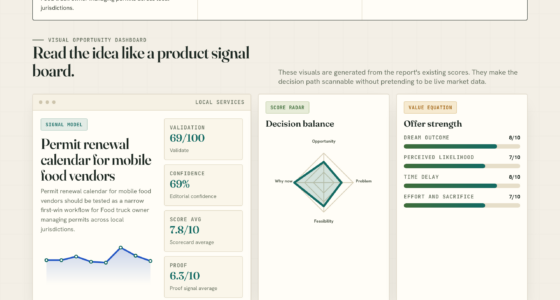

📊 Full opportunity report: Memory Stopped Being a Commodity on ThorstenMeyerAI.com — validation score, market gap, and execution plan.
TL;DR
Micron has announced long-term, take-or-pay contracts covering about 20% of its memory output, with $22 billion in customer deposits. This marks a shift from memory as a volatile commodity to a strategic, prepaid input for large buyers.
Micron has revealed that it has signed 16 long-term take-or-pay contracts covering roughly 20% of its DRAM and NAND output through 2030, with $22 billion in customer deposits and commitments. This development indicates that memory is no longer a flexible, spot-market commodity, but a strategically pre-funded input for large buyers, marking a significant shift in the industry’s traditional supply and demand dynamics.
Micron’s Strategic Customer Agreements run primarily from 2026 to 2030, with some automotive deals extending three years. These contracts require customers to purchase a fixed volume annually or pay a penalty, effectively locking in demand. The contracts are designed with a price band, setting a ceiling near current market prices and a floor that ensures Micron maintains gross margins above previous cyclical peaks, even if prices collapse.
Most notably, these agreements include $22 billion in customer deposits and commitments, which are paid upfront and held on Micron’s balance sheet until returned later. For more insights, see The Six Chokepoints. This means large buyers are effectively pre-funding capacity, financing the construction of new memory fabs—an industry shift from manufacturers bearing the capital risk to buyers doing so. Micron’s record financial results in the quarter preceding these contracts—$41.5 billion revenue, 84.9% gross margin, and $18.3 billion free cash flow—highlight the company’s strong position amidst this strategic realignment.
Memory stopped being a commodity
Micron just locked up a fifth of its DRAM and a third of its NAND through 2030 with binding take-or-pay contracts — and collected $22 billion in deposits from the customers, up front. The boom-bust cycle that always brought cheap RAM back is being contracted away.
A dream deal for Micron — near-peak prices, margin floors above any past peak, customer-funded fabs. Insurance for the buyers who signed — real protection against a real shortage, bought dear. And for everyone else, a forecast: don’t expect cheap memory back soon. The structure is also a large, leveraged bet on AI demand holding to 2030 — and floors get tested in a genuine downturn. The contracts run to 2030; the test arrives sooner.
Implications of Memory Contracts on Industry Dynamics
This shift signifies that memory is transitioning from a volatile commodity to a strategic, prepaid resource for major technology firms. It reduces the cyclical volatility traditionally seen in memory markets and gives Micron greater pricing power and revenue certainty. For buyers, pre-funding capacity ensures supply security, especially amid AI-driven demand growth, but also locks them into multi-year obligations at near-peak prices. The move could reshape how memory supply chains operate, potentially leading to less price volatility but also raising questions about market flexibility and competition.

CORSAIR Vengeance LPX DDR4 RAM 32GB (2x16GB) Up to 3200MHz CL16-20-20-38 1.35V Intel XMP AMD EXPO Computer Memory – Black (CMK32GX4M2E3200C16)
Disclaimer: Maximum Speed requires overclocking/PC BIOS adjustments. Maximum speed and performance depend on system components, including motherboard and…
As an affiliate, we earn on qualifying purchases.
As an affiliate, we earn on qualifying purchases.
Historical Industry Volatility and New Contract Trends
For decades, memory chips—particularly DRAM and NAND—have been characterized as commodities, with prices fluctuating sharply based on supply-demand cycles. This cycle has historically involved periods of shortages and glut, with prices crashing after oversupply, then rebounding as new capacity was built. Micron’s recent announcement marks a departure from this pattern, as the company’s contracts lock in demand and prices years in advance. Previously, memory manufacturers bore the capital risk of building capacity, waiting for market recoveries, but now large buyers are pre-paying for future supply, effectively financing capacity expansion themselves.
This trend emerged amid a booming AI market, where demand for high-bandwidth memory (HBM) and other advanced chips has surged. Micron’s record financial performance and the signing of these long-term agreements suggest a strategic shift toward industry stability and predictability, although it also indicates increased leverage by large buyers and a potential reduction in market volatility.
“These agreements secure our revenue streams and allow us to plan capacity expansion with confidence.”
— Micron CFO

Gigastone 【NAS Certified】 1TB High Endurance SSD (2-Pack) Up to 550MB/s TLC Flash with SLC Caching 24/7 Reliable for Gaming/PC/NAS SSD 5-Year Warranty 2.5" SATA Internal Solid State Drives RAID Disk
[High Endurance Grade] : No.1 NAS SSD choice in heavy workloads NAS systems|24/7 superior NAS Cache with reliable…
As an affiliate, we earn on qualifying purchases.
As an affiliate, we earn on qualifying purchases.
Unclear Long-Term Market Impact and Competition
It remains uncertain how widespread these contractual practices will become across the industry, as Micron currently covers only about 20% of its output. It is also unclear whether other memory manufacturers will adopt similar strategies or how this will influence overall market competition and pricing dynamics in the long term. Additionally, the impact on smaller buyers and the potential for supply bottlenecks or reduced market flexibility are still developing issues.

862974-B21 Server Memory Module, 8GB 1Rx8 PC4-2400 ECC DDR4 RAM
Exact Model Match: Specifically identified as model 862974-B21 to ensure precise compatibility and seamless integration as a direct…
As an affiliate, we earn on qualifying purchases.
As an affiliate, we earn on qualifying purchases.
Future Industry Trends and Contract Expansion Plans
Micron aims to expand the proportion of its revenue secured through such long-term agreements, potentially covering over half of its output. The company and other industry players will likely monitor how these contracts influence market stability, pricing, and capacity expansion. Regulatory scrutiny and competitive responses may also shape the evolution of this contractual approach in the memory industry.

2 Pcs/1pc MT29F4G08ABAEAWP:E 29F4G08ABAEA-48 4Gb NAND Flash Memory Chip IC 1Gb 2Gb 8Gb MT29F1G08ABAEAWP MT29F2G08ABAEAWP Industrial Grade Precision Reliable Electronic Module
✅ HIGH FOR QUALITY ELECTRONICS COMPONENTS: Our products are made with top-of-the-line electronics components, ensuring reliable and long-lasting…
As an affiliate, we earn on qualifying purchases.
As an affiliate, we earn on qualifying purchases.
Key Questions
What does this mean for memory prices?
Memory prices are likely to become more stable and predictable due to long-term contracts, reducing the cyclical volatility historically seen in the industry.
Will this strategy affect smaller buyers?
Yes, smaller buyers may face less flexibility and could be disadvantaged if capacity is pre-funded and locked in by large contracts.
Is this a sign that memory is no longer a commodity?
Yes, Micron’s contracts suggest memory is shifting toward a strategic, pre-paid infrastructure component rather than a flexible commodity.
Could other manufacturers adopt similar contracts?
It is possible, but currently Micron is leading this shift; industry-wide adoption will depend on market conditions and competitive strategies.
What happens if AI demand slows down?
If AI demand disappoints, buyers are still obligated to purchase at the contracted floor prices, which could lead to excess capacity or financial strain for some firms.
Source: ThorstenMeyerAI.com