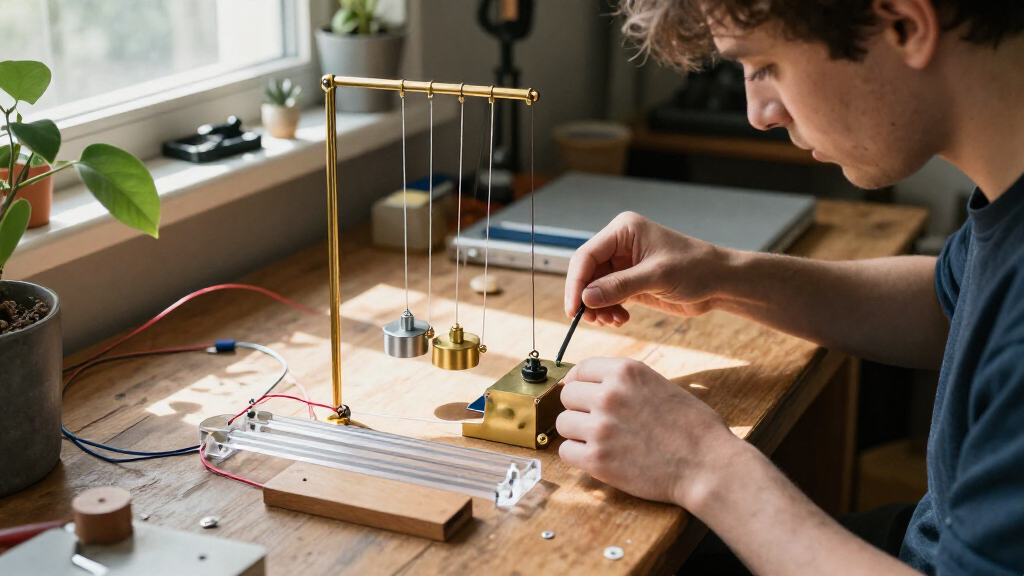

Physics experiment kits for adults range from broad workbenches to focused projects in optics, mechanics, electricity, and magnetism. I’d put the Thames & Kosmos Physics Workshop STEM Science Kit first for its 305-piece assortment and broad scope, while the Thames & Kosmos Forces, Motion & Energy Physics Set is a strong pick for learning core mechanics through experiments. For a narrower challenge, the MUXWELL DIY Ultrasonic Standing Wave Levitation Soldering Kit centers on one striking electronics-based effect. The main tradeoff is breadth versus depth: larger kits offer more directions to explore, while focused kits can provide a clearer project but may involve soldering or a steeper setup. Read on for the full breakdown and help matching a kit to your experience, space, and preferred physics topic.

Prime made for students and young adults
- Fast, free delivery for dorm and study essentials
- Prime Video and Amazon Music included
- Member-only deals
Key Takeaways
- The Physics Workshop is the broadest starting point: its 305 pieces give it a wider activity range than the focused optics, mechanics, and soldering kits.
- Topic focus matters more than piece count: the 26-experiment Matifaner mechanics kit and 37-piece Matifaner optics kit each suit a more specific learning goal.
- Adult-level challenge often comes from assembly: the MUXWELL levitation and MiOYOOW shooting-game kits add soldering, which changes the experience from guided experimentation to electronics project work.
- Electricity options serve different purposes: the EUDAX Basic Electricity Circuit Kit emphasizes circuit fundamentals, while the Matifaner and EUDAX Electricity and Magnetism kits point toward a broader subject mix.
- Not every kit is a general physics course: the Engino set focuses on motion concepts, the Simple Machines set on mechanical advantage, and the NikolaToy kit on an electromagnetic accelerator project.
| Thames & Kosmos Forces, Motion & Energy Physics Set |  | Best for Broad Mechanics Exploration | Brand: Thames & Kosmos | Experiments: 20 | Age range: 8–14 years | VIEW LATEST PRICE | See Our Full Breakdown |
| Matifaner Physics Electricity and Magnetism Experiment Kit |  | Best for Electricity and Magnetism | Brand: Matifaner | Age range: 14 years and up | Number of items: 77 | VIEW LATEST PRICE | See Our Full Breakdown |
| Matifaner 37-Piece Physics Optics Experiment Kit |  | Best for Optics | Brand: Matifaner | Piece count: 37 | Age range: 14 years and up | VIEW LATEST PRICE | See Our Full Breakdown |
| MUXWELL DIY Ultrasonic Standing Wave Levitation Soldering Kit |  | Best for Soldering and Resonance | Brand: MUXWELL | Model: KIT03 | Kit contents: Soldering kit and instruction | VIEW LATEST PRICE | See Our Full Breakdown |
| EUDAX Basic Electricity Circuit Kit for Students |  | Best Compact Starting Point | Kit type: Basic electricity circuit kit | Circuit types: Series and parallel | Instructions: English | VIEW LATEST PRICE | See Our Full Breakdown |
| Engino Physics Laws STEM Building Set: Inertia, Friction and Circular Motion |  | Best for Model-Based Experiments | Brand: Engino | Set name: Physics Laws: Inertia, Friction & Circular Motion | Number of models: 6 | VIEW LATEST PRICE | See Our Full Breakdown |
| NikolaToy Electromagnetic Coil Accelerator STEM Physics Kit |  | Best for Electromagnetism Demonstrations | Brand: NIKOLATOY | Product type: Electromagnetic coil accelerator model | Materials: Metal and acrylic | VIEW LATEST PRICE | See Our Full Breakdown |
| Matifaner Physics Mechanics Experiment Kit, 26 Experiments |  | Best for Measurement-Focused Mechanics | Brand: Matifaner | Number of experiments: 26 | Recommended age: 14 years and up | VIEW LATEST PRICE | See Our Full Breakdown |
| Thames & Kosmos Physics Workshop STEM Science Kit, 305 Pieces |  | Best for Extensive Guided Builds | Brand: Thames & Kosmos | Pieces: 305 | Models: 38 | VIEW LATEST PRICE | See Our Full Breakdown |
| Thames & Kosmos Simple Machines Physics and Engineering Set |  | Best for Focused Simple-Machine Builds | Brand: Thames & Kosmos | Model number: 665069 | Exercises: 26 model-building exercises | VIEW LATEST PRICE | See Our Full Breakdown |
| EUDAX Electricity and Magnetism Experiment Kit |  | Best for Broad Electricity and Magnetism Practice | Brand: EUDAX | Model: EUDAX-FC-80PCS | Item count: 79 | VIEW LATEST PRICE | See Our Full Breakdown |
| MiOYOOW DIY Electromagnetic Shooting Game Soldering Kit |  | Best for a Compact Electromagnetism Build | Brand: MiOYOOW | Model: mini shooting game kit | Kit type: DIY electromagnetic shooting game | VIEW LATEST PRICE | See Our Full Breakdown |
| physics experiment kits for adult | Brand | Included components |
|---|---|---|
| Thames & Kosmos Forces | Thames & Kosmos | Spring scale, plastic building parts, rubber bands |
| Matifaner Physics Electricity | Matifaner | Lab manual, repair kit, storage box |
| Matifaner 37-Piece Physics Opt | Matifaner | Optical bench, lenses, mirrors, screens, light sources, water lens, periscope, manual, and storage box |
| MUXWELL DIY Ultrasonic Standin | MUXWELL | — |
| EUDAX Basic Electricity Circui | — | — |
| Engino Physics Laws STEM Build | Engino | — |
| NikolaToy Electromagnetic Coil | NIKOLATOY | Toy |
| Matifaner Physics Mechanics Ex | Matifaner | Instruction manual and storage box |
| Thames & Kosmos Physics Worksh | Thames & Kosmos | — |
| Thames & Kosmos Simple Machine | Thames & Kosmos | Plastic building pieces, spring scale, and manual |
| EUDAX Electricity and Magnetis | EUDAX | — |
| MiOYOOW DIY Electromagnetic Sh | MiOYOOW | Electronic components |
More Details on Our Top Picks
Thames & Kosmos Forces, Motion & Energy Physics Set
I’d choose this set for adult learners who want to connect several mechanics topics through physical models rather than focus on one branch of physics. Its 20 experiments span forces, motion, and energy, with builds such as collision cars and a spring launcher that make the concepts tangible. The 32-page illustrated manual adds assembly guidance, real-world examples, and NGSS-aligned lesson plans. Compared with Matifaner’s electricity-and-magnetism kit, this set trades circuit work for a wider introduction to mechanical ideas. That breadth comes with a hands-on setup cost: models need to be assembled before experiments, so it suits patient learners more than someone seeking quick demonstrations. Its stated age range is 8–14, which may also make the presentation feel young to adults looking for advanced theory or measurement.
Pros:- Twenty experiments cover several connected mechanics concepts.
- Reconfigurable models support repeated experiments with different setups.
- Illustrated manual includes assembly steps and real-life examples.
- NGSS-aligned lesson plans provide a structured learning path.
Cons:- Building the models adds setup time before experiments can begin.
- The age recommendation of 8–14 may feel juvenile to some adult learners.
Best for: Adult beginners who want a guided, model-based introduction to forces, motion, and energy, especially those learning alongside a younger student.
Not ideal for: Adults seeking advanced equations, electronics experiments, or activities that begin without model assembly.
- Brand:Thames & Kosmos
- Experiments:20
- Age range:8–14 years
- Included components:Spring scale, plastic building parts, rubber bands
- Manual:32-page, full-color
- Educational objective:STEM learning
- Model number:550076
Our verdict“Choose this set if you want structured, hands-on mechanics coverage and are comfortable assembling models before investigating the physics.”
Matifaner Physics Electricity and Magnetism Experiment Kit
For an adult learner drawn to circuits and electromagnetism, I’d put this ahead of EUDAX’s basic circuit kit: Matifaner adds experiments with Ohm’s law, electromagnets, electric bells, and a hand-crank generator rather than stopping at series and parallel circuits. Its 77-item assortment includes a sensitive ammeter and magnetically controlled switch, giving learners more ways to observe how electrical behavior changes across setups. A sturdy, organized carrying case is useful when components need to move between a home workspace and a class or club. The tradeoff is a narrower subject focus than the Thames & Kosmos Forces, Motion & Energy set, and the manual-led, step-by-step format may not satisfy buyers who want open-ended design challenges. You’ll also need to supply three AA batteries.
Pros:- Covers circuits, electromagnetism, magnetic fields, and Ohm’s law.
- Includes specialized parts such as a sensitive ammeter and magnetic switch.
- Manual guides learners through experiment procedures.
- Fixed-position storage case supports organized transport and cleanup.
Cons:- Three AA batteries are required but not included.
- Its electricity-focused scope is narrower than the Thames & Kosmos mechanics set.
- The guided procedure format offers less emphasis on designing independent investigations.
Best for: Adult beginners and returning learners who want guided circuit and electromagnetism experiments, with components organized for home or classroom use.
Not ideal for: Buyers who want a broad mechanics-and-energy kit, prefer open-ended projects, or need a kit ready to use without sourcing batteries.
- Brand:Matifaner
- Age range:14 years and up
- Number of items:77
- Included components:Lab manual, repair kit, storage box
- Materials:Metal and plastic
- Dimensions:14.96 x 9.84 x 3.85 inches
- Weight:4 pounds
- Batteries required:Three AA batteries, not included
Our verdict“Pick Matifaner over a basic circuit set if your priority is a guided progression from circuit fundamentals into electromagnetism.”
Matifaner 37-Piece Physics Optics Experiment Kit
I’d choose this kit when the goal is to study light directly, not build a general-purpose physics collection. Its 60 cm optical bench and three adjustable light sources create a defined workspace for exploring reflection, refraction, lenses, and image formation. The 37-piece assortment also reaches beyond simple ray demonstrations, including a periscope, water lens, vision lenses, and colored-light equipment. Compared with the Matifaner electricity-and-magnetism kit, this one offers a more focused visual subject area and a bench-based way to arrange experiments; it does not offer the same circuit or magnetic investigations. The acrylic components are described as shatter-resistant, but the many separate pieces need careful organization between sessions. I’d also check that your work area can accommodate the 60 cm bench before choosing it over the more compact EUDAX circuit kit.
Pros:- Explores reflection, refraction, imaging, and primary colors of light.
- Integrated 60 cm bench provides a stable setup without assembly.
- Three adjustable light sources support varied demonstrations.
- Acrylic optical pieces are described as shatter-resistant.
Cons:- The bench requires more workspace than compact circuit kits such as EUDAX.
- The large component assortment needs careful sorting and storage.
- The optics focus leaves little coverage of other physics subjects.
Best for: Adult learners, hobbyists, or educators with workspace for a bench who want hands-on demonstrations of lenses, mirrors, refraction, and color.
Not ideal for: Buyers seeking electricity, magnetism, or mechanics experiments, or anyone with limited room to store and arrange a 60 cm bench and its components.
- Brand:Matifaner
- Piece count:37
- Age range:14 years and up
- Optical bench length:60 cm
- Light sources:3 adjustable light sources
- Lens types:F10 cm convex, F5 cm convex, F-10 cm concave
- Included components:Optical bench, lenses, mirrors, screens, light sources, water lens, periscope, manual, and storage box
- Model number:op-1
Our verdict“Choose this kit if optics is your main interest and you have space for a dedicated bench and its many components.”
MUXWELL DIY Ultrasonic Standing Wave Levitation Soldering Kit
This is the most project-like option in the group: rather than offering a sequence of separate experiments, it asks you to solder and assemble an ultrasonic levitation device. That makes it a distinctive pick for adults who want electronics practice tied to a memorable physics effect: standing waves and resonance. Compared with the Matifaner electricity-and-magnetism kit, MUXWELL has a narrower learning path but gives the build itself a central role; it is less suited to comparing many circuit arrangements or working through a broad manual of experiments. The payoff depends on completing the assembly, so soldering ability and troubleshooting patience matter. The listed recommended age of 0–10 is at odds with the soldering requirement and adult-oriented project appeal, so I would not treat that age field as a reliable guide to suitability.
Pros:- Connects a build project with demonstrations of standing waves and resonance.
- Includes components for assembling an ultrasonic levitation device.
- Provides hands-on soldering and electronics practice.
- Offers a distinctive project format compared with manual-led experiment collections.
Cons:- Soldering and assembly are required before the device can be used.
- Troubleshooting may be needed to complete the project.
- The kit focuses on one device rather than a range of physics experiments.
Best for: Adults with basic soldering skills who want to build one physics demonstration device and learn about resonance through electronics.
Not ideal for: Beginners without soldering access or troubleshooting patience, and learners who want multiple experiments or a broad physics curriculum.
- Brand:MUXWELL
- Model:KIT03
- Kit contents:Soldering kit and instruction
- Material:Metal
- Dimensions:12 x 12 x 8 inches
- Weight:0.08 kg
- Theme:Physics
- Listed recommended age:0–10 years
Our verdict“Choose MUXWELL if you want a soldering project centered on resonance, and skip it if you need a ready-to-run kit with varied experiments.”
EUDAX Basic Electricity Circuit Kit for Students
I’d treat EUDAX as a focused first step into circuit physics, not as a full adult experiment lab. It supports series and parallel circuits with English instructions and a plastic storage box, keeping the activity centered on fundamental electrical connections. That simpler scope makes it easier to approach than the Matifaner electricity-and-magnetism kit, which adds topics such as electromagnets, Ohm’s law, and a hand-crank generator. The tradeoff is limited breadth: adults who already understand basic circuits may outgrow this kit quickly, and it does not cover optics, mechanics, or magnetism. Its stated fit is grades 7–9, so the presentation may also feel school-oriented. Two AA batteries are required but not included, a small practical step to plan for before starting.
Pros:- Introduces series and parallel circuit arrangements through hands-on building.
- English instructions support guided setup.
- Plastic storage box keeps accessories together.
- Narrow scope can make it a less demanding starting point than Matifaner’s larger electricity kit.
Cons:- Limited to basic electricity rather than a broad physics subject range.
- Two AA batteries are required but not included.
- Grades 7–9 recommendation may feel young or elementary to adult learners.
Best for: Adult beginners who want a straightforward, low-complexity introduction to series and parallel circuits, or mentors supporting a young learner.
Not ideal for: Adults who already know circuit basics or want broader electrical investigations, measurement tools, or experiments beyond simple circuits.
- Kit type:Basic electricity circuit kit
- Circuit types:Series and parallel
- Instructions:English
- Storage:Plastic storage box
- Recommended grade levels:Grades 7–9
- Batteries:Two AA batteries required, not included
Our verdict“Choose EUDAX for a simple, guided start with series and parallel circuits; choose Matifaner if you want to progress into magnetism and more varied electrical experiments.”
Engino Physics Laws STEM Building Set: Inertia, Friction and Circular Motion
I’d choose the Engino Physics Laws set for an adult who wants to explore motion by building mechanisms rather than working through a broad lab kit. Its six models—including a rocket launcher, crash test rig, sharpening wheel, and rubber-band car—give inertia, friction, and circular motion a tangible form. The theory, experiments, and quizzes add more guidance than the NikolaToy Electromagnetic Coil Accelerator, which focuses on demonstrating one specialized concept. Compared with the wider-ranging Matifaner Mechanics Experiment Kit, Engino is more construction-led and covers fewer mechanics topics. That focus is also its tradeoff: builders get fewer experiments, and some extra model instructions require the app or online access. The age guidance also varies between 8+ and 9+, so I’d check the instructions before involving younger learners.
Pros:- Six working builds connect motion concepts with observable mechanisms
- Theory, experiments, and quizzes support structured learning
- Free 3D app adds virtual building instructions and model ideas
- Snap-fit parts allow flexible model designs
Cons:- Covers fewer experiments and topics than the Matifaner Physics Mechanics Experiment Kit
- Some additional model instructions depend on online or app access
- Age recommendations conflict between 8+ and 9+
Best for: Adult hobbyists who prefer building working models to measuring a wide range of mechanics variables
Not ideal for: Learners seeking a large, instrument-based experiment set or complete printed instructions for every model
- Brand:Engino
- Set name:Physics Laws: Inertia, Friction & Circular Motion
- Number of models:6
- Recommended age:9 years and up; description also states 8+
- Included learning materials:Instruction manual, quiz book, experiments, theory book, and free app
- Model number:ENG-STEM902
- Warranty:2-year limited warranty
Our verdict“I’d pick Engino for adults who want a guided, build-first introduction to inertia, friction, and circular motion, not a broad mechanics lab.”
NikolaToy Electromagnetic Coil Accelerator STEM Physics Kit
The NikolaToy coil accelerator is the most specialized choice here: it gives learners a physical demonstration of circular acceleration and electromagnetic principles rather than a set of varied experiments. For an adult curious about accelerator concepts, its metal-and-acrylic construction and compact footprint make the mechanism easier to observe and handle than a box of small parts. It stands apart from the mechanical builds in the Thames & Kosmos Physics Workshop, which ranges across gears, gravity, and energy transfer. The tradeoff is narrow scope: this is a demonstration model, not a working particle accelerator or a broad physics course. The listing also gives conflicting age details—36+ and 15 years and up—so I would not use that information alone to judge suitability.
Pros:- Presents circular acceleration and electromagnetic principles in a hands-on format
- Metal and acrylic construction is suited to repeated handling
- Compact dimensions fit a home desk or classroom demonstration area
Cons:- Demonstrates the concept rather than accelerating real particles
- Covers a much narrower range than the Thames & Kosmos Physics Workshop
- Age information conflicts between 36+ and 15 years and up
Best for: Adult learners who want a compact, visual demonstration of electromagnetic acceleration and accelerator principles
Not ideal for: Buyers looking for multiple experiments, adjustable lab measurements, or a kit spanning several areas of physics
- Brand:NIKOLATOY
- Product type:Electromagnetic coil accelerator model
- Materials:Metal and acrylic
- Dimensions:24 × 24 × 6 cm (9.5 × 9.5 × 2.5 in)
- Weight:1,165 g
- Manufacturer recommended age:15 years and up; listing also states 36+
- Included components:Toy
Our verdict“I’d choose this model for a focused visual lesson on electromagnetic acceleration, but not as a substitute for a multi-topic experiment kit.”
Matifaner Physics Mechanics Experiment Kit, 26 Experiments
For adults who want to measure forces and motion instead of mainly assembling models, the Matifaner 26-experiment kit offers the broadest hands-on mechanics toolkit in this group. Its balance, pulleys, lever ruler, pressure gauge, spring dynamometer, trolley, and ramp let learners work across Newton’s laws, kinematics, gravity, pressure, buoyancy, and simple machines. That makes it a more instrument-led counterpart to the Engino Physics Laws set, whose six builds focus on observing motion through models. The range is appealing for self-directed study, but the product data do not give instrument dimensions or measurement ranges, which makes it hard to plan precise experiments. Compared with the more tightly scoped Thames & Kosmos Simple Machines set, Matifaner covers more ground but may offer less model-building structure.
Pros:- Includes 26 experiments across several classical mechanics topics
- Tools support studies of forces, motion, pressure, and simple machines
- Includes an instruction manual and storage box
- Suitable for independent study or classroom use
Cons:- Instrument dimensions and exact measurement ranges are not specified
- Its broad topic list may be less structured around model building than the Engino set
- Recommended for ages 14 and up, limiting use with younger learners
Best for: Adult self-learners and instructors who want varied tools for hands-on classical mechanics experiments
Not ideal for: Buyers who need documented instrument ranges, detailed product dimensions, or a construction-focused kit
- Brand:Matifaner
- Number of experiments:26
- Recommended age:14 years and up
- Topics:Newton’s laws, kinematics, gravity, pressure, buoyancy, pulleys, and levers
- Included tools:Tray balance, pulleys, lever ruler, U-tube pressure gauge, spring dynamometer, trolley, and ramp
- Materials:Plastic and metal
- Included components:Instruction manual and storage box
Our verdict“I’d choose Matifaner for a varied, measurement-oriented mechanics practice set, provided the unspecified instrument ranges meet your needs.”
Thames & Kosmos Physics Workshop STEM Science Kit, 305 Pieces
The Thames & Kosmos Physics Workshop leads this group for sheer breadth of guided mechanical activity: 38 models and 37 experiments cover gravity, inertia, simple machines, gears, energy transfer, forces, and centrifugal force. Its 104-page illustrated manual adds explanations, charts, examples, and equations, giving adult learners more structured reading and progression than the shorter manual in the Thames & Kosmos Simple Machines set. It also reaches beyond that kit’s concentrated focus on the six classic simple machines. The tradeoff is that the workshop still centers on mechanical physics; it is not a broad survey of electricity, optics, or other fields. Its age recommendation is 8+, and some builds may need adult help, so adults seeking independent, advanced lab work may find the format more introductory than they want.
Pros:- Combines 38 models with 37 experiments
- 104-page illustrated manual includes explanations, charts, examples, and equations
- Progresses from basic builds to more involved mechanisms such as a pendulum clock
- Covers more mechanical topics than the Simple Machines set
Cons:- Focuses on mechanical physics rather than a wide range of science topics
- Model assembly and experiment steps may require assistance for some learners
- Age recommendation of 8+ signals a more introductory presentation
Best for: Adult learners who want a large, manual-led sequence of mechanical physics models and experiments
Not ideal for: Buyers seeking advanced measurement equipment or experiments spanning electricity, optics, and other physics fields
- Brand:Thames & Kosmos
- Pieces:305
- Models:38
- Experiments:37
- Manual:104-page, full-color illustrated manual
- Topics:Gravity, inertia, simple machines, gears, energy transfer, forces, and centrifugal force
- Recommended age:8 years and up
- Warranty:One-year limited warranty for defective parts
Our verdict“I’d pick the Physics Workshop for adults who want the most extensive guided mechanical build-and-experiment sequence in this lineup.”
Thames & Kosmos Simple Machines Physics and Engineering Set
I’d favor the Thames & Kosmos Simple Machines set when the goal is to understand how familiar mechanisms change the force needed to do a task. Its 26 model-building exercises cover gears and all six classic simple machines, while the included spring scale gives learners a way to measure force rather than rely only on observation. That makes it a more focused, measurement-supported option than the broader Thames & Kosmos Physics Workshop, which includes many more models and topics. The narrower scope can be a benefit for studying levers, pulleys, and inclined planes in sequence, but it will not match the workshop’s variety. The listed kit contains plastic building pieces, a spring scale, and a manual, so buyers seeking a wider range of lab instruments should look at the Matifaner Physics Mechanics Experiment Kit instead.
Pros:- Covers gears and all six classic simple machines
- Spring scale supports direct force comparisons
- Modular pieces can be rebuilt for repeated exercises
- Illustrated manual pairs instructions with real-world examples
Cons:- Narrower topic range than the Thames & Kosmos Physics Workshop
- Listed contents include only building pieces, a spring scale, and a manual
- Age recommendation of 8+ indicates an introductory level
Best for: Adult beginners who want to build and compare simple machines while measuring how they affect applied force
Not ideal for: Learners seeking a broad mechanics curriculum, numerous measuring tools, or experiments beyond gears and simple machines
- Brand:Thames & Kosmos
- Model number:665069
- Exercises:26 model-building exercises
- Educational focus:Simple machines, gears, and mechanical physics
- Included components:Plastic building pieces, spring scale, and manual
- Manual:32-page, full-color illustrated manual
- Recommended age:8 years and up
- Warranty:1 year against manufacturer defects
Our verdict“I’d choose this set for a structured, hands-on study of simple machines and force, rather than a wide-ranging physics course.”
EUDAX Electricity and Magnetism Experiment Kit
The EUDAX kit earns its place for adults who want to work through several foundational electricity and magnetism topics rather than build one showpiece. Its 79 pieces cover series and parallel circuits, fruit batteries, Ohm’s law, electromagnets, and a hand-crank generator, so the projects connect circuit behavior with magnetic effects. Compared with the EUDAX Basic Electricity Circuit Kit for Students, this set reaches further into magnetism; it is less focused than the Thames & Kosmos Physics Workshop STEM Science Kit, 305 Pieces, which spans a wider range of physics activities. The color manual and storage bag support repeat use, though the supplied age guidance is school-focused rather than adult-specific. You’ll also need to provide three AA batteries, and the number of components means keeping parts organized between experiments matters.
Pros:- Combines circuit experiments with electromagnetism and generator activities.
- Includes a color manual to guide the projects.
- Storage bag helps keep the 79 pieces together between sessions.
- Project range includes Ohm’s law and fruit-battery investigations.
Cons:- Requires three AA batteries, which are not included.
- Recommended age and grade guidance is aimed at school students, not adult learners.
- Its broad collection of basic projects may not satisfy buyers seeking advanced quantitative experiments.
Best for: Adult learners who want a guided, hands-on introduction to circuits and electromagnetism across multiple small experiments.
Not ideal for: Buyers seeking an adult-only advanced lab set, a single polished build, or a kit ready to use without supplying batteries.
- Brand:EUDAX
- Model:EUDAX-FC-80PCS
- Item count:79
- Electricity components:56
- Magnetism components:21
- Included:Color manual and storage bag
- Power requirement:3 AA batteries, not included
- Example projects:Series and parallel circuits, fruit battery, Ohm’s law, Oersted experiment, electromagnet, electric bell, hand-crank generator
Our verdict“Choose this kit for guided practice across basic circuits and magnetism, but pick a broader physics set for experiments beyond those subjects.”
MiOYOOW DIY Electromagnetic Shooting Game Soldering Kit
Where the EUDAX kit spreads its attention across many guided experiments, the MiOYOOW kit turns electromagnetism into a single interactive build: assemble a small shooting game and observe how its circuit operates. It suits adults who would rather complete one functional project than sort through a larger collection of parts. The kit calls for relatively little soldering, and green and blue LEDs indicate charging progress, giving useful feedback during operation. An English paper manual and QR-linked PDF provide two instruction formats. The tradeoff is that this is not a broad experiment set like EUDAX: its learning centers on one device, and the circuit uses high voltage. The capacitor must be discharged before troubleshooting, so this is a poor fit for anyone who wants a low-risk, open-ended kit or plans to leave the build unsupervised around younger users.
Pros:- Turns circuit assembly and electromagnetism into an interactive shooting-game build.
- Requires relatively little soldering compared with more involved electronics projects.
- Green and blue LEDs show charging progress.
- Includes both a paper manual and QR access to PDF instructions.
Cons:- High-voltage operation requires careful handling and capacitor discharge before troubleshooting.
- Focuses on one build rather than offering a range of experiments like the EUDAX kit.
- Users under 14 require adult supervision.
Best for: Adults and teens who want to assemble a compact, interactive electromagnetism project with limited soldering.
Not ideal for: Beginners who want a low-voltage collection of experiments, or households where users under 14 would handle the kit without adult supervision.
- Brand:MiOYOOW
- Model:mini shooting game kit
- Kit type:DIY electromagnetic shooting game
- Included components:Electronic components
- Charging time:About 10–30 seconds
- Indicators:Green and blue LEDs
- Instructions:English paper manual and QR code for PDF instructions
- Recommended age:Teens and adults; users under 14 require adult supervision
- Safety note:High voltage; discharge the capacitor before troubleshooting
Our verdict“Pick MiOYOOW for one hands-on, interactive electromagnetism build, not for a broad or low-voltage experiment collection.”
How We Picked
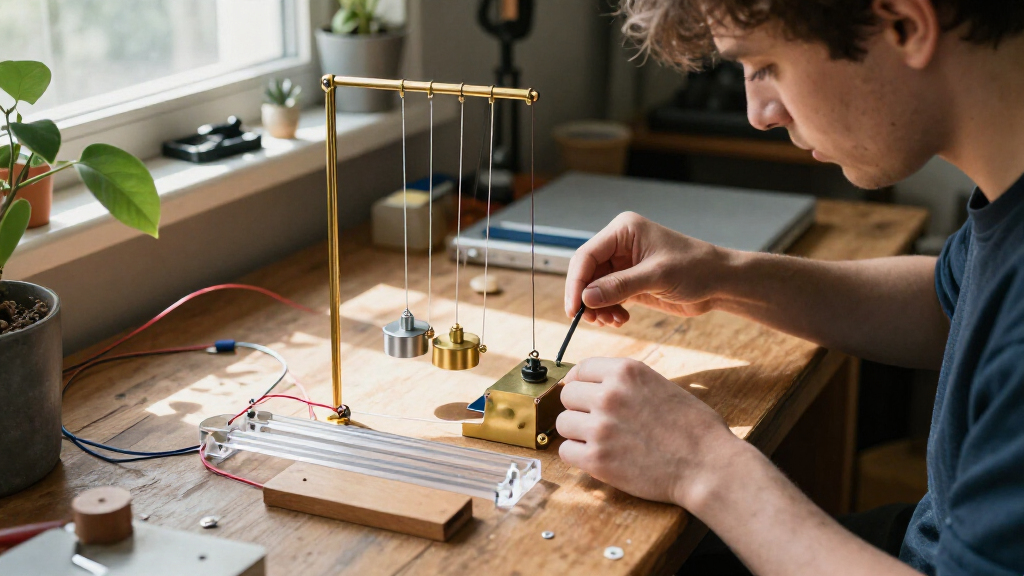
I compared these kits by subject coverage, hands-on activity, adult suitability, and practical setup demands. A kit can suit adults without advanced mathematics if it lets them build, observe, and test a physical idea; I gave weight to whether its stated topic and format support that kind of active learning. I also distinguished general-purpose sets from kits that concentrate on one field or one finished project, since those choices serve different goals.
The ranking favors versatility and useful learning range near the top, then gives focused options their place when they offer a clear reason to choose them. I also considered whether the format suggests extra demands such as soldering, a narrower activity scope, or a student-oriented presentation. Product details vary, so buyers should check the current contents and instructions before ordering; the descriptions alone do not establish the depth of every experiment or the tools and materials included.
Factors to Consider When Choosing Physics Experiment Kits For Adults
Before choosing among these kits, I’d start with the kind of physics you want to explore and how you want to work. A big box is not automatically more useful than a small focused set, and an eye-catching project may teach less breadth than its finished effect suggests. These points help match the kit to your goals and avoid buying based on piece count alone.
Choose a subject you will keep returning to
Physics is a wide field, so a kit that covers everything in outline may be less satisfying than one that lets you repeat experiments in a subject you care about. Ask whether you are most interested in motion, optics, simple machines, or circuits and magnetism. A focused kit can make it easier to compare variables because its activities stay within one topic. A broad set may suit someone who is still deciding, but breadth does not guarantee equal depth in every subject. Avoid choosing a topic only because a demonstration looks dramatic; check whether the underlying concept interests you too. Your best fit is the one whose experiments you can imagine revisiting after the first build.
Look for repeatable experiments, not just a finished effect
A kit is more educational when you can change one condition, observe what happens, and try again. Before buying, look for clues that activities involve comparing results or varying a setup rather than assembling a device once. A memorable outcome can make a project engaging, but it may not offer much ongoing exploration if the build has only one intended result. This tradeoff is especially relevant for single-project electronics kits. If learning is your main goal, favor clear instructions and experiments that invite prediction and adjustment. If you mainly want a satisfying build, a focused project may be the better match.
Check the real setup demands
Descriptions may not make clear whether a kit requires soldering, extra tools, batteries, or household materials, so verify the included-items list and instructions before purchase. Soldering adds a useful electronics skill but changes the project’s difficulty and safety needs. A build that assumes prior tool experience can frustrate a first-time maker even when the physics idea is accessible. Think about where you will work, whether you can leave a project assembled, and how you will store small parts. Do not assume that an adult-focused label means every activity is advanced, or that a student-oriented label means it lacks value for adults. Setup fit can matter more to your enjoyment than a long list of experiments.
Treat piece count as a clue, not a quality score
A high piece count can signal a broader build environment, but it can also mean more sorting, storage, and assembly. A smaller kit with a defined set of experiments may be easier to start and finish, especially if you have limited workspace. Consider how many distinct activities the pieces support and whether they serve a shared learning path. A large assortment is most useful when you want to explore multiple concepts over time. For a specific goal, such as optics or mechanics, a focused kit may reduce distractions. Compare the stated activities and subject range rather than choosing by component total alone.
Match the kit to your preferred learning style
Some learners want to follow a structured sequence, while others prefer building freely and troubleshooting as they go. A guided experiment set can make abstract ideas easier to approach, but it may feel restrictive if you already know the basics and want to modify designs. Construction-focused kits give more room to test configurations, though they may offer less step-by-step explanation. If you learn best by measuring, check whether the activities support observation and comparison; if you learn by making, prioritize hands-on assembly. Think about whether you want a solo project, a shared activity, or a starting point for self-directed study. Matching the format to your habits makes it more likely the kit will get used.
Pay more for range only when you will use it
A broader kit can make sense if you want to sample several areas of physics or share activities with others over time. If you already know your interest is electricity or mechanical motion, extra components for unrelated topics may sit unused. Focused kits can be a better fit for a first project, a specific learning objective, or a compact workspace. Conversely, buying several narrow sets may be less convenient than one broad assortment if you want varied experiments. Judge value by the activities you expect to complete, not by the size of the box or the number of parts alone. A clear personal goal is the best safeguard against paying for unused scope.
Frequently Asked Questions
Which kit is the best starting point if I have not studied physics recently?
I’d start with a kit that gives you several accessible ways into a topic rather than assuming you already know electronics or advanced theory. The Thames & Kosmos Forces, Motion & Energy Physics Set is a more focused entry to core motion concepts, while the Physics Workshop offers a wider set of directions if you are undecided. Check the instructions before buying to see how much explanation accompanies each activity. If a kit requires soldering, treat that as a separate skill from understanding the physics. A manageable first build is usually a better starting point than the most technically ambitious project.
Should I choose a broad kit or a focused one?
Choose a broad kit if you want to sample different areas and are not yet sure which subject will hold your attention. A focused kit makes more sense when you already know you want to study optics, mechanics, or electricity and magnetism. The broad option can reduce the need to select a specialty right away, but it may not explore every topic in equal detail. A focused set can offer a clearer learning path, though it gives you fewer ways to change subjects. Decide whether variety or depth is more likely to keep you engaged after the first experiment.
Do I need soldering experience for the electronics kits?
Not necessarily, but a soldering kit is a different purchase from a ready-to-assemble circuit set. Confirm whether the product requires soldering, what tools it includes, and whether its instructions explain the process. If you have never soldered, plan for the build to involve learning a practical skill as well as exploring physics. A circuit kit that does not center on soldering may be a more comfortable choice if your priority is understanding electrical behavior. Follow the kit’s safety instructions and use an appropriate work area.
Is a student-oriented kit still suitable for an adult?
Yes, if the activities match what you want to learn and you are comfortable with the kit’s level of guidance. A student-oriented label may indicate a more accessible presentation, not that an adult cannot benefit from building and testing the concepts. Adults seeking advanced measurement, open-ended design, or technical documentation may find a guided kit too introductory. Review the listed experiments and the expected assembly before deciding. The best test is whether the kit gives you enough room to question, repeat, or modify the activity.
What should I check before buying a kit with many parts?
Look for the activity list, a clear contents inventory, storage details, and any mention of tools or materials you must supply. A large assortment can support varied builds, but it also takes more room to sort and store. Check whether the parts serve multiple experiments or are mainly tied to a few specific constructions. If the instructions are not described in detail, avoid assuming that a high component count means a long or advanced curriculum. Match the kit’s scope to the time and workspace you actually have.
Conclusion
For the best overall, I’d choose the Thames & Kosmos Physics Workshop for its broad 305-piece scope; the best value in learning focus is the Matifaner Physics Mechanics Experiment Kit if motion is your priority and you want a defined set of 26 experiments. The best premium-style pick for breadth is also the Physics Workshop, while the best for beginners is the Thames & Kosmos Forces, Motion & Energy set for a more contained route into core mechanics. For specific needs, choose the Matifaner Optics kit for light experiments, EUDAX Basic Electricity for circuit fundamentals, or MUXWELL’s levitation kit if you want a soldering project. I’d favor the focused options over a broad set when you already know your subject; if you are still exploring, start with the Physics Workshop.