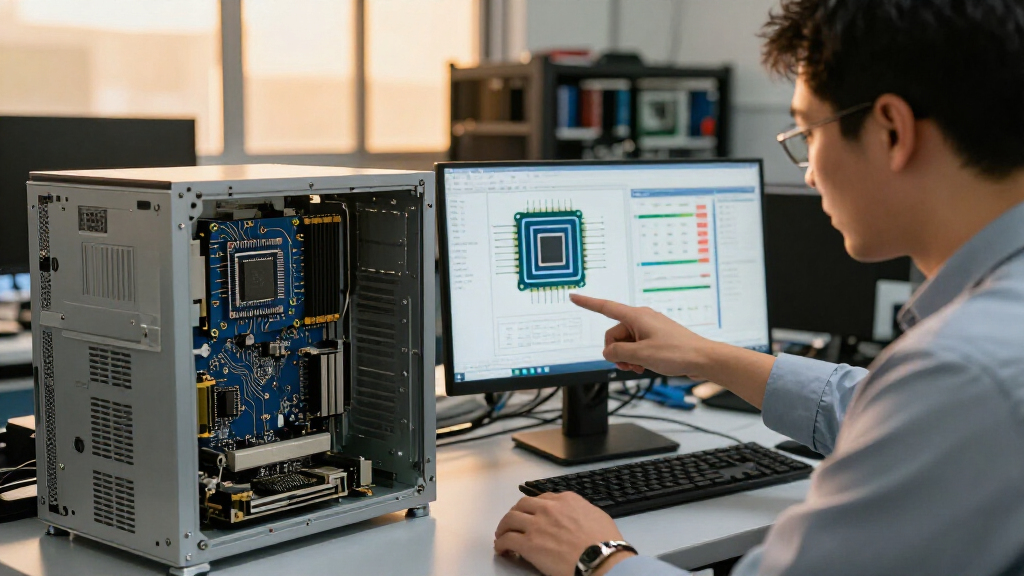

🔍 Read the full analysis: What OpenAI’s AI Models Changed In AMD Chip Designs on ThorstenMeyerAI.com

Prime made for students and young adults
- Fast, free delivery for dorm and study essentials
- Prime Video and Amazon Music included
- Member-only deals
TL;DR
OpenAI said on November 18 that its models rewrote parts of AMD chip designs, finding up to 14% gains in power, performance and area against heavily optimized baselines. The company says some changes are in a design sent to manufacturing, but AMD has not published its own figures and the results have not been independently audited.
OpenAI said November 18 that its AI models rewrote portions of AMD chip designs and found up to 14% improvements in power, performance and area (PPA) against heavily optimized baselines. OpenAI says some model-generated changes are already in an AMD design sent for manufacturing, but the companies have not released enough detail for outside researchers to verify the headline result.
OpenAI described the work in a post titled “Advancing chip design with OpenAI models.” The account was reported by ANI, The Decoder and Inside AI; OpenAI’s post was not directly accessible to the article’s source. According to those reports, models proposed rewrites to SystemVerilog register-transfer-level code, which specifies how chip components behave. Conventional Synopsys design tools then checked whether the changes preserved the original behavior and assessed their effects on PPA, OpenAI said.
The headline figure applies to an AMD flagship GPU design, and is a maximum rather than an average: OpenAI reported “up to” 14% improvement relative to what it called heavily optimized baselines. The company did not identify the specific GPU blocks, the portion of the chip they represent, or whether the figure reflects results after synthesis or after physical placement and wiring. OpenAI also said AMD had verified single-digit PPA gains in key blocks of a next flagship CPU. AMD has not published its own measurements, according to the source material.
OpenAI reported separate results for its own custom inference chip, Jalapeño. It said model-proposed changes reduced standard-cell area by about 13% in one unit and 10% in another, with validation after the first chips came back. Reports differ on the name of the first unit: ANI calls it a vector unit, while Inside AI calls it a warp engine. Inside AI also described a multiplier redesign that used about 15% less cell area in synthesis while reducing latency from two clock cycles to one, and an adder redesign with about 15% less area at the same two-cycle latency. These are reported examples, not independently audited results.
AI Moves Into Chip Engineering
If the reported gains hold up, the work suggests AI can contribute not only to software and scientific research but also to the design of the processors that run AI systems. Improving PPA in even selected blocks could give chipmakers more room to trade power use against speed and silicon area. Those trade-offs affect manufacturing costs, computing capacity and the electricity required by large data centers.
The immediate evidence is narrower than the broad implication. OpenAI describes model-generated proposals at the RTL stage, with traditional tools checking behavior and estimating design effects. That is a useful division of labor: a model can search for alternative implementations, while established verification and synthesis software tests them. It does not establish that AI can independently design a complete processor, or that every reported improvement will survive later engineering and manufacturing steps.
There is also a financial relationship readers should keep in view. Since October 2025, OpenAI has held a warrant for up to 160 million AMD shares, which vests as AMD chips are deployed, according to the source material. That connection does not disprove the reported engineering results, but it makes independent measurement and clear disclosure especially relevant when OpenAI is describing benefits to AMD products.
Products Worth Considering

Apple AirPods Pro (2nd Generation) Wireless Earbuds with USB-C MagSafe Charging Case

Bose QuietComfort True Wireless Earbuds with Active Noise Cancellation, Bluetooth 5.3, USB-C Charging, IPX4, Black

Samsung 27-Inch Odyssey G5 QHD Gaming Monitor (G50F)
As an affiliate, we earn on qualifying purchases.
From RTL Rewrites to Silicon
Chip designers use RTL code to describe a circuit’s behavior cycle by cycle. Synthesis software translates that description into logic gates; later stages arrange and connect those gates for fabrication. A rewrite can change the implementation without changing the intended function—for example, by reorganizing a calculation or reducing intermediate storage. The source material says Synopsys tools checked OpenAI’s proposed changes for behavioral equivalence and evaluated their PPA effects.
OpenAI also reported a benchmark using two public processor cores, PicoRV32 and Ibex. Its models completed 9,881 scored runs across the tests, and OpenAI said GPT-6.2 Astra, released the day before its announcement, scored highest. The source material says each model was given the original design and asked to improve throughput. This benchmark is distinct from the AMD results: it uses open-source cores and does not independently confirm the reported gains in AMD products.
OpenAI president Greg Brockman characterized the AMD work as roughly a year of progress achieved in less than five months. That is his summary of the company’s results, not a published independent estimate of engineering time saved. AMD chief executive Lisa Su praised the results on X, as quoted by Stocktwits. The source material says AMD has not released detailed figures of its own.
“Su praised the results.”
— Lisa Su, AMD chief executive, on X, as quoted by Stocktwits
The Missing Measurement Details
The 14% figure is a best-case result, and the public account does not name the design blocks, their share of the chip, the measurement stage, or an average across the work. It also does not provide enough information to compare the reported PPA gains across different designs or to tell whether all three metrics improved together in each case. “Up to” should not be read as a typical result for the whole GPU.
OpenAI says some changes have been included in a design AMD sent for manufacturing, but the source material does not identify the product, the changes, or when the chip might be made available. It is also unclear what results emerged from later stages of physical design, whether the reported GPU improvements have been replicated, and how AMD’s CPU figures were measured. No independent audit of the chip-design results is cited.
The source material describes Synopsys tools as checking functional equivalence and assessing PPA, but does not give tool versions, test coverage, or detailed methodology. OpenAI’s financial relationship with AMD is another reason to seek company-level documentation and outside review. The available information supports the conclusion that OpenAI reports using models in chip-design work; it does not settle the scale or commercial effect of the gains.
Awaiting AMD and Independent Data
The next useful evidence would be AMD’s own account of the results, including which blocks were changed, what “single-digit” gains mean for the CPU, and which model-generated revisions are in the design sent for manufacturing. More detail from OpenAI on baselines, measurement stages, test coverage and results across all candidate rewrites would help distinguish a best case from a repeatable outcome.
For now, the reported manufacturing submission is a milestone, not proof of a production chip’s final performance or power consumption. Later physical-design results and, if disclosed, measurements from manufactured hardware could show whether the RTL-level gains persist. Until those details appear, the headline percentages should be treated as company-reported engineering results, with their broader impact still open.
Key Questions
What did OpenAI say its models changed?
OpenAI said its models rewrote portions of SystemVerilog RTL, the code describing chip behavior. Synopsys tools then checked whether the rewrites preserved behavior and assessed their power, performance and area effects, according to OpenAI’s account.
Does AMD’s GPU improve by 14% overall?
That has not been established. OpenAI reported up to 14% improvement against heavily optimized baselines, but did not identify the affected blocks, provide an average, or explain their share of the full GPU.
Has AMD confirmed the reported gains?
OpenAI said AMD verified single-digit gains in key blocks of a next flagship CPU and praised results publicly. The source material says AMD has not published its own measurements or a detailed technical account.
Are any of the changes going into manufacturing?
OpenAI said some model-generated changes were included in a recent AMD design sent for manufacturing. The public account does not identify the product or changes, and it does not establish the final performance of a manufactured chip.
Have independent researchers checked the results?
The source material cites no independent audit. OpenAI says Synopsys tools checked functional behavior and evaluated PPA, but outside verification of the reported AMD results has not been reported.
Source: ThorstenMeyerAI.com