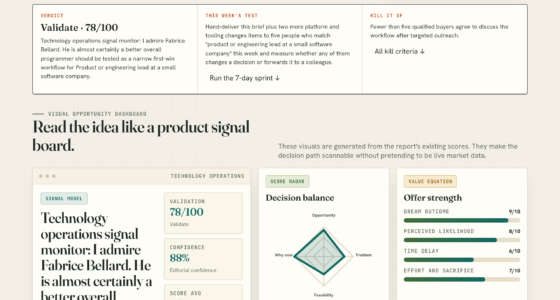

📊 Full opportunity report: Europe Regulated the Interface and Forgot to Build the Engine on ThorstenMeyerAI.com — validation score, market gap, and execution plan.
TL;DR
Europe has heavily regulated AI interfaces, such as cookie banners, but has not built competitive AI models. This regulatory focus has limited its ability to lead in AI technology, risking dependence on foreign models.
Europe has primarily regulated the surface of AI technology, such as cookie banners and consent interfaces, without investing in or developing the underlying AI models. This approach has left the continent behind in the global AI landscape, where competitors like China and the US are advancing rapidly.
Despite implementing the AI Act and focusing on regulating user interfaces, Europe’s own AI research and development efforts remain limited. Its flagship AI company, Mistral, has raised only a few billion dollars and trails behind global leaders like OpenAI, Google, and Chinese models in capability and market share. Meanwhile, China has shipped several advanced open-weight models, such as Zhipu’s GLM 5.2, which outperform some of Europe’s models and are freely available. The US maintains dominance through models like GPT-5.5 and Anthropic’s Claude, with valuations reaching hundreds of billions of dollars.
This regulatory focus has coincided with a lack of capital investment in European AI startups. The continent’s fragmented markets and regulatory burdens have discouraged large-scale funding, leading to talent and capital migration to the US and China. Europe’s AI ecosystem remains narrow, mainly limited to regulatory frameworks and small-scale research, without the technological breakthroughs needed to compete globally.
Europe regulated the interface and forgot the engine
The cookie banner is the most-used European software of the decade. While Brussels perfected the consent pop-up, the frontier was built elsewhere — and now, in H2 2026, Europe wants to buy back in without changing what put it on the outside.
This isn’t about whether privacy or safety matter — they do. It’s that Europe mistook regulating the interface for having a seat at the table. You can’t grant your way out of a structural problem while keeping the structure — the laws, the capital gaps, the energy costs, the talent drain all left untouched. The fix isn’t another framework: it’s open weights as a product, sovereign compute on affordable power, real capital plumbing — and to stop mistaking a check for a strategy.
Implications of Europe’s Regulatory Approach on AI Leadership
This focus on regulating AI interfaces rather than building the underlying technology has significant consequences. Europe risks becoming dependent on foreign AI models for critical applications, losing strategic autonomy. The continent’s failure to invest in AI R&D may result in diminished influence over future technological standards and security infrastructure, impacting its economic and geopolitical standing.

Tools and Algorithms for the Construction and Analysis of Systems: 28th International Conference, TACAS 2022, Held as Part of the European Joint Conferences … Notes in Computer Science Book 13244)
As an affiliate, we earn on qualifying purchases.
As an affiliate, we earn on qualifying purchases.
Europe’s AI Policy and Market Limitations
The European Union pioneered comprehensive AI regulation with the AI Act, aiming to set standards for safety and privacy. However, this legislation was enacted before Europe had a significant presence in AI development. As a result, European AI companies like Mistral have struggled to raise capital and compete with US and Chinese firms. The US and China have prioritized building and deploying advanced models, with China shipping models like GLM 5.2, and US firms like OpenAI leading in innovation and valuation. Europe’s regulatory approach has thus coincided with a technological lag, leaving it reliant on external sources for AI infrastructure.
“We are constrained by regulations that prevent us from scaling and innovating at the pace of our competitors.”
— European AI startup CEO
Uncertain Impact of Future Policy Changes
It remains unclear whether upcoming European policies will shift focus toward supporting AI development or continue to prioritize regulation. The effectiveness of Brussels’ efforts to catch up in AI technology depends on future investments, policy adjustments, and global market dynamics, which are still evolving.
Next Steps for Europe’s AI Strategy
Europe is likely to continue refining its regulatory framework, possibly introducing measures to incentivize AI R&D and investment. Watch for initiatives aimed at fostering European AI startups, increasing funding, and establishing partnerships with global players. The success of these efforts will determine whether Europe can transition from regulation to technological leadership.
Key Questions
Why has Europe focused on regulating AI interfaces instead of developing AI models?
Europe prioritized data privacy and user protection, leading to regulation of interfaces like cookie banners, but did not invest enough in building its own AI technology infrastructure, partly due to regulatory burdens and limited capital markets.
What are the risks of Europe not developing its own AI models?
Europe risks becoming dependent on foreign AI models, losing strategic autonomy, and missing out on economic and geopolitical influence in future AI-driven industries.
Can European policies still change to support AI development?
It is uncertain; future policy shifts, increased funding, and strategic investments could help Europe catch up, but current trends suggest a continued focus on regulation over R&D.
How does China’s AI development compare to Europe’s?
China is shipping advanced open-weight models like GLM 5.2, which outperform some European models and are freely available, giving China a technological edge in accessible AI capabilities.
What is the significance of the AI models like GPT-5.5 and Claude for global AI leadership?
These models represent the current frontier of AI capability and valuation, with US firms leading the innovation race. Europe’s lack of comparable models limits its influence and strategic leverage.
Source: ThorstenMeyerAI.com