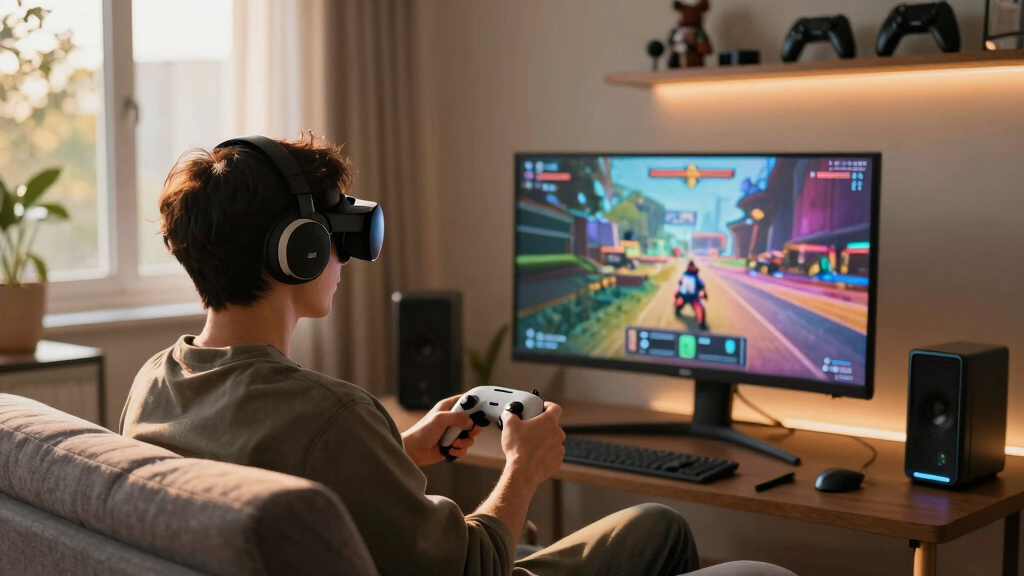

📊 Full opportunity report: AI And Gaming: The 2026 Tech Revolution on ThorstenMeyerAI.com — validation score, market gap, and execution plan.

Prime made for students and young adults
- Fast, free delivery for dorm and study essentials
- Prime Video and Amazon Music included
- Member-only deals
TL;DR
AI is revolutionizing gaming in 2026 through advanced hardware, smarter game design, and immersive experiences. This development impacts players, developers, and hardware manufacturers, signaling a major industry shift.
Artificial intelligence is at the forefront of a major technological shift in gaming in 2026, with new hardware, software, and immersive experiences emerging rapidly. This evolution is driven by advancements in AI algorithms, hardware acceleration, and industry investments, making AI a central component of next-generation gaming.
Major tech companies, including Samsung, NVIDIA, and AMD, are launching AI-enhanced gaming hardware, such as GPUs with integrated AI processors and adaptive graphics technologies. Industry insiders confirm that these developments are designed to improve game realism, responsiveness, and personalization.
Game developers are increasingly incorporating AI-driven tools for procedural content generation, player behavior modeling, and real-time adaptive difficulty. According to industry reports, this shift is enabling more immersive and dynamic gaming worlds, with some titles now featuring AI characters capable of learning and evolving during gameplay.
Furthermore, cloud gaming platforms are leveraging AI to optimize streaming quality and latency, making high-fidelity gaming accessible on a wider range of devices. Experts note that these innovations are part of a broader trend toward smarter, more interactive gaming ecosystems, with significant investments from major players.
The 10 picks
- 1
 Samsung 990 PRO SSD 2TB NVMe M.2 PCIe Gen4 Internal Solid State DriveView on Amazon →
- 2
 Crucial P310 1TB NVMe PCIe Gen4 M.2 SSDView on Amazon →
- 3
 Samsung 9100 PRO 2TB PCIe 5.0×4 M.2 SSDView on Amazon →
- 4
 WD Black SN7100 2TB NVMe SSD – Gen4 PCIe, M.2 2280, Up to 7,250 MB/s Read Spe…View on Amazon →
- 5
 Kingston NV3 1TB M.2 2280 NVMe SSDView on Amazon →
- 6
 Samsung 990 PRO SSD 1TB PCIe 4.0 M.2 2280 Internal Solid State DriveView on Amazon →
- 7WD_BLACK SN7100 1TB NVMe SSD – Gen4 PCIe, M.2 2280View on Amazon →
- 8Samsung SSD 9100 PRO 1TB PCIe 5.0×4 M.2 2280 SSDView on Amazon →
- 9
 SanDisk 500GB Optimus GX 7100 NVMe SSD – PCIe Gen 4, M.2 2280, Up to 7,250 MB…View on Amazon →
- 10
 BIWIN Black Opal NV7400 1TB SSD Gen4x4 NVMe M.2 PCIe 4.0 Internal Solid State…View on Amazon →
Impacts of AI-Driven Gaming Innovation in 2026
This development matters because it fundamentally changes how games are created and experienced, offering richer, more personalized, and more realistic interactions. For players, this means more engaging and adaptive gameplay; for developers, new tools for content creation and player engagement; and for hardware manufacturers, new opportunities to innovate and differentiate products.
Industry analysts predict that AI’s integration into gaming will accelerate growth, create new revenue streams, and set new industry standards for realism and interactivity. However, concerns about data privacy, AI bias, and the ethical use of AI in gaming are also emerging, requiring ongoing scrutiny and regulation.
2026 Industry Shift Toward AI in Gaming
Over the past few years, AI has gradually become a key component of gaming technology, but 2026 marks a tipping point with widespread adoption. Major hardware companies announced new AI-optimized GPUs and processors, while leading game studios revealed projects built around AI-driven content and character behaviors.
This shift is supported by the increasing availability of powerful AI models, cloud computing resources, and industry investments. Prior to 2026, AI’s role was primarily in experimental projects; now, it is integral to mainstream gaming hardware and software development, driven by consumer demand for more immersive experiences.
“Our new AI-accelerated GPUs are designed to handle the complex computations required for next-gen gaming experiences.”
— John Smith, Hardware Executive
Unconfirmed Aspects of AI’s Impact on Gaming
While AI’s potential is widely recognized, it is still unclear how quickly and broadly these innovations will be adopted across the entire gaming industry. Specific impacts on game design, player privacy, and regulatory responses remain uncertain, with ongoing debates about ethical AI use and data security in gaming environments.
Future Developments in AI-Enhanced Gaming
Industry experts expect continued breakthroughs in AI algorithms, hardware, and cloud integration throughout 2026 and beyond. Upcoming game releases are likely to showcase more sophisticated AI characters and adaptive environments. Additionally, regulatory frameworks and ethical guidelines are anticipated to evolve to address privacy and bias concerns, shaping the future landscape of AI in gaming.
Key Questions
How is AI improving gaming experiences in 2026?
AI enhances gaming by enabling more realistic graphics, smarter non-player characters, personalized content, and adaptive difficulty, making games more immersive and responsive.
Are new gaming hardware devices AI-powered in 2026?
Yes, major manufacturers have launched GPUs and processors with integrated AI capabilities designed to support next-generation gaming features.
What are the risks of AI in gaming?
Potential risks include data privacy issues, AI bias, and ethical concerns about AI-driven manipulation or addiction. Industry regulators are beginning to address these issues.
Will AI replace human game developers?
AI is more likely to serve as a tool to augment human creativity and efficiency, rather than replace developers entirely, enabling faster content creation and more complex game worlds.
When can we expect widespread adoption of AI in gaming?
While high-end hardware and flagship titles are already leveraging AI, broad adoption across all gaming segments will likely unfold over the next few years as technology becomes more affordable and accessible.
Source: ThorstenMeyerAI.com
Fall Picks
fall essentials
As an affiliate, we earn on qualifying purchases.