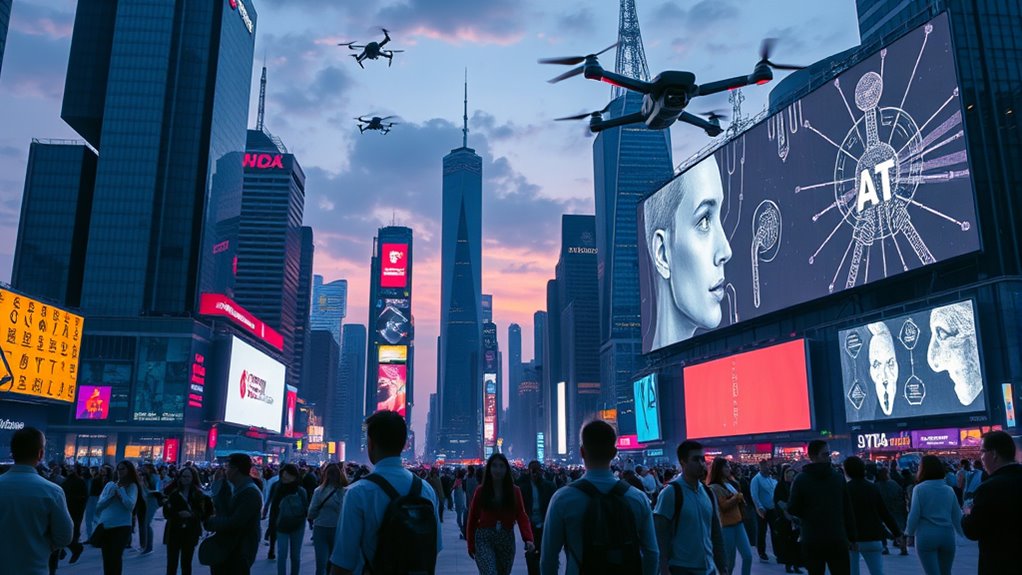

By 2025, you’ll see AI deeply woven into your daily routines, transforming industries like healthcare and transportation. While these breakthroughs offer immense benefits, they also raise pressing ethical questions about bias, privacy, and control. The rapid innovations spark societal debates on fairness and responsibility. If you want to understand how these developments shape your future and what challenges to expect, there’s more to uncover about AI’s evolving landscape.
Key Takeaways
- AI integration in daily life accelerates, transforming industries, homes, and decision-making processes by 2025.
- Ethical challenges emerge around responsibility, privacy, bias, and societal fairness due to rapid AI advancements.
- Regulatory efforts focus on ensuring transparency, accountability, and fairness in AI applications across sectors.
- Increased AI capabilities augment human skills but raise concerns about job displacement and infrastructure security.
- 2025 marks a critical point where balancing innovation with ethical considerations becomes essential for societal well-being.

What will AI look like in 2025? You’ll find that artificial intelligence has become more embedded in daily life, shaping industries, homes, and even your personal routines. But as AI advances, you’ll also face complex ethical dilemmas that challenge your understanding of responsibility, privacy, and fairness. These dilemmas are a natural consequence of rapid technological integration, where AI systems are no longer just tools but active participants in decision-making processes. Technologies that once seemed futuristic now influence everything from healthcare diagnostics to autonomous vehicles, making it essential for you to stay informed about the moral implications behind these innovations. You might wonder how to navigate a landscape where AI can manipulate data, predict behaviors, or even influence societal norms. The key lies in developing frameworks that prioritize transparency, accountability, and human oversight, ensuring that AI’s integration benefits everyone without compromising core ethical values.
By 2025, you’ll see AI seamlessly woven into the fabric of everyday life, yet this very integration raises questions about morality and control. As companies and governments push for faster adoption, you’ll need to be vigilant about the potential for bias embedded within AI models. These biases often stem from the data used to train these systems, which can reflect societal prejudices. The ethical dilemmas then become not just theoretical debates but practical concerns about fairness. Will AI perpetuate inequality or help bridge gaps? It’s a question you’ll have to grapple with constantly, especially as AI’s influence expands across sectors like employment, law enforcement, and social services. Continuous monitoring and AI safety measures will be crucial to mitigating these risks.
Technological integration in 2025 is less about replacing humans and more about augmenting human capabilities—yet this shift introduces its own set of challenges. You’ll notice that AI-powered tools will become more intuitive and capable, making tasks easier but also raising concerns about job displacement and autonomy. The more AI systems learn and adapt, the more vital it becomes for you to advocate for regulations that prevent misuse and protect individual rights. At the same time, integrating AI into critical infrastructure demands rigorous testing and oversight to prevent unintended consequences, such as security breaches or system failures.
In essence, 2025 will be a pivotal year where AI’s technological integration accelerates, but it also compels you to confront ethical dilemmas head-on. You’ll need to balance innovation with responsibility, ensuring that these powerful tools serve humanity’s best interests. With every breakthrough, the questions surrounding morality, fairness, and control become more urgent, demanding your active engagement and thoughtful reflection.
Frequently Asked Questions
How Will AI Impact Global Economic Inequality by 2025?
By 2025, AI will likely widen the wealth gap and access disparity if you don’t actively work to bridge these divides. Wealthier nations and individuals will benefit more from AI advancements, leaving poorer communities behind. You might see tech-driven job losses in low-income areas, increasing economic inequality. To prevent this, it’s vital that policies focus on equitable AI access and education, ensuring everyone can benefit from these technological breakthroughs.
What Are the Most Significant Ethical Dilemmas Facing AI Developers Today?
You face significant ethical dilemmas as an AI developer, especially around bias mitigation and transparency enhancement. You must guarantee your models don’t perpetuate harmful biases and remain understandable to users. Balancing innovation with accountability is vital, as you navigate societal impacts and trust issues. Prioritizing these ethical considerations helps create AI that is fair, responsible, and aligned with societal values, ultimately guiding responsible AI development.
How Will AI Influence Geopolitical Power Dynamics in 2025?
In 2025, AI will reshape geopolitical power dynamics through AI diplomacy and strategic influence. You’ll see power shifts as nations leverage AI for economic growth, military advantage, and intelligence. Countries that lead in AI development will gain leverage, while others might fall behind, creating global competition. Your role in this evolving landscape involves understanding these shifts, advocating for responsible AI use, and ensuring that AI benefits all, not just a few.
What Measures Are in Place to Prevent AI Misuse or Malicious Applications?
Imagine AI governance systems so advanced, they could prevent misuse or malicious applications before they even happen. You’re protected by strict regulations, international agreements, and cutting-edge misuse prevention measures. Governments and organizations are actively developing AI oversight frameworks, deploying real-time monitoring tools, and enforcing penalties for misconduct. These efforts create a fortress of safeguards around AI, ensuring its power is harnessed responsibly and malicious acts are swiftly thwarted.
How Will AI Advancements Affect Employment Across Different Industries?
You’ll see AI advancements cause automation job displacement in many industries, especially in routine tasks. However, you’ll also need to address the growing AI skill gap, which creates opportunities for new roles. While some jobs may fade, others will emerge, requiring you to reskill and adapt. Embracing continuous learning helps you stay relevant and thrive amid these changes, turning challenges into opportunities for growth.
Conclusion
As you look ahead to 2025, it’s clear AI will bring incredible breakthroughs, but also serious questions about ethics and control. Some argue that rapid advancements could outpace our ability to regulate them, risking unintended consequences. While the technology promises progress, it’s essential you stay informed and involved in shaping policies. Only by understanding AI’s true potential and limits can you help guarantee it benefits everyone without leading to unforeseen dangers.