
Smart telescopes make astronomy easier for you by automatically aligning themselves and pinpointing celestial objects with little effort. They use built-in GPS, Wi-Fi, and internal databases to guide you to stars, planets, and galaxies effortlessly. Smartphone apps and augmented reality features help you navigate the night sky with confidence. These intuitive tools remove the technical barriers so you can focus on the wonder of the universe. Keep exploring to discover how these features can transform your stargazing experience.
Key Takeaways
- Built-in GPS and Wi-Fi enable automatic location detection and alignment, reducing setup time and technical difficulties.
- Internal databases and software overlays help users easily find and identify celestial objects without complex charts.
- Smartphone apps with augmented reality guide users through star and constellation identification in real-time.
- User-friendly features act as personal astronomy assistants, supporting confident exploration for beginners.
- Educational resources like interactive star charts and tutorials promote ongoing learning and skill development.
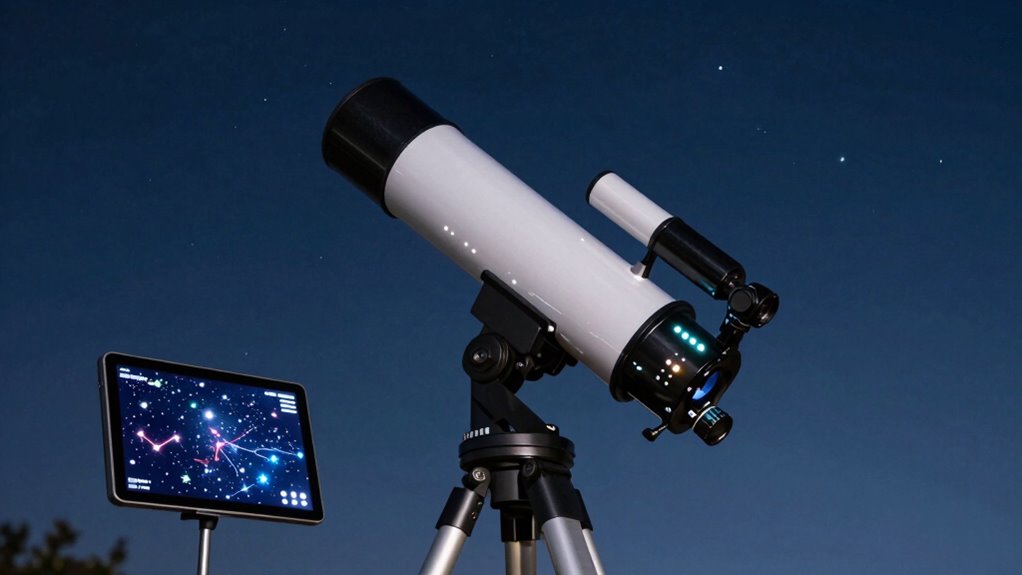
If you’re new to astronomy, the idea of steering the night sky can feel overwhelming. With so many stars, planets, and distant galaxies, it’s easy to feel lost or unsure where to look. That’s where smart telescopes come in. These advanced devices are designed to simplify your experience by combining technology with user-friendly features. One of the biggest benefits they offer is helping you with galaxy mapping and sky navigation, making it easier to find interesting objects without a steep learning curve.
Smart telescopes use built-in GPS and Wi-Fi connectivity to automatically identify your location. Once they know where you are, they can align themselves precisely, eliminating the complicated manual setup that traditional telescopes require. This quick setup means you spend less time fussing with equipment and more time observing the night sky. As you start your viewing session, the telescope’s internal database comes alive, guiding you toward celestial objects based on your preferences. It’s like having a personal astronomy assistant that knows exactly where to point.
Galaxy mapping becomes much simpler with these telescopes. Instead of manually tracking distant galaxies or star clusters, the device’s software overlays a map of the night sky onto your viewing experience. When you select an object, such as a galaxy or nebula, the telescope automatically adjusts its position to bring it into view. This powerful feature removes the guesswork from sky navigation, allowing you to focus on learning and enjoying the universe rather than struggling with complicated charts or star atlases. It’s perfect for beginners who want to explore confidently and learn as they go.
Sky navigation, which can be particularly tricky for newcomers, is also greatly enhanced by smart telescopes. Many models feature smartphone apps that connect seamlessly, providing real-time star maps and guiding you through constellations. These apps often include augmented reality features, allowing you to hold up your phone and see labels for stars and planets overlaid on the sky. With this technology, you can quickly become familiar with the layout of the night sky, building your confidence as an amateur astronomer. Additionally, digital content such as interactive star charts and guided tutorials can further enhance your learning experience. Understanding the importance of accurate alignment in telescope setup can greatly improve your viewing success and enjoyment.
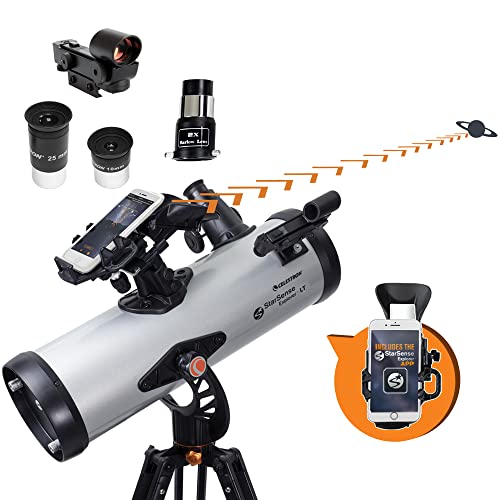
Celestron StarSense Explorer LT 114AZ App-Enabled Telescope – 114mm Newtonian Reflector with Smartphone Dock & StarSense App – iPhone & Android Compatible – Easy-to-Use for Beginners
SMARTPHONE-POWERED SKY TOUR: No experience needed! Just dock your phone, launch the StarSense Explorer app, and follow the…
As an affiliate, we earn on qualifying purchases.
As an affiliate, we earn on qualifying purchases.
Frequently Asked Questions
Can Smart Telescopes Operate Without Wi-Fi or Internet?
Yes, smart telescopes can operate without Wi-Fi or internet. You can perform a manual setup, aligning the telescope without wireless connectivity. Many models have onboard controls or manual operation options, enabling you to find and track celestial objects independently. While wireless connectivity offers convenience, these telescopes are designed to function offline, giving you the flexibility to explore the night sky even when Wi-Fi or internet isn’t available.
Are Smart Telescopes Suitable for Professional Astronomers?
Sure, smart telescopes are perfect for professional astronomers—if you enjoy amateurish features like automatic tracking and user-friendly interfaces. They excel in basic observations but fall short in professional calibration and advanced imaging. For true scientific work, you’ll need specialized equipment with precise calibration capabilities and high-resolution sensors. So, while they’re charming toys, they’re not quite ready to replace the sophisticated gear used in professional astronomy.
How Durable Are Smart Telescopes in Harsh Weather Conditions?
Smart telescopes are generally designed with weatherproof features and durable materials, making them quite resilient in harsh weather conditions. You can confidently use them outdoors, even in rain or snow, as long as you follow the manufacturer’s guidelines. Their weatherproof design helps prevent damage from moisture and dust, while robust material durability guarantees they withstand wind, temperature fluctuations, and other challenging elements, keeping your stargazing experience uninterrupted.
Do Smart Telescopes Require Regular Software Updates?
Yes, smart telescopes do require regular software updates to stay at their best. Think of updates as the heartbeat of your device, ensuring software compatibility and firmware optimization. Without them, your telescope might struggle with new features or encounter glitches, much like a car missing regular tune-ups. Staying current guarantees smooth operation, improved accuracy, and continued access to the latest astronomical discoveries, making your stargazing experience seamless.
Can Smart Telescopes Track Objects Across the Night Sky Automatically?
Yes, smart telescopes can automatically track objects across the night sky, thanks to advanced object tracking and sky automation features. These telescopes use built-in sensors and software to identify celestial objects and follow their movement, so you don’t have to manually adjust the telescope manually. This makes stargazing more enjoyable and less frustrating, especially for beginners, as you can focus on observing instead of constantly repositioning your telescope.

Intelligent Automatic Star Finder Telescope – High Magnification Professional Stargazing for Astronomy Enthusiasts
203mm large objective lens to ensure the light-gathering power and high resolution, as well as large field of…
As an affiliate, we earn on qualifying purchases.
As an affiliate, we earn on qualifying purchases.
Conclusion
With smart telescopes, astronomy becomes accessible and fun, even if you’re just starting out. You won’t need a PhD in astrophysics to find planets or stars—they guide you every step of the way, like having your own personal space robot. It’s like having a trusty sidekick from a sci-fi flick, making stargazing simple and exciting. So, grab a smart telescope and prepare for your cosmic adventure—no flux capacitor required!

WiFi Telescope Camera Eyepiece, 64G Electronic Eyepiece Camera with 1.5" Screen, Astronomy Camera Fits to 28mm- 50mm Scopes, Perfect for Astrophotography, Birds Watching
1.5” Screen & Remote Observing: The new upgraded WiFi telescope camera is covered with a 1.5” IPS mini…
As an affiliate, we earn on qualifying purchases.
As an affiliate, we earn on qualifying purchases.
Celestron StarSense Explorer LT 114AZ App-Enabled Telescope – 114mm Newtonian Reflector with Smartphone Dock & StarSense App – iPhone & Android Compatible – Easy-to-Use for Beginners
SMARTPHONE-POWERED SKY TOUR: No experience needed! Just dock your phone, launch the StarSense Explorer app, and follow the…
As an affiliate, we earn on qualifying purchases.
As an affiliate, we earn on qualifying purchases.