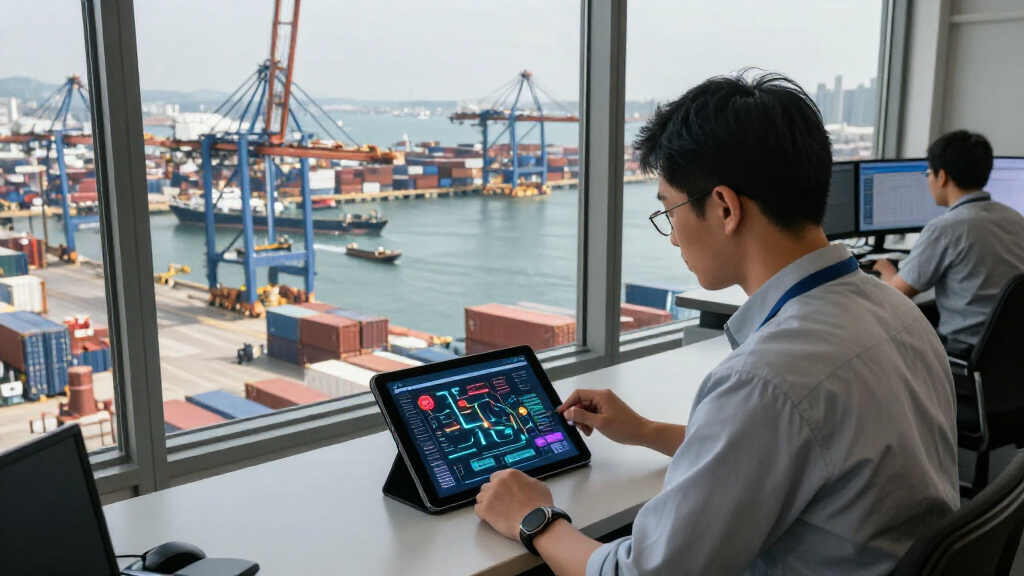

🔍 Read the full analysis: Global Supply Chains Meet AI on ThorstenMeyerAI.com

Prime made for students and young adults
- Fast, free delivery for dorm and study essentials
- Prime Video and Amazon Music included
- Member-only deals
TL;DR
ThorstenMeyerAI.com’s Nov. 17 report says goods that AI runs on represented 14.8% of world goods trade and accounted for 47% of its growth in the first half of 2026, citing the WTO. It also points to a shift in US sourcing: imports from Vietnam reached $205 billion in the first nine months of 2026, close to $215 billion from China. The figures show AI-related products and changing supplier patterns are reshaping trade, but the report does not specify which goods count as AI-related or establish that AI caused the sourcing shift.
Separate US Census Bureau figures cited in the report show that, from January through September 2026, the United States imported $205 billion in goods from Vietnam and $215 billion from China. The comparison is a snapshot of import values over nine months; it does not, by itself, establish why sourcing patterns changed or whether the same products moved between suppliers.
The report places these developments alongside the long-running economic case for trade and evidence that trade can impose concentrated costs on particular workers and places. It draws on historical research about the US “China shock,” as well as estimates of trade-related job gains in Germany. The central question is not simply whether trade expands, but who benefits, who bears its costs, and how technologies such as AI affect what countries make and exchange.
AI Goods Reshape Trade Growth
The reported 47% share of trade growth matters because it suggests that a relatively defined group of goods associated with AI contributed a large portion of the increase in global goods trade during the first half of 2026. That could affect how businesses and policymakers track supply exposure: demand for equipment and components used in AI may influence production, purchasing, and the movement of goods across borders.But the figure should not be read as proof that AI has made trade grow by itself, or that AI products account for nearly half of all trade. The WTO figure, as presented in the report, describes a share of growth in goods trade, while the 14.8% figure describes a share of the trade total. Both are distinct from trade in services and from AI’s broader economic effects.
The Vietnam-China comparison is relevant for companies and workers because supplier shifts can redistribute production and jobs between locations. The data show near-parity in US import values for the first nine months of 2026, but not which industries or firms drove it. Readers should treat the figures as evidence of changing trade patterns, not a complete account of supply-chain relocation.
Products Worth Considering

DJI Mini 3 Drone with DJI RC Controller

Bose Lifestyle Ultra Wireless Home Speaker, White Smoke

LG UltraGear 34-Inch Curved QHD Gaming Monitor, 160Hz, FreeSync Premium
As an affiliate, we earn on qualifying purchases.
From Trade Theory to Supply Shifts
The report begins with comparative advantage, the 1817 idea associated with economist David Ricardo: countries can benefit from specializing in what they produce at lower opportunity cost, even if one country is more productive in every activity. That theoretical gain does not guarantee that every worker or region benefits equally.Research by David Autor, David Dorn and Gordon Hanson examined the local effects of Chinese import competition in the United States. The source report says the losses were concentrated in some communities and that damage remained visible years after the import surge. It cites an estimate that, in more exposed US regions, 86% of factory jobs lost to Chinese imports were not replaced by other local jobs. That is a finding about particular regions and a specified research question, not a measure of all US job losses.
The report also gives a longer trade timeline: the share of world GDP represented by exports plus imports rose from 26% in 1970 to a peak of 60% in 2008, then stood at 57% in 2024, according to World Bank data cited there. It says trade has continued to grow since the financial crisis, but has not grown faster than the global economy. These measures provide context for current supply changes without showing that one cause explains them.
“Goods that AI runs on were 14.8% of world goods trade but delivered 47% of its growth in the first half of 2026.”
— ThorstenMeyerAI.com report, citing the World Trade Organization
What the Trade Figures Cannot Show
The supplied report does not explain the WTO’s precise definition of goods that AI runs on, the source dataset behind the 47% estimate, or how much of the growth came from specific product categories. It also does not establish whether the rise in US imports from Vietnam reflects companies moving production, higher demand, changes in prices, or other factors.The Vietnam and China figures cover January through September 2026 and compare import values. The material gives no product-by-product breakdown, company-level sourcing information, or matching export figures for Vietnam. It is therefore unclear whether the two totals represent a durable shift across supply chains or a temporary pattern in particular goods.
The historical job-loss and job-gain estimates cited in the report come from different countries, periods, and research methods. They should not be combined into a single net estimate of trade’s effect. The report also does not quantify AI’s impact on employment or distinguish AI’s influence on production from its influence on trade flows.
The Next Supply-Chain Evidence
The next useful evidence will be more detailed trade data showing which products account for the AI-related growth and whether the first-half trend continued later in 2026. Further WTO releases and updated national trade figures could clarify whether the reported concentration persisted and which countries supplied the relevant goods.For the Vietnam-China comparison, subsequent Census Bureau data and product-level import records can show whether Vietnam’s total continued to approach or pass China’s, and whether changes were concentrated in particular industries. Until those details are available, the report supports a clear but limited conclusion: AI-linked goods were a major contributor to reported goods-trade growth, while US import values show Vietnam close to China over the first nine months of the year. The causes and durability of both patterns remain open.
Key Questions
What is the main development in the report?
The report says goods used to run AI accounted for 47% of global goods-trade growth in the first half of 2026, citing the WTO. It also notes that US imports from Vietnam nearly matched imports from China over the first nine months.
Did AI cause US companies to shift suppliers to Vietnam?
The cited figures do not establish that. They show US import values from Vietnam and China, but provide no company-level sourcing data or explanation for the difference.
Does 47% mean AI-related goods are nearly half of world trade?
No. The report says these goods delivered 47% of trade growth in the first half of 2026. It separately says they represented 14.8% of world goods trade.
How much did the United States import from Vietnam and China?
In the first nine months of 2026, the United States imported $205 billion from Vietnam and $215 billion from China, according to Census Bureau figures cited in the report.
What remains unknown about AI’s effect on supply chains?
The report does not define the full set of AI-related goods or measure AI’s effect on company sourcing, jobs, or production locations. More detailed product and company data would be needed to answer those questions.
Source: ThorstenMeyerAI.com