TL;DR

Prime made for students and young adults
- Fast, free delivery for dorm and study essentials
- Prime Video and Amazon Music included
- Member-only deals
NASA’s Astronomy Picture of the Day for Oct. 29, 2026, features a view of Venus near the line between Earth and the Sun. The image explanation describes how sunlight scattered and refracted by Venus’s atmosphere creates a crescent arc extending beyond 180 degrees, with tips known as “horns.”
NASA’s Astronomy Picture of the Day for Oct. 29, 2026, features Venus viewed nearly between Earth and the Sun, where its backlit atmosphere produces a bright crescent arc extending beyond 180 degrees. The explanation calls the arc’s tips the “horns” of Venus and says the crescent can be observed with binoculars or a small telescope during twilight.
The NASA page describes the view as one that might be mistaken for a crescent Moon, while noting that Venus also shows phases. When Venus lies nearly between Earth and the Sun, the planet’s illuminated side is turned largely away from Earth. The visible crescent is not simply a dark outline: according to the APOD explanation, sunlight is refracted and scattered by Venus’s atmosphere, producing a luminous arc that reaches past a half-circle.
The picture is credited to Thierry Legault. The NASA page lists Cecilia Chirenti, Robert Nemiroff, Jerry Bonnell and Keighley Rockcliffe as authors and editors. It describes this near alignment as occurring about once every year and a half, comparing the geometry to the Sun-Earth-Moon arrangement at new Moon while distinguishing Venus’s glowing atmospheric crescent from the dark new Moon.
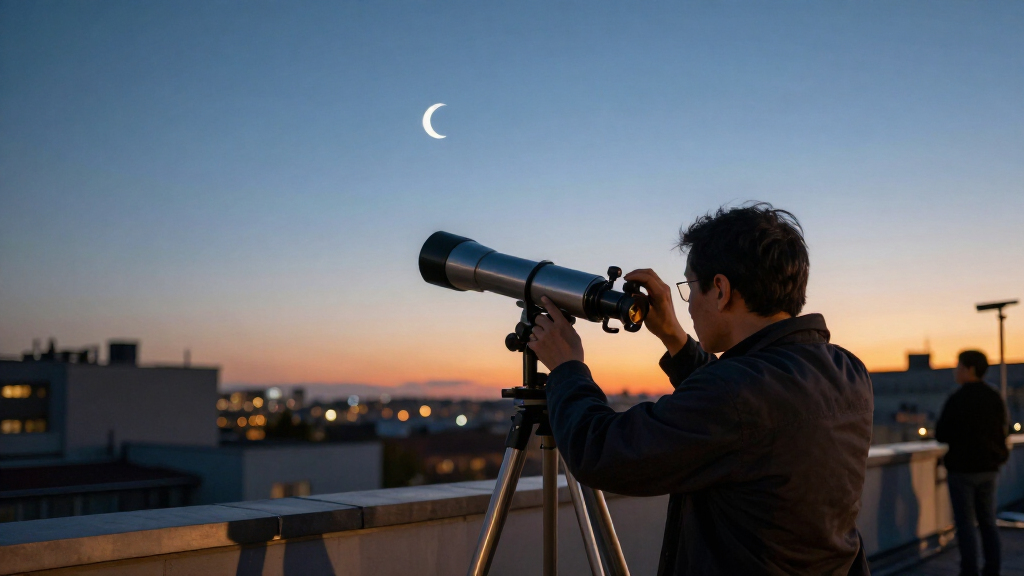
The explanation says the crescent can be viewed with a small telescope or binoculars during twilight. It adds that people with exceptionally acute eyesight may be able to see it without optical aid. That possibility is presented as a qualified observation, not a general promise of naked-eye visibility.
How Venus’s Atmosphere Shapes the Crescent
The APOD feature gives readers a visual example of how a planet’s appearance depends on both its position and its atmosphere. Venus’s phase follows its position relative to Earth and the Sun, but the extended bright horns described here are linked to sunlight interacting with the planet’s atmosphere. The effect makes the visible crescent appear to continue beyond the boundary expected from a simple illuminated half-disc.
The explanation also connects an image to practical observing. It identifies twilight and modest equipment—binoculars or a small telescope—as conditions for viewing the crescent. That guidance helps distinguish the striking photographed view from what an observer should expect to see unaided. The page’s caveat about exceptional eyesight matters: it does not claim that the feature is readily visible to everyone without a telescope.
As a daily astronomy feature, the item is an educational explanation rather than a report of a new discovery or a change in Venus’s behavior. Its value is in making a familiar bright planet’s phases and atmospheric scattering easier to understand through a particular alignment and image.
Products Worth Considering

Amazon Kindle Paperwhite (12th Generation, 2024), 16 GB, 7-inch Display, Jade

EcoFlow Smart Home Panel 2 Whole-Home Backup System Hub

Logitech MX Brio Ultra HD 4K Webcam, Graphite
As an affiliate, we earn on qualifying purchases.
Venus Near the Sun-Earth Line
Venus’s phases arise because observers on Earth see different portions of the planet’s sunlit hemisphere as the planet moves around the Sun. The APOD description focuses on a time when Venus is seen almost directly between Earth and the Sun. In that geometry, the illuminated side is mostly turned away from Earth, leaving a narrow crescent visible from our viewpoint.
The NASA explanation compares the alignment to a new Moon, which occurs when the Moon is between Earth and the Sun. It stresses a difference: the new Moon appears dark to observers on Earth, whereas Venus’s atmosphere can scatter and refract sunlight into a visible arc. The page says the near alignment occurs about every 18 months; it does not provide a precise observation time or viewing location for this specific image.
The feature also notes historical interest in Venus’s changing brightness. It says ancient Babylonian astronomers may have been among the first to study those changes, which are related to the planet’s phases, and refers to astronomical records from other cultures, including the oldest surviving Maya book. These references provide a brief historical frame rather than a detailed account of the records or their interpretation.
Limits of the Viewing Guidance
The APOD page does not give the photograph’s exact exposure details, the precise date and time the image was taken, or the location from which it was captured. It also does not identify a specific observing date for readers hoping to see the same appearance, or provide local twilight and safety guidance.
The statement about naked-eye visibility is explicitly qualified and does not establish how often people can see the crescent without equipment. The page offers no measurement of the arc or the atmospheric refraction and scattering involved. Its explanation describes the phenomenon, but the material provided does not include additional technical analysis or independent commentary.
The Next Daily Astronomy Picture
The NASA page points readers to the next installment of the daily series with the prompt “Tomorrow’s picture: What’s next?” It does not name the next subject in the supplied material. For this feature, the immediate next step for interested observers is to use binoculars or a small telescope during twilight when Venus’s position and local conditions allow; the page gives no specific schedule or location-based forecast.
Further details about the photograph or a particular viewing opportunity would require information beyond the Oct. 29 APOD entry. Until then, the confirmed development is the publication of the image and its explanation of Venus’s extended crescent, not a newly announced observation campaign or scientific finding.
Key Questions
What does “the horns of Venus” mean?
The NASA explanation uses “horns” for the tips of Venus’s crescent arc, which it says extends beyond 180 degrees.Why does Venus look like a crescent?
Venus shows phases because observers on Earth see different portions of its sunlit side as the planet moves around the Sun. When Venus is nearly between Earth and the Sun, the visible portion is a narrow crescent.What makes the crescent appear to extend beyond a half-circle?
The APOD explanation says Venus’s atmosphere refracts and scatters sunlight, creating a glowing arc that extends beyond 180 degrees.Can Venus’s crescent be seen without a telescope?
The page says binoculars or a small telescope can show it during twilight. It adds that unaided viewing may be possible for people with exceptionally acute eyesight, but does not describe it as readily visible to everyone.How often does this near alignment occur?
According to the NASA explanation, Venus is seen almost directly between Earth and the Sun about once every year and a half.Source: science.nasa.gov