Choosing the right robotics kits for kids depends heavily on whether your child prefers tactile building or digital coding. My top overall pick is the Makeblock mBot because it balances easy assembly with genuine programming potential, making it ideal for beginners who want to see results quickly. For those who prefer a more hands-on, mechanical approach without screens, the Klutz LEGO Gear Bots offers a familiar building experience that focuses on gears and motion rather than code. Parents often struggle to distinguish between simple toy robots and educational tools that actually teach logic; this guide breaks down that difference. Continue reading to see how these thirteen options stack up against each other in terms of durability, age appropriateness, and educational value.

Prime made for students and young adults
- Fast, free delivery for dorm and study essentials
- Prime Video and Amazon Music included
- Member-only deals
Key Takeaways
- Kits with dedicated apps like the Makeblock mBot offer better long-term coding progression than those relying solely on remote controls.
- Mechanical-only kits, such as the Smartivity Robotic Hand, build spatial reasoning but lack the logical sequencing skills taught by programmable models.
- Assembly complexity varies widely; some kits require 30 minutes of assembly while others take hours, which can frustrate younger builders if not matched to their patience level.
- The presence of sensors (ultrasonic, infrared) distinguishes true robotics kits from basic motorized toys, allowing for interactive behaviors.
- Expansion capabilities matter: kits that allow adding new parts or code modules provide more value over time than single-function models.
| ELEGOO UNO R3 Smart Robot Car Kit V4 with Camera |  | Best for Programmable Driving | Controller: UNO R3 | Camera and Wi-Fi module: ESP32-WROVER-based | Sensors: Line-tracking and ultrasonic | VIEW LATEST PRICE | See Our Full Breakdown |
| EggTailz Smart Robot Car Kit for Kids Ages 8+ |  | Best for Beginner Robot-Car Play | Recommended age: 8 years and up | Drive: 2WD | Control modes: Autonomous and remote control | VIEW LATEST PRICE | See Our Full Breakdown |
| BeAndge 6-in-1 Robotics STEM Kit for Kids Ages 8–12 |  | Best for Variety of Builds | Projects: 6 | Recommended age: 8–14 years | Example projects: Reptile robot, balance car, bubble machine, fiber lamp, and buzzer wire game | VIEW LATEST PRICE | See Our Full Breakdown |
| Klutz LEGO Gear Bots STEM Activity Kit for Ages 8–12 |  | Best for Mechanical Principles | Age range: 8–12 years | Number of models: 8 | LEGO elements: 62 | VIEW LATEST PRICE | See Our Full Breakdown |
| Smartivity Robotic Mechanical Hand STEM Toy for Kids Ages 8–14 |  | Best Single-Build Project | Recommended age: 8–14 years | Material: Engineered wood | Theme: Anatomy and robotics | VIEW LATEST PRICE | See Our Full Breakdown |
| Sillbird 5-in-1 Programmable STEM Robot Building Kit |  | Best Value for Variety | Brand: Sillbird | Piece Count: 488 | Models: 5-in-1 | VIEW LATEST PRICE | See Our Full Breakdown |
| Makeblock mBot STEM Coding Toys Robotics Kit | 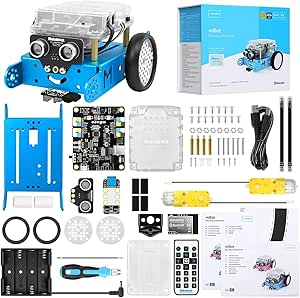 | Best for Serious Coding Education | Brand: Makeblock | Model: mBot | Construction: Metal Alloy | VIEW LATEST PRICE | See Our Full Breakdown |
| Butterfly EduFields 40-in-1 STEM Robotics Kit |  | Best for Screen-Free Exploration | Brand: Butterfly EduFields | Project Count: 40+ | Components: 100+ | VIEW LATEST PRICE | See Our Full Breakdown |
| Sillbird 12-in-1 Solar Robot Building Kit |  | Best for Renewable Energy Concepts | Brand: Sillbird | Piece Count: 190 | Models: 12-in-1 | VIEW LATEST PRICE | See Our Full Breakdown |
| ACEBOTT 4-in-1 Smart Robot Arm and Tank Car Kit |  | Best for Advanced Mechanics | Brand: ACEBOTT | Model: QD043 | Controller: ESP32 | VIEW LATEST PRICE | See Our Full Breakdown |
| ANNISOKA DIY Wooden Robotic Arm Kit |  | Best for Circuit Basics | Brand: ANNISOKA | Material: Wood | Recommended Age: 8 years and up | VIEW LATEST PRICE | See Our Full Breakdown |
| Teach Tech HydroBot Arm Hydraulic STEM Building Kit for Ages 12+ |  | Best for Physics Concepts | Brand: Teach Tech | Model: TTR-632 | Recommended Age: 12 years and up | VIEW LATEST PRICE | See Our Full Breakdown |
| Thames & Kosmos My Robotic Pet: Coding Chameleon |  | Best for Screen-Free Coding | Brand: Thames & Kosmos | Model Number: 620507 | Length: 15 inches | VIEW LATEST PRICE | See Our Full Breakdown |
| robotics kits for kid | Brand | Recommended age |
|---|---|---|
| ELEGOO UNO R3 Smart Robot Car | — | 12 years and up |
| EggTailz Smart Robot Car Kit f | — | 8 years and up |
| BeAndge 6-in-1 Robotics STEM K | — | 8–14 years |
| Klutz LEGO Gear Bots STEM Acti | — | — |
| Smartivity Robotic Mechanical | — | 8–14 years |
| Sillbird 5-in-1 Programmable S | Sillbird | — |
| Makeblock mBot STEM Coding Toy | Makeblock | — |
| Butterfly EduFields 40-in-1 ST | Butterfly EduFields | — |
| Sillbird 12-in-1 Solar Robot B | Sillbird | — |
| ACEBOTT 4-in-1 Smart Robot Arm | ACEBOTT | — |
| ANNISOKA DIY Wooden Robotic Ar | ANNISOKA | 8 years and up |
| Teach Tech HydroBot Arm Hydrau | Teach Tech | 12 years and up |
| Thames & Kosmos My Robotic Pet | Thames & Kosmos | 8–12 years |
More Details on Our Top Picks
ELEGOO UNO R3 Smart Robot Car Kit V4 with Camera
For kids ready to move from assembling a robot to programming its behavior, the ELEGOO UNO R3 is the most coding-focused car in this group. Its UNO R3 controller, Arduino IDE examples, and guided tutorial give learners a practical starting point, while line tracking and ultrasonic obstacle avoidance turn code into visible driving results. The camera and Wi-Fi module add FPV video, a feature the simpler EggTailz car does not list; app and IR remote control also provide ways to drive it without programming every session.
The tradeoff is a steeper setup: assembly and coding may need adult help, especially for first-time builders. Unlike the Klutz LEGO Gear Bots, which use hand-cranked mechanisms, this kit depends on electronics and programming—and it is a less suitable pick for younger children who want quick, mostly ready-to-play action.
Pros:- UNO R3 controller and Arduino IDE examples support hands-on programming.
- Line tracking and ultrasonic sensing give code practical driving uses.
- Camera and Wi-Fi module add FPV video.
- App and IR remote controls offer more than one way to drive.
Cons:- Assembly and programming can be demanding for beginners without adult help.
- The more involved electronics setup is less immediate than a manual kit such as Klutz LEGO Gear Bots.
Best for: Families with children aged 12 and up who want an Arduino-based car for learning sensors, basic coding, and remote driving.
Not ideal for: Younger first-time builders or families seeking a simple, mostly manual activity; assembly and programming may call for adult guidance.
- Controller:UNO R3
- Camera and Wi-Fi module:ESP32-WROVER-based
- Sensors:Line-tracking and ultrasonic
- Control:App and IR remote
- Battery:2000 mAh rechargeable lithium-ion
- Recommended age:12 years and up
- Dimensions:8 x 7 x 6 inches
- Weight:1.23 kg
Our verdict“Choose this kit for an older beginner who wants to learn programming through a sensor-equipped robot car and can get help with setup.”
EggTailz Smart Robot Car Kit for Kids Ages 8+
The EggTailz Smart Robot Car suits children who want to build a moving robot and then try autonomous and remote-control modes without the Arduino coding emphasis of the ELEGOO UNO R3 car. Its ultrasonic obstacle avoidance gives the car a clear robotics behavior to explore, while self-balancing and multiple lights add variety to play. Illustrated and video instructions can help families work through assembly, and the listed age recommendation starts at eight.
This is a more approachable fit for introductory car play than the ELEGOO, but its description does not specify a programming platform or camera, so it offers less depth for a child aiming to learn code or FPV control. The rechargeable car battery is useful for repeat sessions, though playtime varies from one to four hours, and the remote still needs two AA batteries. Compared with the hand-cranked Klutz LEGO Gear Bots, this is the choice for kids who want a powered vehicle rather than stationary mechanisms.
Pros:- Autonomous and remote-control modes give children different ways to interact with the car.
- Ultrasonic obstacle avoidance and self-balancing introduce visible robot behaviors.
- Illustrated and video instructions support the build.
- Rechargeable car battery provides a stated one-to-four-hour playtime range.
Cons:- The remote control requires two AA batteries.
- No programming platform or camera is specified, limiting its appeal for coding-focused learners.
- Assembly may need parent assistance for beginners.
Best for: Families with children aged eight and up who want an assembled-by-the-child robot car with autonomous and remote-control modes.
Not ideal for: Kids specifically seeking Arduino programming, camera-based FPV, or a project that avoids separate remote-control batteries.
- Recommended age:8 years and up
- Drive:2WD
- Control modes:Autonomous and remote control
- Features:Self-balancing, ultrasonic obstacle avoidance, headlights, taillights, and top ring light
- Car battery:Rechargeable; about 2 hours to charge
- Playtime:1–4 hours
- Remote control batteries:2 AA batteries, included
- Assembly instructions:Illustrated tutorial and video instructions
Our verdict“Pick EggTailz for a younger beginner who wants hands-on construction and powered robot-car play without the ELEGOO kit’s stated Arduino focus.”
BeAndge 6-in-1 Robotics STEM Kit for Kids Ages 8–12
The BeAndge 6-in-1 kit is the widest project sampler among these five: children can build six different projects, including a reptile robot and balance car, then switch to non-car activities such as a bubble machine, fiber lamp, or buzzer wire game. That variety makes it a better match for a child who likes changing projects than the Smartivity Robotic Mechanical Hand, which concentrates on one working model. Step-by-step manuals and a mini screwdriver give the build a more hands-on feel than a simple demonstration toy.
There is a tradeoff: the project list spans several kinds of science activities, so this is not the clearest choice for a child seeking a focused, programmable robot. AA batteries and bubble solution are not included, adding supplies to source before some builds can be completed. It offers breadth rather than the camera, remote-control, and sensor focus of the ELEGOO car.
Pros:- Six projects provide more variety than the single-model Smartivity hand kit.
- Includes step-by-step instructions and a mini screwdriver.
- Projects encourage exploration of circuits, problem solving, and motor skills.
- The set mixes robot builds with other hands-on science activities.
Cons:- AA batteries are required but not included.
- Bubble solution is needed for one project and must be supplied separately.
- The varied project selection is less focused on programming a robot than the ELEGOO car.
Best for: Families with children aged 8–14 who enjoy rotating among several hands-on electronics and science projects rather than mastering one robot.
Not ideal for: Children looking for a dedicated programmable robot car, or families who want every required consumable included.
- Projects:6
- Recommended age:8–14 years
- Example projects:Reptile robot, balance car, bubble machine, fiber lamp, and buzzer wire game
- Included components:Electronic STEM kit components, mini screwdriver, and instruction manuals
- Batteries:AA batteries required, not included
- Bubble solution:Required, not included
- Educational objectives:Coding, motor skills, problem solving, and STEM
- Model number:BA1001
Our verdict“Choose BeAndge for a child who values switching between multiple science builds more than developing one focused robot or coding project.”
Klutz LEGO Gear Bots STEM Activity Kit for Ages 8–12
The Klutz LEGO Gear Bots offers a low-electronics route into robotics: children build eight kinetic creatures from LEGO Technic elements and papercraft, then turn a crank to make the mechanisms move. The 64-page illustrated book explains axles, cams, and cranks as part of the build, so the motion has a mechanical lesson behind it. Compared with the powered EggTailz and ELEGOO cars, this kit trades driving modes and sensors for a direct, screen-free way to see how moving parts work.
That simplicity is also its limit. The models are manually operated, not programmable or self-driving, and the kit is described as a single-player activity. It suits children curious about mechanisms more than those who want to steer a vehicle or work with coding. For a child who prefers one standout build, Smartivity’s mechanical hand is more focused; Klutz offers more model variety.
Pros:- Eight creature models offer more build variety than the single Smartivity mechanical hand.
- The 64-page illustrated book explains mechanical concepts alongside the builds.
- LEGO Technic elements and papercraft combine different construction materials.
- Manual cranking makes the source of each model’s movement easy to observe.
Cons:- Models require manual cranking and do not provide powered or remote-controlled play.
- The activity is designed for a single player.
- Its mechanical focus does not offer the coding and sensor work found in the ELEGOO car.
Best for: Children aged 8–12 who like building small mechanical models and want a screen-free introduction to how gears and linkages create motion.
Not ideal for: Kids seeking a motorized, remote-controlled, or programmable robot, or families wanting a collaborative multi-player activity.
- Age range:8–12 years
- Number of models:8
- LEGO elements:62
- Papercraft sheets:10
- Book:64 pages
- Operation mode:Manual
- Dimensions:10 x 1.5 x 10 inches
- Weight:16 ounces
Our verdict“Choose Klutz for a child interested in how mechanisms move, not one expecting a self-driving or programmable robot.”
Smartivity Robotic Mechanical Hand STEM Toy for Kids Ages 8–14
The Smartivity Robotic Mechanical Hand is a focused build for children curious about how a hand can be represented through a working mechanism. Its engineered-wood parts and step-by-step instructions make construction the main activity, with screen-free STEM play as the payoff. Compared with the BeAndge kit’s six varied projects, Smartivity gives a child one coherent object to assemble; unlike the ELEGOO robot car, it does not rely on a controller, camera, or coding to make robotics tangible.
That narrow focus is a strength for a child who wants to complete and explore one model, but a limitation for anyone seeking repeated rebuilds, multiple project themes, or a powered vehicle. Assembly is required, and the listed age range is eight to fourteen. The manufacturer offers lifetime replacement parts, a useful support detail for a kit with individual components, though it does not change the fact that this is a single-kit activity rather than a broad project collection.
Pros:- A working mechanical-hand concept gives the build a clear theme.
- Screen-free activity centers on hands-on construction.
- Step-by-step instructions support the assembly process.
- Manufacturer offers a lifetime supply of replacement parts.
Cons:- Assembly is required, so it is not a ready-to-play toy.
- The single-kit format offers less project variety than BeAndge’s six builds.
- It does not provide the car controls, sensors, or coding focus of the ELEGOO kit.
Best for: Children aged 8–14 who enjoy building one hands-on model and are curious about mechanical movement and anatomy.
Not ideal for: Kids who want multiple different builds, a remote-controlled robot car, or coding and sensor activities.
- Recommended age:8–14 years
- Material:Engineered wood
- Theme:Anatomy and robotics
- Set contents:1 kit
- Dimensions:40.2 × 29 × 8.9 cm
- Replacement parts:Lifetime supply offered by manufacturer
- Model:SMRT1135
Our verdict“Pick Smartivity for a child who would rather build and explore one mechanical hand than rotate among projects or program a robot car.”
Sillbird 5-in-1 Programmable STEM Robot Building Kit
This kit stands out for its versatile building options, allowing children to construct five distinct models ranging from a dinosaur to a tank. Compared to the Makeblock mBot, which focuses on a single durable robot with advanced coding, the Sillbird prioritizes immediate visual variety and tactile assembly. The Bluetooth app and remote control integration makes it accessible for younger builders who might struggle with complex coding interfaces initially. However, the 40-minute battery life is a significant limitation for extended play sessions, requiring frequent recharging. While the step-by-step instructions are colorful and clear, the assembly process can be tedious for some children, potentially dampening enthusiasm if not managed with patience. This option makes the most sense for families seeking a low-commitment entry point into robotics without investing in expensive, specialized hardware.
Pros:- Offers five distinct buildable models to maintain interest
- Dual control methods via Bluetooth app and physical remote
- Includes rechargeable battery to reduce ongoing costs
- Colorful, easy-to-follow assembly instructions
Cons:- Limited playtime of approximately 40 minutes per charge
- Assembly can be frustrating for children with less patience
Best for: Children aged 8–12 who enjoy building different physical models and prefer simple remote control over complex programming.
Not ideal for: Serious coders or families looking for a long-lasting, expandable platform with deep software integration.
- Brand:Sillbird
- Piece Count:488
- Models:5-in-1
- Control:Bluetooth App & Remote
- Battery Life:Up to 40 minutes
- Age Range:8–16 years
- Dimensions:6 x 7 x 8 inches
Our verdict“Choose this if you want a fun, multi-model building experience with simple controls, but skip it if you need long battery life or advanced coding depth.”
Makeblock mBot STEM Coding Toys Robotics Kit
The Makeblock mBot is engineered for longevity and educational depth, featuring a durable metal chassis that distinguishes it from the plastic-heavy Sillbird 5-in-1. Its primary strength lies in its open-source platform, supporting both Scratch for beginners and Arduino for advanced users. This allows for seamless progression as the child’s skills improve, a feature largely absent in simpler plug-and-play kits. The robot offers line-following and obstacle avoidance out of the box, providing immediate interactive feedback. However, the exclusion of batteries means you must supply AA cells and a CR2025 for the remote, adding a small hidden cost. Additionally, unlocking its full potential often requires purchasing additional modules, which can escalate the total investment. This model is better suited to parents who view the kit as a long-term learning tool rather than a one-time toy.
Pros:- Durable metal construction ensures long-term durability
- Supports both Scratch (block) and Arduino (text) coding
- Highly expandable with hundreds of compatible modules
- Includes line-following and obstacle avoidance sensors
Cons:- Batteries for robot and remote are not included
- Advanced features require purchasing extra add-on packs
Best for: Parents and educators focused on teaching actual programming logic and hardware expansion rather than just assembly.
Not ideal for: Families wanting a complete, ready-to-play experience without buying extra batteries or add-on modules.
- Brand:Makeblock
- Model:mBot
- Construction:Metal Alloy
- Software:mBlock (Scratch/Arduino)
- Age Range:8 years and up
- Key Features:Line Following, Obstacle Avoidance
- Power:4 AA batteries (not included)
Our verdict“This is the definitive choice for serious STEM education, offering a robust metal chassis and deep coding capabilities, though it requires extra batteries and potential module purchases.”
Butterfly EduFields 40-in-1 STEM Robotics Kit
This kit differentiates itself by focusing on plug-and-play electronics without requiring any coding or soldering, making it an excellent bridge for children intimidated by software. Unlike the ACEBOTT 4-in-1, which demands programming knowledge for its robotic arm, the Butterfly EduFields allows kids to instantly see results by connecting components like sensors and motors. With over 100 components supporting 40+ projects, it covers a wide range of concepts from home automation to basic robotics. The inclusion of IR, flame, and touch sensors introduces real-world engineering principles in a safe, modular environment. However, the incompatibility with Duracell batteries is a specific and annoying constraint that requires careful battery selection. Furthermore, the lack of digital interactivity means it cannot compete with app-controlled kits for engagement among highly digital-native kids. This option stands out for its tactile, hands-on approach to understanding circuits and logic.
Pros:- No coding or soldering required for immediate results
- Includes diverse sensors (IR, flame, LDR, touch)
- Supports over 40 distinct project builds
- Reusable components allow for endless experimentation
Cons:- Specific battery holder is incompatible with Duracell brands
- Lacks digital or app-based interactive features
Best for: Kids who prefer physical building and understanding circuits over screen-based programming or app controls.
Not ideal for: Families looking for Bluetooth connectivity, app integration, or compatibility with standard Duracell batteries.
- Brand:Butterfly EduFields
- Project Count:40+
- Components:100+
- Assembly:Plug-and-play (No Soldering)
- Age Range:8–17 years
- Sensors Included:IR, Flame, Touch, LDR
- Power:AA Batteries (Duracell incompatible)
Our verdict“Ideal for screen-free STEM learning that focuses on circuit logic and physical assembly, provided you avoid incompatible battery brands.”
Sillbird 12-in-1 Solar Robot Building Kit
This kit introduces the concept of solar power as a primary energy source, a unique angle compared to the battery-dependent Makeblock mBot or the app-controlled Sillbird 5-in-1. Building 12 different models from just 190 pieces encourages resourcefulness and efficient design thinking. The activity is entirely screen-free, relying on sunlight or strong artificial light to power the mechanisms, which provides a tangible lesson in renewable energy. The step-by-step instructions are clear, but the reliance on light means indoor use can be frustrating without a dedicated bright lamp. Additionally, the mechanical nature of the builds means there is no programmable element or sensor feedback, limiting its appeal for kids interested in coding or AI. It serves as a strong introductory tool for engineering and physics rather than computer science.
Pros:- Teaches renewable energy principles through solar power
- Builds 12 unique mechanical models from one kit
- Completely screen-free and eco-friendly
- Lightweight and easy to store
Cons:- Requires strong light source for indoor operation
- No coding, apps, or electronic sensors involved
Best for: Children interested in environmental science, renewable energy, and mechanical engineering without screen time.
Not ideal for: Kids who want to program robots, use apps, or play indoors without access to bright light sources.
- Brand:Sillbird
- Piece Count:190
- Models:12-in-1
- Power Source:Solar Panel
- Age Range:10 years and up
- Material:ABS Plastic
- Dimensions:10.24 x 7.87 x 2.56 inches
Our verdict“A strong educational choice for teaching solar mechanics and engineering, but unsuitable for those seeking digital interactivity or indoor flexibility.”
ACEBOTT 4-in-1 Smart Robot Arm and Tank Car Kit
The ACEBOTT 4-in-1 targets a more mature demographic with its inclusion of a 5-degree-of-freedom (5DOF) robotic arm, a complexity level far exceeding the simple chassis of the Makeblock mBot. This kit allows users to build four distinct configurations, including a robotic arm tank, which introduces complex kinematics and servo control. Powered by an ESP32 controller, it supports both Arduino and Scratch, offering a professional-grade coding experience. However, the age recommendation of 12 and up is realistic; the assembly and programming logic can be overwhelming for younger children without adult assistance. Furthermore, the reliance on the manufacturer’s website for tutorials and code downloads adds a layer of friction compared to kits with fully integrated offline software. This model is better suited to teenagers ready to tackle real-world robotics challenges.
Pros:- Includes a complex 5DOF robotic arm for advanced learning
- ESP32 controller supports Wi-Fi and Bluetooth capabilities
- Four distinct build options including tank and arm variants
- Includes 16 guided tutorials for structured learning
Cons:- High complexity may require significant adult supervision
- Tutorials and code are hosted externally on the manufacturer’s site
Best for: Teens aged 12+ who are ready to handle complex servo mechanics and advanced Arduino/Scratch programming.
Not ideal for: Younger children or beginners who may find the 5DOF arm assembly and coding logic too difficult.
- Brand:ACEBOTT
- Model:QD043
- Controller:ESP32
- Arm Type:5DOF Robotic Arm
- Build Options:4-in-1 (Car, Tank, Arm Car, Arm Tank)
- Programming:Arduino & Scratch
- Age Range:12 years and up
Our verdict“This is the best choice for older teens interested in robotic arms and advanced control systems, but it is too complex for younger beginners.”
ANNISOKA DIY Wooden Robotic Arm Kit
This kit stands out for its no-soldering assembly, making it an accessible entry point for kids who are intimidated by electronics but eager to understand how motors and circuits interact. Unlike the Makeblock mBot, which relies on pre-built modules and app-based coding, the ANNISOKA requires you to physically wire the microcontroller, providing a tangible lesson in electrical flow. The wooden chassis offers a satisfying mechanical feel, though it lacks the durability of plastic alternatives. Tradeoffs include the need for six AA batteries (not included) and a complexity level that may frustrate younger builders under eight. It is less about immediate play and more about the engineering process of building a functional arm from scratch.
Pros:- No soldering required, reducing safety risks and skill barriers.
- Includes motors, microcontroller, and wires for a complete circuit lesson.
- Encourages patience and problem-solving through manual assembly.
- Wooden construction provides a sturdy, tactile mechanical experience.
Cons:- Requires six AA batteries that are not included in the box.
- Assembly complexity can be challenging for younger or impatient builders.
- Lacks the immediate interactive feedback of sensor-driven kits.
Best for: Kids aged 8+ who are ready to learn basic wiring and circuit logic without the risk of soldering tools.
Not ideal for: Younger children under 8 or parents seeking a quick, low-effort assembly experience.
- Brand:ANNISOKA
- Material:Wood
- Recommended Age:8 years and up
- Batteries Required:6 AA (not included)
- Soldering Required:No
- Dimensions:6.8 x 4.48 x 4.3 inches
- Included Components:Robot arm kit
- Manufacturer Part Number:A-48
Our verdict“Choose this if you want a hands-on introduction to wiring and mechanics, but be prepared for a longer build time.”
Teach Tech HydroBot Arm Hydraulic STEM Building Kit for Ages 12+
This kit offers a unique hydraulic-powered experience that distinguishes it from the battery-dependent electronics found in the ACEBOTT 4-in-1 Kit. By using water pressure to move the six-axis arm, it teaches fundamental physics principles like fluid dynamics and leverage without any coding or electronics. The interchangeable gripper adds versatility, allowing kids to switch between grabbing and suction tasks. However, this mechanical purity comes with limitations; the 50g lifting capacity is strictly for lightweight objects, making it unsuitable for moving toys or tools. It demands significant assembly time and precision, appealing more to those who enjoy the build process than immediate interactive play.
Pros:- Operates entirely on water hydraulics, requiring no batteries.
- Teaches real-world physics concepts like pressure and leverage.
- Features a 6-axis design with interchangeable gripper components.
- Promotes fine motor skills through precise assembly.
Cons:- Limited lifting capacity of 50g restricts practical application.
- Assembly is time-consuming and requires careful attention to detail.
- No electronic components or coding elements included.
Best for: Older kids and teens interested in mechanical engineering and hydraulics rather than coding or electronics.
Not ideal for: Children under 12 or those looking for a fast build with high lifting power.
- Brand:Teach Tech
- Model:TTR-632
- Recommended Age:12 years and up
- Power Source:Water hydraulics
- Axes:6
- Maximum Lifting Capacity:50 g
- Warranty:1 year against manufacturer defects
Our verdict“Ideal for older students who want to master mechanical principles through a battery-free, water-powered build.”
Thames & Kosmos My Robotic Pet: Coding Chameleon
This kit excels at making coding concepts tangible for younger children by using physical action cards instead of screens, a distinct advantage over app-dependent options like the Sillbird 5-in-1 Kit. The chameleon’s ability to change color and react to touch provides immediate feedback, keeping engagement high. It blends biology with robotics, teaching biomimicry through its animal-inspired movements. However, the assembly process may require adult supervision for kids at the lower end of the age range, and the reliance on batteries (not explicitly confirmed as included) adds a hidden cost. While it lacks the complex mechanical depth of the Teach Tech HydroBot, it prioritizes interactive play and logical sequencing over structural engineering.
Pros:- Uses physical action cards for intuitive, screen-free coding.
- Features three distinct play modes: Coding, Wild, and Pet.
- Includes color and infrared sensors for interactive responses.
- Teaches biomimicry and robotics concepts through play.
Cons:- Assembly may be difficult for younger children without help.
- Battery requirements are unclear, potentially adding extra cost.
- Less focus on mechanical engineering compared to structural kits.
Best for: Children aged 8–12 who need a gentle, screen-free introduction to programming logic and robotics.
Not ideal for: Older kids seeking complex mechanical builds or advanced coding challenges.
- Brand:Thames & Kosmos
- Model Number:620507
- Length:15 inches
- Play Modes:Coding, Wild, Pet
- Sensors:Color sensor, infrared sensor
- Recommended Age:8–12 years
- Manual Pages:48
Our verdict“A perfect choice for parents wanting to introduce coding logic without screens, prioritizing fun over complex mechanics.”
How We Picked
I evaluated these thirteen robotics kits based on three core pillars: educational depth, build quality, and age-appropriate usability. Educational depth wasn’t just about whether a kit has a motor; I looked for kits that introduce specific STEM concepts like sensor input, loop logic, or mechanical advantage. Build quality was assessed by examining material durability—plastic snap-fits versus wooden components or metal brackets—as children often handle these kits roughly. I also considered the learning curve, noting which kits require adult intervention for assembly versus those that are truly self-guided.
Ranking logic prioritized versatility and longevity. A kit that can be reprogrammed or modified offers more value than a single-use model, even if the single-use model is cheaper. I favored kits with strong community support or clear documentation, as these factors significantly impact the child’s ability to troubleshoot independently. Products were excluded if they lacked clear age guidance or had inconsistent sensor functionality, ensuring that every recommendation provides a reliable entry into robotics.
Factors to Consider When Choosing Robotics Kits For Kids
Selecting a robotics kit is not just about picking a popular brand; it requires matching the child’s current skill level and interests with the kit’s complexity. Here are the critical factors to weigh before purchasing.Assembly vs. Programming Balance
Many parents assume all robotics kits are equal in educational value, but the ratio of building to coding varies drastically. Some kits, like wooden mechanical models, focus entirely on physical construction and understanding gears, which builds fine motor skills and spatial awareness. Others, such as programmable cars, require minimal assembly but demand logical thinking to write code sequences. Identify whether your child learns better through hands-on construction or through problem-solving puzzles. If they get frustrated by tiny screws and loose parts, a snap-together kit is better. If they love screens and logic puzzles, a kit with a robust app interface will keep them engaged longer. Mismatching this balance is the most common reason for abandoned kits.
Sensor Integration and Interactivity
A key differentiator between a ‘robot’ and a ‘toy car’ is the presence of sensors. Kits with ultrasonic, line-following, or light sensors allow the robot to react to its environment, which introduces the concept of input-output processing. Without sensors, the robot merely executes pre-set movements, which teaches less about real-world robotics logic. Check the spec sheet for specific sensor types. If the kit only comes with a remote control, it is essentially a motorized toy. For true STEM learning, ensure the kit includes at least one sensor that changes the robot’s behavior based on external stimuli, such as stopping when an obstacle is detected.
Software Accessibility and Coding Language
The coding interface dictates how accessible the kit is for beginners. Block-based coding (drag-and-drop) is ideal for younger children or those new to logic, as it removes syntax errors. Text-based coding (Python, C++) is better for older kids who want to transition to professional programming skills. Look for kits that offer a bridge between these two methods. Some apps allow you to start with blocks and view the underlying code, which helps transition to text. Avoid kits that require proprietary software that is difficult to update or incompatible with current tablet operating systems, as this creates unnecessary friction.
Durability and Part Replacement
Children are not gentle with electronics. I prioritized kits made from ABS plastic or sturdy wood over flimsy cardboard or thin plastic. A major consideration is whether individual parts can be replaced if broken. Check if the manufacturer sells spare motors or chassis parts. Kits with integrated, non-replaceable units are less sustainable if a component fails. Additionally, look for designs where wires are protected from tangling, as exposed wiring is a common failure point in cheaper kits. Investing in a durable kit saves money in the long run by avoiding the need for replacements.
Expansion and Community Support
Robotics is a journey, and a good kit should grow with the child. Some kits are closed systems with no way to add new capabilities, while others allow for add-on sensors, arms, or grippers. Evaluate the ecosystem surrounding the kit. A large online community means that when a child gets stuck, there are likely forum posts or YouTube tutorials solving their specific problem. Closed systems often leave parents alone to troubleshoot. Choose a kit with an active user base if you want ongoing support without needing to hire a tutor.
Frequently Asked Questions
What is the best robotics kit for a complete beginner with no coding experience?
For a child with zero coding background, the Makeblock mBot is often the most accessible starting point because its assembly is straightforward and the accompanying software uses intuitive block-based coding. Unlike kits that require complex wiring or soldering, the mBot uses plug-and-play cables, reducing frustration. Another strong option is the Thames & Kosmos My Robotic Pet, which focuses on simple behavioral commands rather than complex programming logic. These kits prioritize immediate success—getting the robot moving quickly—which builds confidence before introducing harder concepts like loops and conditionals.Are wooden robotics kits better than plastic ones for educational purposes?
Wooden kits, such as the ANNISOKA DIY Wooden Robotic Arm or Smartivity Robotic Mechanical Hand, excel at teaching mechanical engineering principles like leverage, tension, and gear ratios. They are generally more durable in terms of structural integrity but lack the electronic components needed for programming. Plastic kits, like the Sillbird 5-in-1, are better for teaching electronics, circuitry, and software logic. The ‘better’ choice depends on your educational goal: choose wood for mechanical physics understanding and plastic for computer science and electronics basics.How much supervision do these kits actually require during assembly?
Supervision levels vary significantly by age range and complexity. Kits labeled for ages 8-10, such as the Klutz LEGO Gear Bots, are designed for minimal adult intervention, relying on familiar building systems. However, kits with hundreds of pieces or small screws, like the ELEGOO UNO R3, often require an adult to help with initial setup and troubleshooting. I recommend reviewing the assembly time estimates before buying; if a kit takes over two hours to build, plan for a weekend project with parental assistance rather than expecting the child to complete it independently.Do I need a specific computer or tablet to use these robotics kits?
Most modern robotics kits require a device to run the coding interface, but the requirements vary. Many kits, including the Sillbird 5-in-1 and Makeblock mBot, support iOS and Android tablets as well as Windows and Mac computers. Some older or budget kits may only support Windows or require specific USB drivers, which can be problematic for Chromebook users. Always verify the system requirements on the product page before purchasing to ensure compatibility with your household’s existing devices, avoiding the need for extra hardware purchases.Is it worth paying more for kits with sensors compared to basic motor kits?
Yes, if your goal is genuine robotics education. Basic motor kits teach that electricity causes movement, which is a limited lesson. Kits with sensors, like the ELEGOO UNO R3 with Camera or ACEBOTT 4-in-1, teach the fundamental concept of ‘sense-think-act,’ which is the core of all robotics. This allows children to create robots that avoid obstacles, follow lines, or react to light. The added cost buys a deeper understanding of automation and logic, making the investment more valuable for long-term STEM skill development than a simple remote-controlled car.Conclusion
Choosing the right robotics kits for kids ultimately comes down to aligning the product’s strengths with your child’s specific interests and skill level. For the best overall balance of coding and hardware, the Makeblock mBot remains the strongest recommendation for most families. If you prefer a screen-free mechanical experience, the Smartivity Robotic Mechanical Hand offers tangible engineering lessons without the distraction of apps. For those seeking high-value versatility, the Sillbird 5-in-1 Programmable STEM Robot provides multiple build options and app integration at a competitive price point. Beginners should stick to the Thames & Kosmos My Robotic Pet for its gentle learning curve, while advanced users might prefer the ELEGOO UNO R3 for its extensive customization options. By matching the kit to your child’s current abilities, you ensure that robotics remains a fun and educational pursuit rather than a source of frustration.