
📊 Full opportunity report: How A Workflow Audit Helps Choose What To Automate on IdeaNavigator AI — validation score, market gap, and execution plan.

Prime made for students and young adults
- Fast, free delivery for dorm and study essentials
- Prime Video and Amazon Music included
- Member-only deals
TL;DR
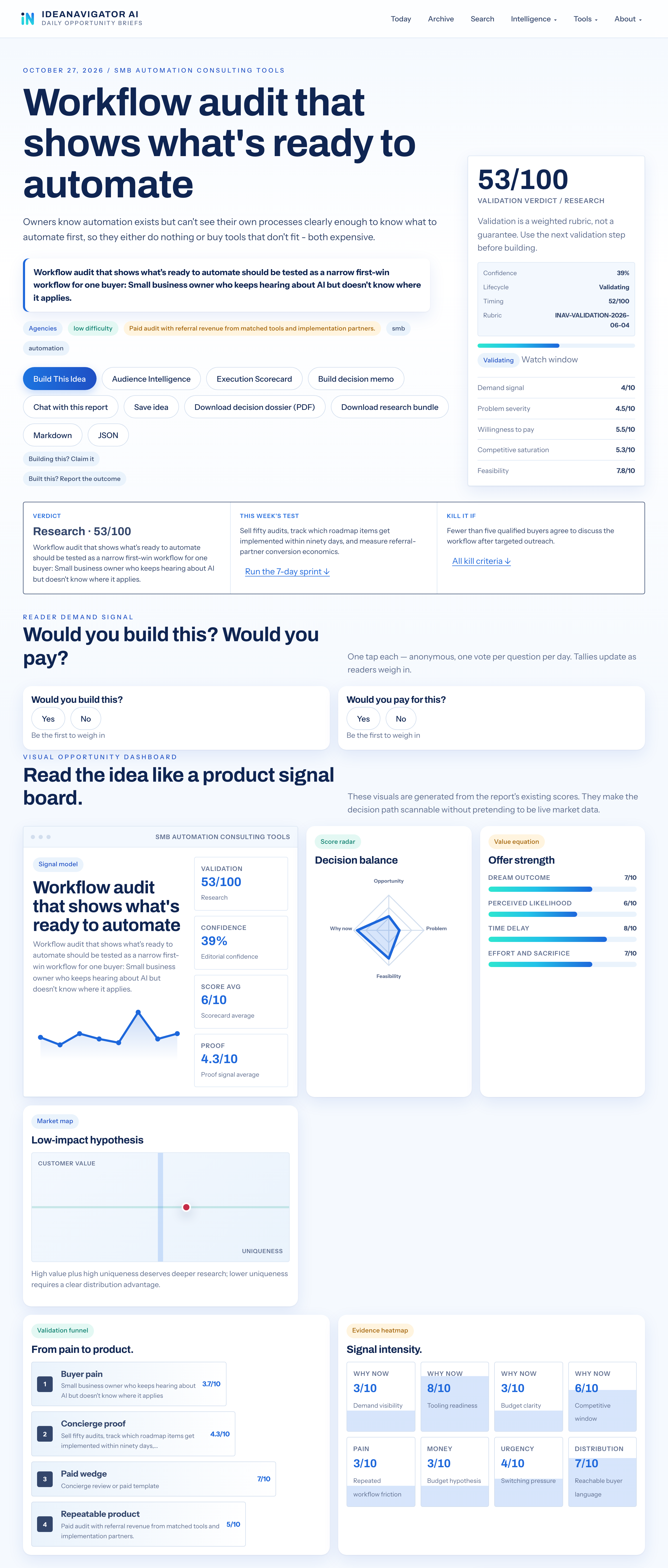
IdeaNavigator AI outlines a proposed workflow-audit service for small-business owners who are unsure where automation fits. The concept would map operations, score processes by readiness, potential return and difficulty, then offer a sequenced 90-day roadmap; its demand and commercial viability have not been demonstrated.
IdeaNavigator AI has outlined a proposed workflow-audit service to help small-business owners decide which operations may be suitable for automation, offering a process map, ranked opportunities and a 90-day roadmap. The concept is presented as an idea to test, not as a launched product or a proven service, and its value will depend on whether owners implement the recommendations and whether the economics work.
The proposed service would interview an owner about how the business operates and turn the answers into a map of recurring processes. It would score potential automation opportunities according to readiness, return on investment and difficulty, then sequence selected work into a 90-day plan. The plan would also suggest tools for individual steps.
The intended customer is a small-business owner unfamiliar with applying AI to day-to-day operations. The premise is that some owners know automation tools are available but cannot readily identify which of their own processes are suitable. The proposal argues that this uncertainty can lead either to inaction or to purchases of tools that do not fit the business.
The suggested business model combines a paid audit with possible referral revenue from recommended software providers and implementation partners. IdeaNavigator AI proposes an initial test: sell 50 audits, then track which roadmap recommendations are implemented within 90 days and measure partner-conversion economics. Those figures describe a proposed validation plan, not results already achieved.
IDEANAVIGATOR AI · BUSINESS CONCEPT
How a Workflow Audit Helps Choose What to Automate
A proposed service would map a small business’s recurring work, rank automation opportunities, and turn selected ideas into a sequenced 90-day roadmap.
01 / THE PROPOSED SERVICE
Turn a business’s daily work into a prioritized plan
The audit is designed for owners who know automation exists but are unsure which of their own processes may be suitable.
INPUT
Owner interview
A guided conversation gathers how the business operates and what recurring tasks take time.
ANALYSIS
Process map + scores
Processes are mapped, then possible opportunities are ranked by readiness, return, and difficulty.
OUTPUT
90-day roadmap
Selected work is sequenced, with tool suggestions for individual steps and a path to implementation.
02 / HOW OPPORTUNITIES WOULD BE RANKED
Three lenses for choosing what to tackle
The proposal names these factors, but does not yet explain how scores would be calculated or tested.
01 · READINESS
Can the process be automated now?
Consider repeatability, clear inputs, exceptions, and whether human judgment remains essential.
02 · POTENTIAL RETURN
Could the effort pay off?
Estimate time, cost, or service gains against setup and ongoing effort. Estimates remain unvalidated.
03 · DIFFICULTY
What would adoption require?
Account for systems, process complexity, sensitive information, and the work needed to implement.
03 / THE CUSTOMER JOURNEY
From uncertainty to a testable next step
The proposed approach works from the business outward: understand the work first, then consider tools.
Describe the work
Owner shares recurring processes, constraints, and current systems.
Map and assess
Audit organizes operations and surfaces possible automation candidates.
Choose priorities
Readiness, expected return, and difficulty inform a proposed sequence.
Implement and learn
Owner acts on the roadmap; results should be measured, not assumed.
04 / WHAT REMAINS UNKNOWN
A useful roadmap depends on credible evidence
The service’s value depends on whether recommendations fit real operations, customers act on them, and the economics work.
Scores need grounding
Interview answers may miss exceptions, customer judgment, or process complexity. The scoring method and accuracy have not been demonstrated.
Trust and data handling matter
The proposal does not define what information is collected, how sensitive business data is handled, or whether a human reviews recommendations.
Recommendations need independence
Possible referral revenue from software and implementation partners could create incentives. Recommendation quality and transparency will matter to trust.
Outcomes go beyond a map
Implementation, completed work, and measurable business results would show whether owners make better decisions and achieve worthwhile savings.
05 / THE VALIDATION PLAN
Test willingness to pay and follow-through
The figures below describe a proposed experiment, not completed sales or results.
Track what happens after delivery
Observe which roadmap recommendations owners implement within 90 days, and measure conversion economics for referral partners. Further evaluation should connect completed recommendations to business outcomes.
TARGET FOR VALIDATION · NOT A RESULT
KEY QUESTIONS
What the proposal does—and does not—establish
What is the proposed workflow audit?
A service concept that interviews an owner, maps operations, and ranks possible automation opportunities by readiness, return, and difficulty.
What would an owner receive?
A process map, suggestions for tools, and a sequenced plan for the next 90 days. The proposal does not show these are available as a product today.
Has it been tested with customers?
No customer results are reported. Selling 50 audits and tracking implementation is a proposed validation test, not a completed trial.
How could the service earn revenue?
The proposed model combines audit fees with possible referral revenue from recommended software and implementation partners. No referral economics are reported.
Turning Automation Into a Prioritized Plan
The idea addresses a practical gap between the availability of automation products and a business owner’s ability to choose among them. A process-by-process audit could make that decision more concrete by connecting a tool recommendation to an identified task, its expected benefits and the work needed to adopt it. For owners with limited time and budgets, prioritization may matter as much as access to software.
But a roadmap is useful only if its assessments reflect the business’s actual operations. A process that appears repetitive during an interview may involve exceptions, customer judgment or sensitive information that make automation harder than a score suggests. Implementation and measured outcomes, rather than the existence of a process map, would show whether the service helps owners make better decisions.
The commercial test also has two parts: whether customers will pay for the audit and whether any referral income supports the service without compromising recommendations. A model that earns money from matched tools has an incentive to recommend products, so the quality and independence of those recommendations would be relevant to customer trust.
Products Worth Considering

Logitech MX Mechanical Wireless Illuminated Keyboard, Tactile Quiet, Graphite

Bose QuietComfort True Wireless Earbuds with Active Noise Cancellation, Black

Samsung 27 Odyssey OLED G5 (G50SF) QHD QD-OLED Gaming Monitor
As an affiliate, we earn on qualifying purchases.
Why Small Firms Need Process Clarity
The proposal is framed around a crowded market for AI and automation tools. Its stated rationale is that a growing range of options can leave small-business owners unsure where to start. The audit would try to make the choice from the business outward: first describe the work, then identify possible automation, rather than begin with a particular product.
The approach also reflects a broader use of guided interviews and language-model tools to structure information supplied in conversation. In this concept, an interview would be the input and a scored process map and implementation sequence would be the output. No evidence is provided that the proposed system has been built, that its scores have been tested for accuracy, or that its recommendations outperform other ways of selecting automation projects.
Demand, Accuracy and Returns Remain Untested
No customer results are reported. The proposed test of 50 paid audits is a target for validation; there are no stated sales, implementation rates, customer outcomes or referral-conversion figures. It is also unclear how the audit would set its scores, estimate return on investment, or account for differences in labor costs, existing systems and process complexity.
The proposal does not specify what information owners would need to provide, how sensitive business data would be handled, or whether a human would review the recommendations. Tool matching and implementation support are also not defined in detail. Until these points are tested, it remains uncertain whether customers will pay for the service, follow its roadmaps, or achieve savings that justify the cost.
Testing Paid Audits and Follow-Through
The next step in the stated plan is to offer 50 paid audits and observe what happens after delivery. The proposed measure is whether owners implement roadmap items within 90 days, alongside the conversion economics for referral partners. Those observations could indicate whether customers act on the advice and whether the revenue model can support the service.
Further evaluation would need to distinguish recommendations that were merely selected from those completed and linked to measurable business results. Until the proposed test produces findings, the workflow audit remains a business concept awaiting validation, not an established solution for small-business automation.
Source: IdeaNavigator AI
Key Questions
What is the proposed workflow audit?
It is a proposed service that interviews a small-business owner about operations, maps processes and ranks possible automation opportunities by readiness, return and difficulty.
What would the audit provide?
The proposed output includes a process map, tool suggestions and a sequenced plan for the next 90 days. The proposal does not establish that these features are already available as a product.
Has the service been tested with customers?
No customer results are reported. Selling 50 audits and tracking implementation within 90 days is a proposed validation test, not a completed trial.
How could the service make money?
The proposed model combines fees for audits with possible referral revenue from recommended tools and implementation partners. The referral economics have not yet been reported.
Source: IdeaNavigator AI