
📊 Full opportunity report: An Empty Trust Tracker For Estate Planning Workflows on IdeaNavigator AI — validation score, market gap, and execution plan.

Prime made for students and young adults
- Fast, free delivery for dorm and study essentials
- Prime Video and Amazon Music included
- Member-only deals
TL;DR
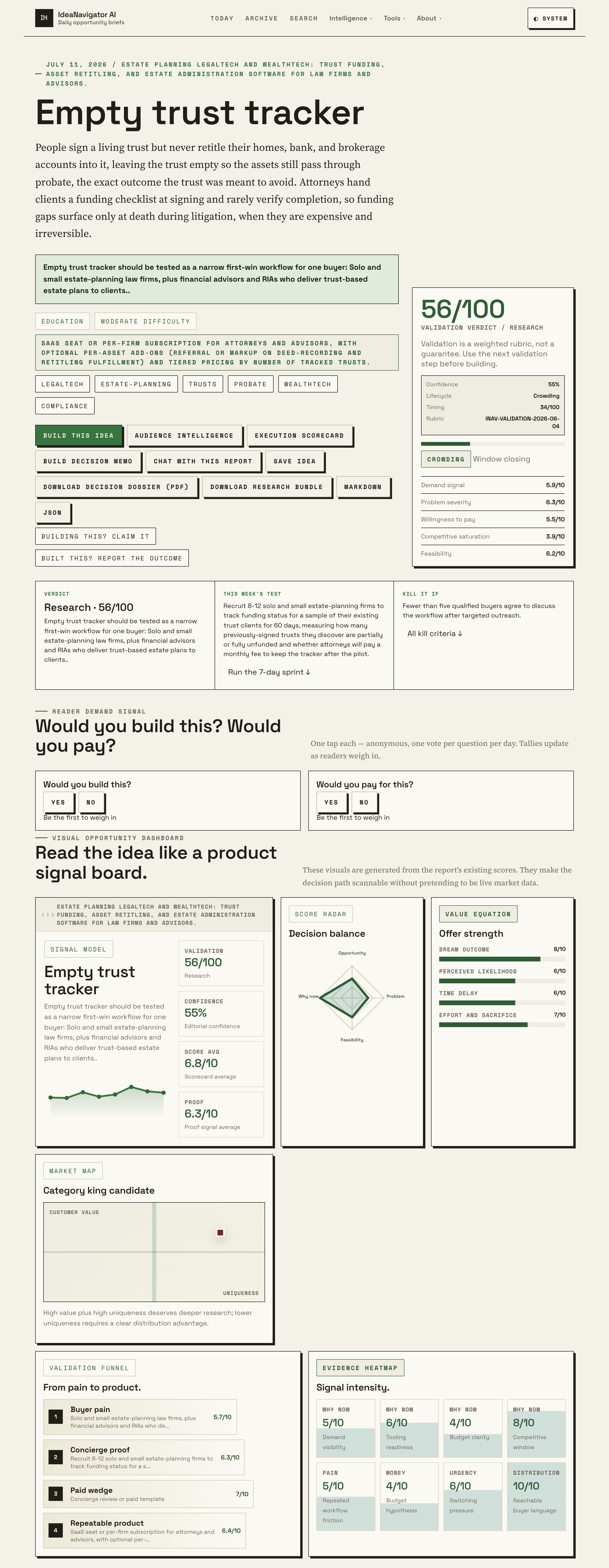
IdeaNavigator AI has proposed an empty trust tracker to help law firms and financial advisors follow whether clients transfer assets into living trusts. The proposal outlines a 60-day pilot with 8 to 12 firms; no pilot results, product launch or customer commitments are reported.
IdeaNavigator AI has proposed an empty trust tracker for solo and small estate-planning law firms and financial advisors, aiming to help them monitor whether clients move assets into living trusts after signing. The proposal calls for a 60-day pilot with 8 to 12 firms; it does not report that the pilot has started or that a product is available.
The proposed software would let an attorney or advisor create a funding checklist for each trust, covering assets such as real estate, bank and brokerage accounts, business interests and beneficiary designations. Each item could be marked pending, in progress or confirmed funded. Users could attach supporting documents, such as a recorded deed or a statement showing a retitled account, and send automated reminders to clients.
A firm dashboard would summarize funding status across its clients, including the share of listed assets confirmed funded for each trust. The proposed business model is a subscription for a firm or its seats, with pricing tiers based on the number of tracked trusts and possible per-asset charges or referral revenue for deed recording and retitling services. These are proposed features and revenue options, not evidence of operating services or signed customers.
To test the concept, IdeaNavigator AI proposes recruiting 8 to 12 solo and small firms to track a sample of existing trust clients for 60 days. The suggested measures are how many trusts prove partly or wholly unfunded and whether participating attorneys would pay a recurring fee to continue using the tracker. No findings or payment commitments are provided.
Tracking Assets After Trust Signing
A living trust may not achieve its intended role for assets that remain titled outside it. The proposal targets the period after a client signs the trust, when responsibility for retitling property and accounts can pass to the client and progress may be hard for a firm to see. A shared checklist and document record could make those outstanding tasks easier to identify while the client is available to act.
That could matter to both legal practices and financial advisors who include trust planning in client services: they could have a clearer view of incomplete funding across their caseload. The practical value is not yet established. The pilot would need to show that firms can obtain reliable proof, that clients respond to reminders and that the tracker changes completion rates enough to justify an ongoing subscription.
The Post-Signing Funding Gap
The proposal describes trust funding as a manual step that follows document preparation. Clients may sign a living trust but still need to change ownership records for relevant assets, a process that can involve different institutions and paperwork. A checklist handed over at signing does not, by itself, show whether those changes were completed.
IdeaNavigator AI says about 11% of Americans hold a trust, but the proposal gives no underlying survey, date range or definition of trust ownership. It also points to deed funding services priced from $250 and says advisors are seeking to offer funded estate plans. Those details are presented as market context; no market-size analysis or independent verification is supplied. The tracker is framed as a possible layer for following tasks and proof, alongside fulfillment services.
Pilot Results Still Pending
No pilot results are reported, and the proposal does not identify a product launch date, participating firms, pricing, or a company building the tracker. It is also unclear how the system would validate documents, handle sensitive financial records, or account for assets whose transfer requires institution-specific steps. The proposed 11% trust ownership figure is not accompanied by a cited methodology, so its precise scope and timing cannot be assessed here.
The central open question is whether firms can use the tracker to increase completed funding, rather than simply record tasks they already follow manually. Client participation, record accuracy and the time required for staff to review evidence would affect whether the workflow is useful and worth paying for.
A 60-Day Firm Pilot
The next step outlined in the proposal is to recruit 8 to 12 firms and follow funding status for a sample of existing trust clients over 60 days. The test would count trusts found partly or wholly unfunded and ask whether attorneys would continue with a paid monthly service. Until those results are published, the tracker remains a proposed workflow, and its effect on asset transfers and probate outcomes is unknown.
Source: IdeaNavigator AI
Key Questions
What is the empty trust tracker?
It is a proposed tool for firms to record which assets clients have transferred into a living trust and attach documents as evidence of completed tasks.
Who is the proposed tool for?
IdeaNavigator AI identifies solo and small estate-planning law firms, financial advisors and registered investment advisors that provide trust-based estate plans.
Has the tracker launched?
The proposal does not say that a product has launched. It describes a possible minimum viable product and a pilot firms could run.
How would the idea be tested?
The proposed test would recruit 8 to 12 firms for 60 days, track funding status for selected existing trust clients and measure unfunded trusts and attorneys’ willingness to pay.
Source: IdeaNavigator AI
Fall Picks
fall essentials
As an affiliate, we earn on qualifying purchases.